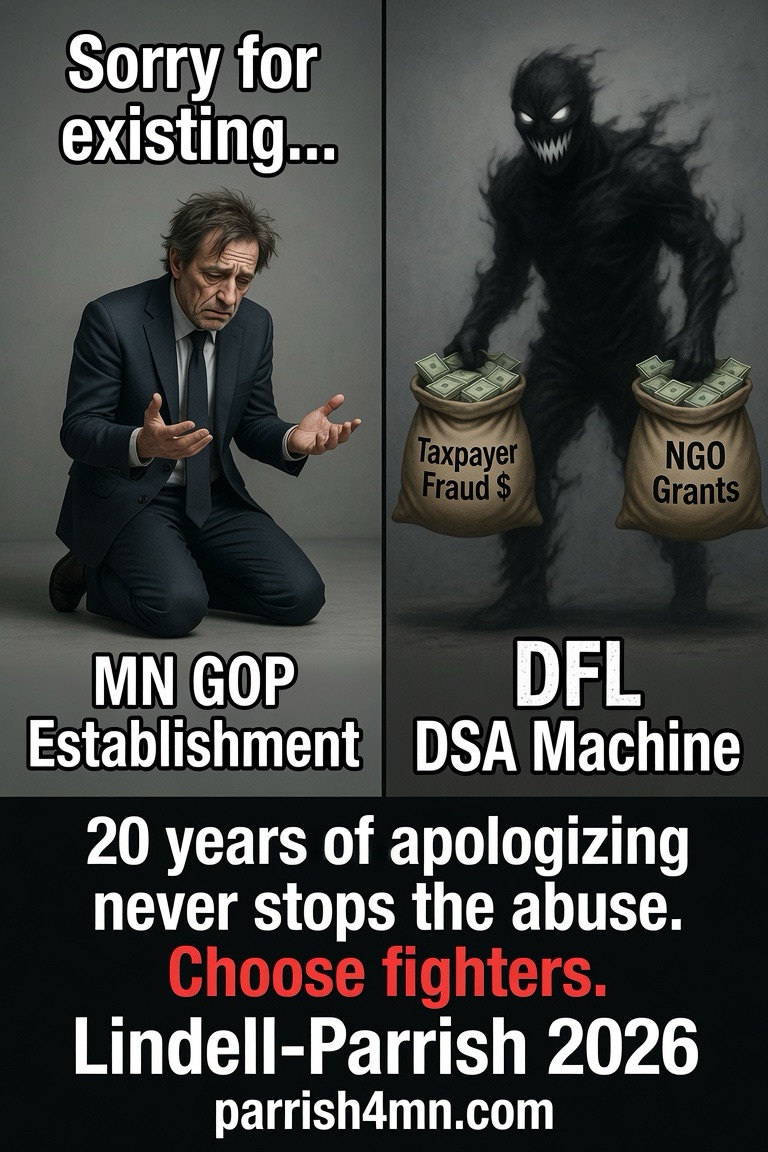
In July 2020, while Minneapolis was still smoldering, seven House Republicans voted with the DFL on House Resolution 1. The resolution declared race a social construct with no biological basis, claimed racism is embedded in America’s foundation beginning with chattel slavery in 1619, and ordered the House to run every bill through an “intersectional race equity lens.” Lisa Demuth cast one of those seven Republican yes votes. That is not rumor. That is the Minnesota House Journal, page 187.
That vote was not an isolated lapse. It was the public face of a twenty-year operating system: negotiate from weakness, prioritize survival over confrontation, and never force a real fight that might risk the seat or the donor check. From that position of weakness they failed to see that the predictable chaos of 2020 was premeditated and coordinated by people of ill intent. That blindness is part of why federal challenges to affirmative-action frameworks now have traction—the racial equity machinery was deliberately advanced while too many Republicans treated it as spontaneous outrage rather than engineered aggression. Approaching from weakness produces a deeper failure: the inability to recognize evil when it is standing right in front of you.
For two decades Minnesota Republicans have behaved like the long-term victim of abuse who keeps apologizing to the abuser, as if their own existence somehow justified the beating. They learned that boldness is expensive and caution is safe. Business donors and even some conservative megadonors learned the same lesson. They prefer predictable insiders who will not rock the boat too hard. When the party refuses to close the deal, the money simply routes around it through outside groups. The result is a self-reinforcing loop. Caution preserves a few seats. It never builds a durable majority. The weakness never ends.
While that apologetic model ran the Republican side of the table, the DFL was given free rein. Unchallenged control produced exactly what you expect from a protection racket with better lawyers: hundreds of millions in federal and state funds flowing through shell nonprofits, LLCs, and connected players while whistleblowers got buried and most politicians looked the other way.
Feeding Our Future remains the clearest example. More than $250 million stolen from a program meant to feed children. Luxury cars, houses, jewelry, and overseas property bought with money intended for hungry kids. Over 200 meal sites. Dozens charged. More than sixty convictions or guilty pleas. The ringleader sentenced to more than forty-one years and ordered to repay over $240 million. Only a fraction of the money has been recovered. The same patterns appear in daycare fraud, COVID relief theft, and vulnerable-adult exploitation. Taxpayer dollars did not merely get stolen. They were systematically converted into political infrastructure—activist networks, media allies, and pressure groups that further entrench the machine and keep any opposition permanently on the defensive.
That is how the DFL morphed into something closer to a DSA-aligned syndicate. The fraud was not a bug. It was a feature that paid for the very activists and agendas that keep alleged Republicans in a permanent position of weakness. Every time the cautious establishment chose not to force accountability, the machine grew stronger, better funded, and more aggressive.
Today the same model persists. Dustin Grage and Lisa Demuth, backed by the same cautious establishment lane and heavy outside money, still operate inside the old framework. They talk tougher now. They pass limited anti-fraud measures when the math allows. Yet the fundamental posture has not changed: manage decline, protect the seat, hope the other side eventually gets tired. Meanwhile the networks that looted the state keep operating under new management and new branding.
The pattern is visible to anyone willing to look—including the people inside the room. They have had twenty years of opportunities to correct course. They have chosen not to. Whether that choice is repeated miscalculation or something closer to complicity is a question every Minnesota voter now has the right to answer for himself.
There is another path.
Mike Lindell and I did not come out of the cautious establishment. We came out of the fight. Twenty-one years of Navy intelligence chasing terrorists and their financiers taught me how criminal networks actually operate. Years of whistleblowing on daycare fraud, COVID relief theft, and election integrity cases taught me that the same networks adapted to Minnesota politics. We do not negotiate from weakness. We do not treat the DFL machine, the nonprofit grifters, and their enablers as legitimate partners. We treat them as the organized crime syndicate they are.
Minnesota can still be a place where working families keep more of what they earn, where parents control their children’s education, where farmers and small businesses are not regulated into the dirt, and where the rule of law actually means something. That vision is not complicated. It simply requires leaders who will stop managing decline and start reclaiming the state for its citizens and its constitutional republic.
The old model of caution has failed. The evidence is in every empty storefront, every inflated budget line, and every fraud investigation that somehow never reaches the top. Minnesotans do not have to keep accepting the same losing strategy. They can choose proven fighters who already understand the enemy and refuse to fold.
The choice is on the ballot.
Phillip C. Parrish
Candidate for Lieutenant Governor of Minnesota
Lindell-Parrish ticket
For press inquiries:
Phillip C. Parrish at phillip@parrish4mn.com
Campaign Manager Heidi Wanty at heidi@parrish4mn.com
Phone: (612) 460-1717
Official website: https://parrish4mn.com
X: @phillipcparrish
Mike Lindell official: https://mikelindellgov.com
###