By Phillip C. Parrish
Candidate for Lieutenant Governor of Minnesota
Lindell-Parrish Ticket
July 21, 2026
Faribault, Minnesota — Today I attended the Rice County Public Accuracy Test at the Government Services Building as a candidate and concerned Minnesotan. What was billed as a transparent demonstration of the machines that will count our votes revealed serious gaps.
Only 3 out of 35 DS200 precinct tabulators were tested. There is reportedly only one DS450 central-count machine for the entire county’s absentee and mail ballots. That is not meaningful verification.
What I Personally Witnessed
As the limited number of machines ran test decks, my phone documented persistent wireless activity in the room:
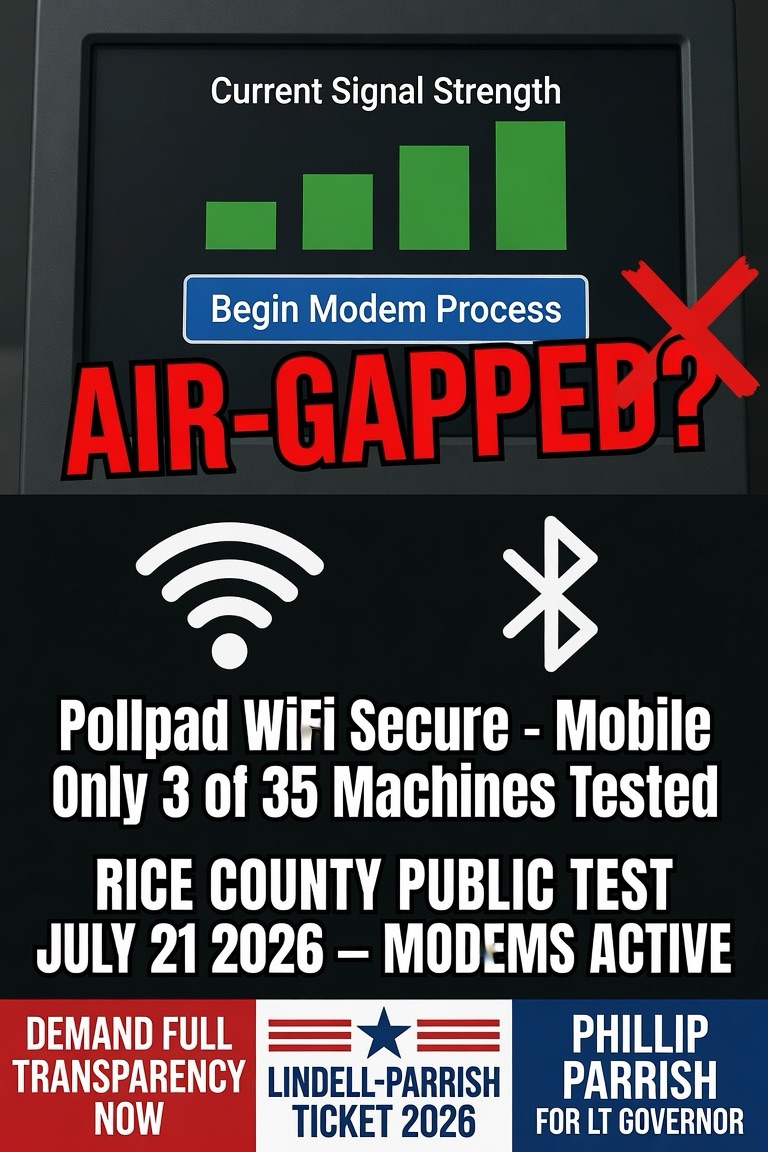
• Pollpad WiFi Secure – Mobile stayed active the entire time.
• Rice County networks (RC-Guardian, RC_Internal, RC_IoT, RC_Mobile, RC_Public) broadcast continuously.
• A vehicle hotspot (CHEVROLET1710) appeared.
• Bluetooth scanning picked up “RCPC-10488” — strongly indicating Rice County polling/central operations equipment.
Most damning: One machine screen openly showed “Current Signal Strength” with green bars and buttons for “Begin Modem Process” and “Cancel Modem.”


When I requested serial numbers and current software/firmware versions with last update dates, I was refused. Denise Anderson, Rice County Property Tax & Elections Director, pointed to the door and told me to file a formal data request. I filed it immediately.

Why These Concerns Are Valid and Urgent
Minnesota law requires these Public Accuracy Tests to be open and meaningful. Instead, we saw a minimal sample in an environment full of wireless signals, with a machine displaying modem functionality.
The DS450 handles absentee and mail ballots — the highest-volume area. Testing only one of them, while wireless networks hum and a modem option sits on the screen, is not reassurance. It is a red flag that demands immediate action before these machines count real votes.
What This Means — Simple Explanations for Every Minnesotan
Air-Gapped is the favorite phrase officials and vendors use to reassure the public. It sounds like the machines are completely isolated — floating in their own secure bubble with no internet, no Wi-Fi, no cellular, nothing. The average voter hears it and thinks “safe.”
In reality, “air-gapped” often just means “not plugged in right this second.” It does not guarantee the machines have zero wireless hardware. Today one machine openly displayed cellular signal strength and a “Begin Modem Process” button. That button means the “air gap” can vanish the moment someone decides to connect it.
Add in the active Pollpad WiFi, Rice County networks, and Bluetooth devices in the same room, and the claim falls apart. Central-count machines like the DS450 process thousands of absentee ballots — exactly where the biggest risks hide if the environment isn’t truly isolated.
Modems and digital vulnerabilities make it worse. A modem lets the machine send and receive data over cellular networks. Once connected — even briefly for “updates” or central reporting — the system can be reached by insiders or outsiders. Past reviews of these ES&S systems have flagged issues with software verification and physical access. When officials refuse basic details like serial numbers and software versions during a public test, the public cannot verify the known risks have been fixed.
Paper ballots are our best safeguard. But if the machines reading them can connect and the people in charge block simple questions, the reassurance is false.
Call to Action
Demand full transparency now:
• Release serial numbers, software versions, and connectivity details for every machine.
• Expand real testing and observable audits.
• Clean voter rolls and secure absentee processes before more votes are cast.
I will continue pressing for answers. Minnesotans deserve elections we can trust — not assurances while the process hides in plain sight.
Phillip C. Parrish
Candidate for Lieutenant Governor of Minnesota
Lindell-Parrish Ticket
(507) 838-6514 / Campaign: (612) 460-1717
###