INTERIM INTELLIGENCE REPORT
Phillip C. Parrish Intelligence Cell — Operation Shadow Hunt
Classification: Unclassified – For Public Dissemination
Date: 16 August 2026
Subject: Primary Turnout, Process Failures, and the Questions Minnesota Officials Must Answer Before Certification
1. Executive Framing
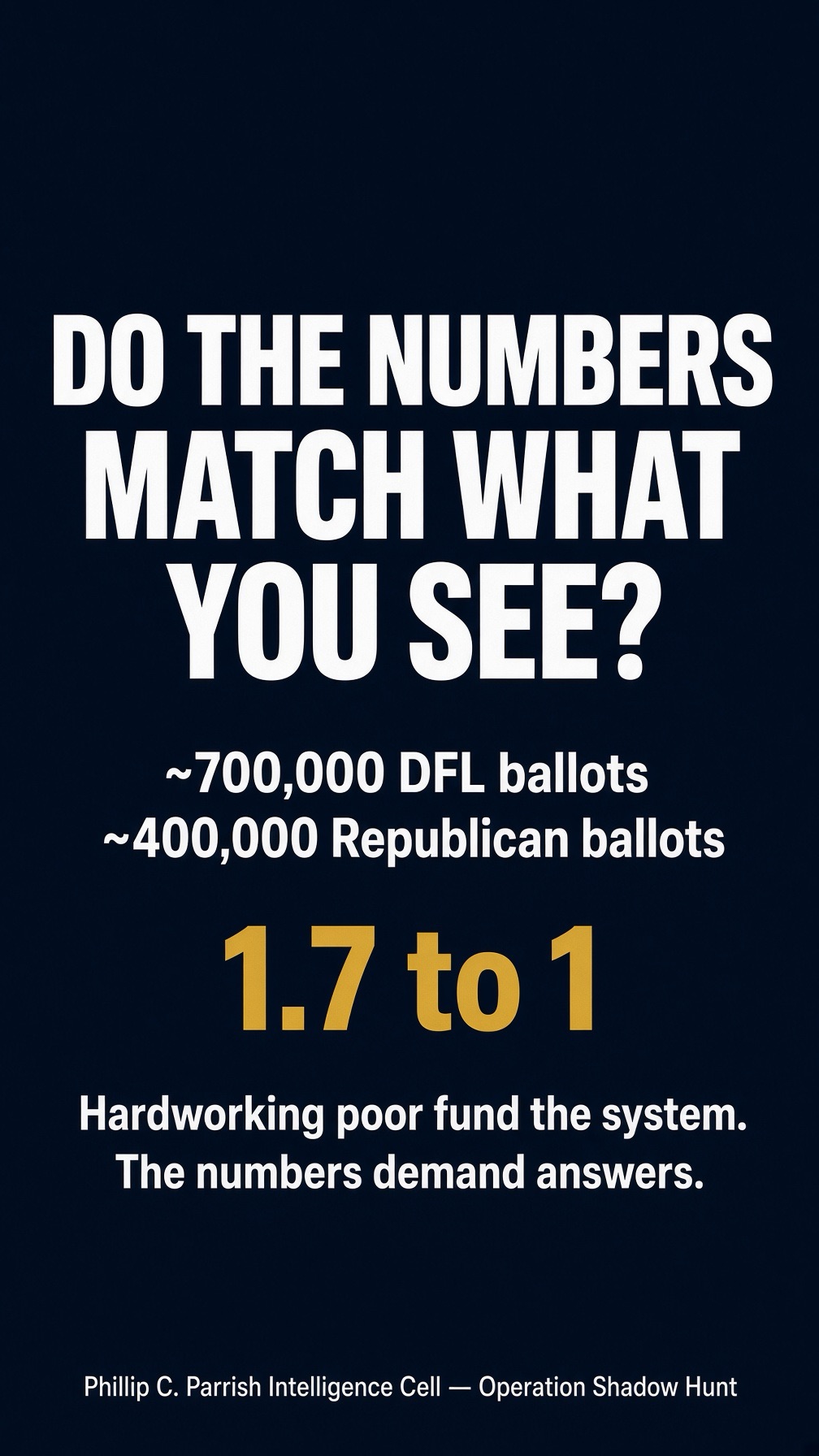
More than 1.1 million ballots were cast in the August 11 primary. Roughly 685,000–700,000 of those ballots appeared on the DFL side of the major statewide contests. Roughly 406,000–413,000 appeared on the Republican side. That is nearly a 1.7-to-1 ratio.
These numbers do not match what many Minnesotans see in their own communities. When official statistics diverge this sharply from lived experience, the response cannot be “accept the narrative.” The response must be to demand the underlying records and force answers to the questions the numbers raise.
This report restates those questions and layers the additional evidence now in the file: documented digital and chain-of-custody failures, geographic concentration of volume, same-day registration and vouching vulnerabilities, observer-access restrictions, and the possibility of differential barriers to Republican participation.
2. The Core Questions
Do the basic numbers match what you witness in your communities?
In large stretches of rural, suburban, and many urban neighborhoods the daily reality is hardworking people, thin margins, rising costs, and visible strain on public systems. The official claim is that nearly twice as many people turned out for the DFL primary as for the Republican primary. Does that track with the relative size and intensity of the two coalitions you actually observe?
If the numbers are real, what does that imply?
If the reported totals are fully legitimate, then Minnesota contains a large population that consistently supports high taxation, expansive welfare, weak border enforcement, and late-term abortion. That population would outnumber the opposing coalition by a wide margin in primary participation. The hardworking poor would be a permanent political minority under a system that extracts from them to sustain the rest.
If the numbers are inflated or manipulated, what does that imply?
If a material portion of the higher volume is the product of same-day registration, vouching without meaningful identity verification, residual test data left on machines, incorrect results files, or other process failures already documented, then the hardworking poor are not simply outvoted — they are systematically underrepresented relative to a looser verification and data-handling regime operating in the highest-volume jurisdictions.
Either way the picture is the same:
Either the majority of primary participants genuinely prefer the current machine, or the machine has structured the rules and the process so that its preferred outcome is easier to generate in the places that decide statewide results. Both possibilities require explanation. Neither can be dismissed by calling the observers “crazy.”
3. Updated Numbers and Demographic Overlay

The hardworking poor — employed people and working households living at or near poverty thresholds — form a substantial share of the lower-income population that funds the system through taxes while receiving the least political protection.
4. Additional Layers Now in the File
Documented digital and chain-of-custody failures
• Blue Earth County: Test data left on a voting machine was added to live results. County officials later accepted full responsibility and described it as a failure in the chain-of-custody checks.
• Todd County: An incorrect results file was uploaded. For a period after 100% of precincts appeared reported, the Secretary of State website displayed the wrong winner in a competitive Republican Senate primary. The error was identified only when totals were balanced against paper reports.
• Pre-primary concerns were raised that equipment in a large share of counties was operating without current certification.
These are not theoretical vulnerabilities. They are acknowledged process failures that temporarily altered or contaminated the reported results until paper reconciliation occurred.
Geographic concentration and process risk
The bulk of the DFL primary volume is concentrated in the same metro counties already flagged for elevated same-day registration and vouching activity, restricted federal observer access, and historical registration-fraud cases involving community outreach networks. When official turnout statistics show a large partisan gap concentrated in precisely those jurisdictions, the numbers themselves become a risk indicator.
Potential differential barriers to Republican participation
Lower Republican turnout relative to underlying community strength appears in both high-volume metro pockets and some rural strongholds. Possible contributing factors include reduced early-voting access in low-population counties, longer travel distances, restricted observer visibility in metro sites, and the psychological effect of watching high-volume metro results that appear disconnected from local experience. Suppression does not require ballot destruction; it can operate through differential access, confidence, and process friction.
5. Bottom Line for Officials and the Public
We are not required to pretend the statistics match reality when our eyes and daily experience say otherwise.
If the numbers are accurate, Minnesota has chosen a permanent majority that accepts high extraction from the productive class.
If the numbers are not accurate, then the hardworking poor are being systematically underrepresented by a process that makes identity verification, data clearing, and results-file handling optional or error-prone in the places that matter most.
The documented machine and data-handling failures, the concentration of volume in high-risk jurisdictions, the vouching and same-day registration vulnerabilities already captured on camera, and the observable asymmetry in participation all point in the same direction: something is structurally wrong. The math is not subtle. The ground truth is not subtle. The refusal to examine the high-volume precincts and the data-handling chain is the only subtlety left — and it is intentional.
Recommendation to the State Canvassing Board and county officials:
Before certification on August 18, produce and make public:
1. Precinct-level Election Day registration applications and vouching oaths in the five highest-volume metro counties.
2. Early-versus-Election-Day candidate splits.
3. Machine and results-file audit logs for Blue Earth, Todd, and any other counties that experienced data or reporting anomalies.
4. Turnout as a percentage of registered voters and of prior general-election partisan performance in both metro and rural counties.
The window is short. The questions are not going away.
Phillip C. Parrish
Intelligence Cell — Operation Shadow Hunt
16 August 2026
###