INTERIM INTELLIGENCE REPORT
On behalf of the Phillip C. Parrish Intelligence Cell and Operation Shadow Hunt
Subject: O’Keefe Undercover Exposes Minnesota Vouching System — Poll Workers Confirm One Registered Voter Can Authorize Eight Unregistered Voters Without ID on Primary Day
Classification: Unclassified – For Public Dissemination
Date: 13 August 2026
Status: Interim – Canvass ongoing; State Canvassing Board scheduled 18 August
Executive Summary
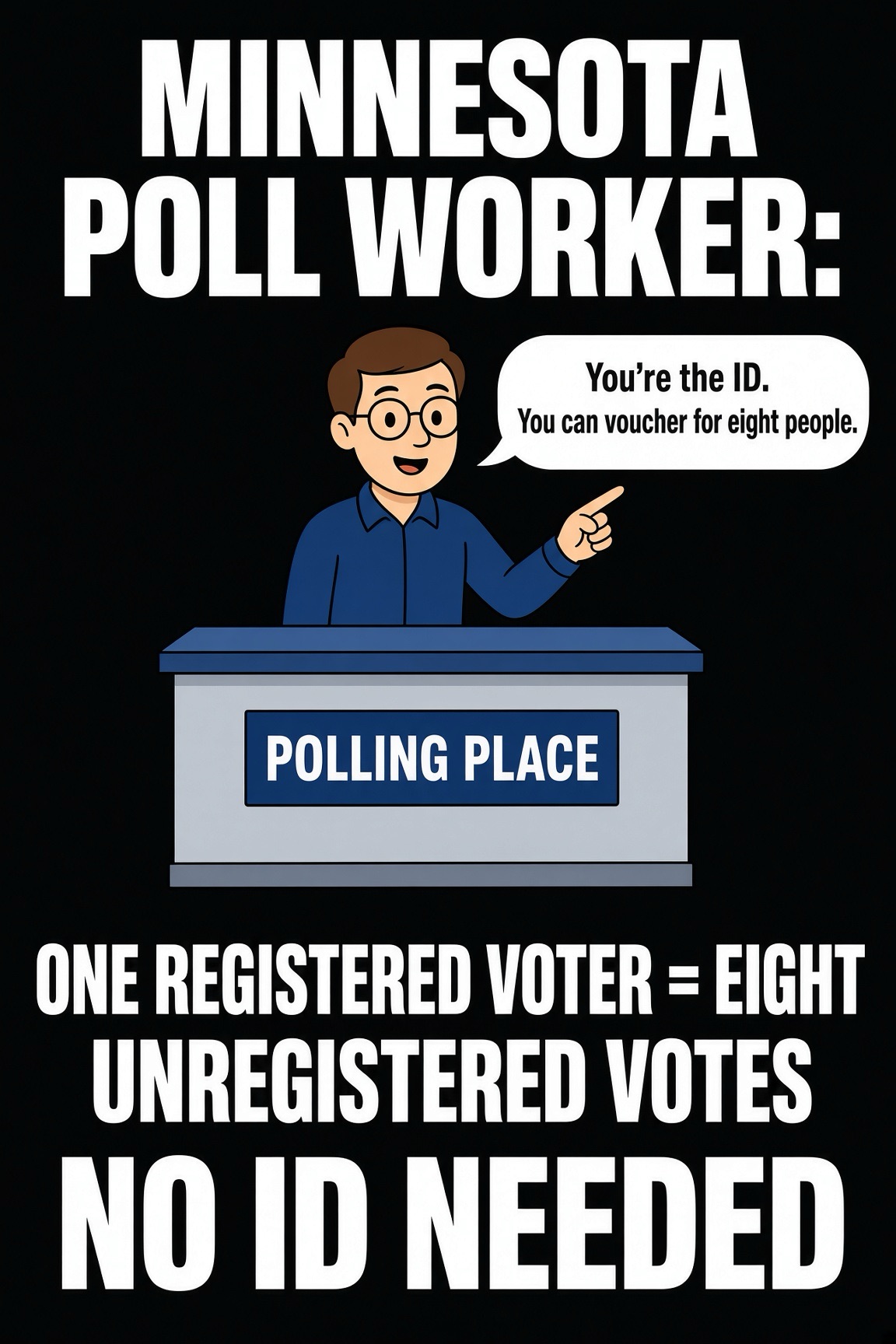
On Primary Election Day, James O’Keefe and undercover journalists from O’Keefe Media Group (including Cam Higby and Anthony Rubin) entered Minneapolis polling places while disguised in traditional Muslim attire. They documented poll workers explicitly confirming that a single registered voter can vouch for up to eight unregistered individuals in the same precinct, with the voucher serving as the functional “ID.” Workers stated the process was acceptable even when the individuals were not registered, and that eligibility checks occur “after the fact.”
You can watch the James O’Keefe report here: https://x.com/jamesokeefeiii/status/2087950683831931327?s=46&t=iwZgKt8NmYsLfBigqsJvwQ
This is not a theoretical loophole. It is the operational reality of Minn. Stat. § 201.061 as applied inside polling booths in Minnesota’s largest jurisdiction on the day of a high-stakes primary. Combined with historical volume data showing tens of thousands of vouched Election Day registrations (EDRs) in recent cycles and the absence of granular tracking by the Secretary of State, the exposure elevates concerns of systematic vulnerability that can be exploited for organized, coordinated same-day ballot injection. This aligns with prior risk mapping focused on metro counties (especially Hennepin) where high refugee resettlement, limited ICE cooperation, and concentrated outstanding absentee activity already flagged elevated risk.
Core Findings from the O’Keefe Investigation
• Statute invoked: Minn. Stat. § 201.061 allows a registered voter in the precinct (or certain residential facility employees) to sign an oath vouching for an individual’s residency, enabling Election Day registration without standard photo ID or documentary proof of residence. Limit: eight per voucher (unlimited for certain facility staff).
• Worker statements captured on video:
• “You’re the ID.”
• Confirmation that unregistered individuals can be vouched for: “I can vouch for them. They are not registered… That’s okay. That’s fine. Yeah!”
• Explicit limit of eight people if all are in the same precinct and the voucher is already registered.
• At White Park Recreation Center: voucher must claim personal knowledge of residency; oaths are signed; eligibility verification is “after the fact.”
• Method: Undercover presentation of an extreme scenario (bringing groups of unregistered persons). Multiple locations produced consistent explanations of the process. Some workers grew suspicious; others facilitated.
• Additional reporting from the same team is pending. Tips are being solicited via Signal and email.
Scale of the Practice (Historical Data)
America First Legal records obtained from the Minnesota Secretary of State show heavy reliance on vouching:
• 2024: 18,898 EDRs using vouching (13,441 updates to existing registrations; 5,457 new vouched-for EDRs).
• 2022: 10,278 EDRs using vouching (8,063 updates; 2,215 new).
• 2020: 17,616 EDRs using vouching (12,547 updates; 5,069 new).
Critical gap: The SOS admits it “does not record or maintain data on vouching method” (individual registered voter vs. residential facility staff) and provided “no data responsive” to requests for facility-specific lists, authorized staff certifications, or breakdowns. No public county-level or precinct-level vouching tallies are readily available for the 2026 primary as of this writing.
Connection to Over/Under-Voting Patterns and Organized Risk
Prior analysis has focused on turnout deviations, early vs. Election Day splits, selective undervotes (statewide contests marked while federal races left blank), and geographic concentration of outstanding absentees in Hennepin, Ramsey, Dakota, Anoka, and Washington.
The vouching system provides a low-friction mechanism to inject same-day votes without contemporaneous documentary verification. In high-volume urban precincts, a small number of coordinated vouchers can multiply registrations rapidly. Because verification is post-election and tracking is minimal, these votes can affect margins before any challenge or reconciliation occurs.
Where over-voting (excessive ballots relative to registered or expected turnout) or under-voting (systematic blanking of certain contests) appears in the same counties/precincts that historically generate high EDR/vouching volume, the combination is consistent with organized exploitation rather than isolated error. Minneapolis/Hennepin remains the highest-priority geography given the filming locations, population density, and prior risk indicators (sanctuary policies, refugee concentrations, limited real-time list maintenance).
Recommended Immediate Actions for Officials
1. During county canvass (ongoing through ~14 August) and ahead of the State Canvassing Board (18 August), demand precinct-level and county-level counts of:
• Election Day registrations.
• Number of proof-of-residence oaths/vouchers executed.
• Number of individuals vouched for per voucher (flag any approaching or exceeding eight).
2. Cross-reference high-vouching precincts against turnout outliers, same-day registration spikes, and undervote rates in federal vs. statewide races.
3. Preserve all voucher oaths, poll books, and related chain-of-custody records.
4. Request from SOS any 2026 primary vouching aggregates and facility staff lists if they exist.
5. Coordinate with county attorneys and, where appropriate, federal authorities on potential coordinated activity.
Bottom Line
O’Keefe’s primary-day footage demonstrates that Minnesota’s vouching process functions exactly as written and is administered permissively inside polling places. Historical volume (tens of thousands of uses) plus the near-total absence of method tracking creates a structural opportunity for organized same-day registration fraud concentrated in specific high-risk counties. This is not merely a theoretical vulnerability—it is an operational reality documented on camera on 11 August 2026.
Full canvass data and any follow-up O’Keefe reporting will determine the precise scale in this cycle. Until those numbers are examined, no final certification posture should be locked. All will be reviewed against the data.
Next update: Upon release of additional O’Keefe footage or county canvass vouching/EDR statistics.