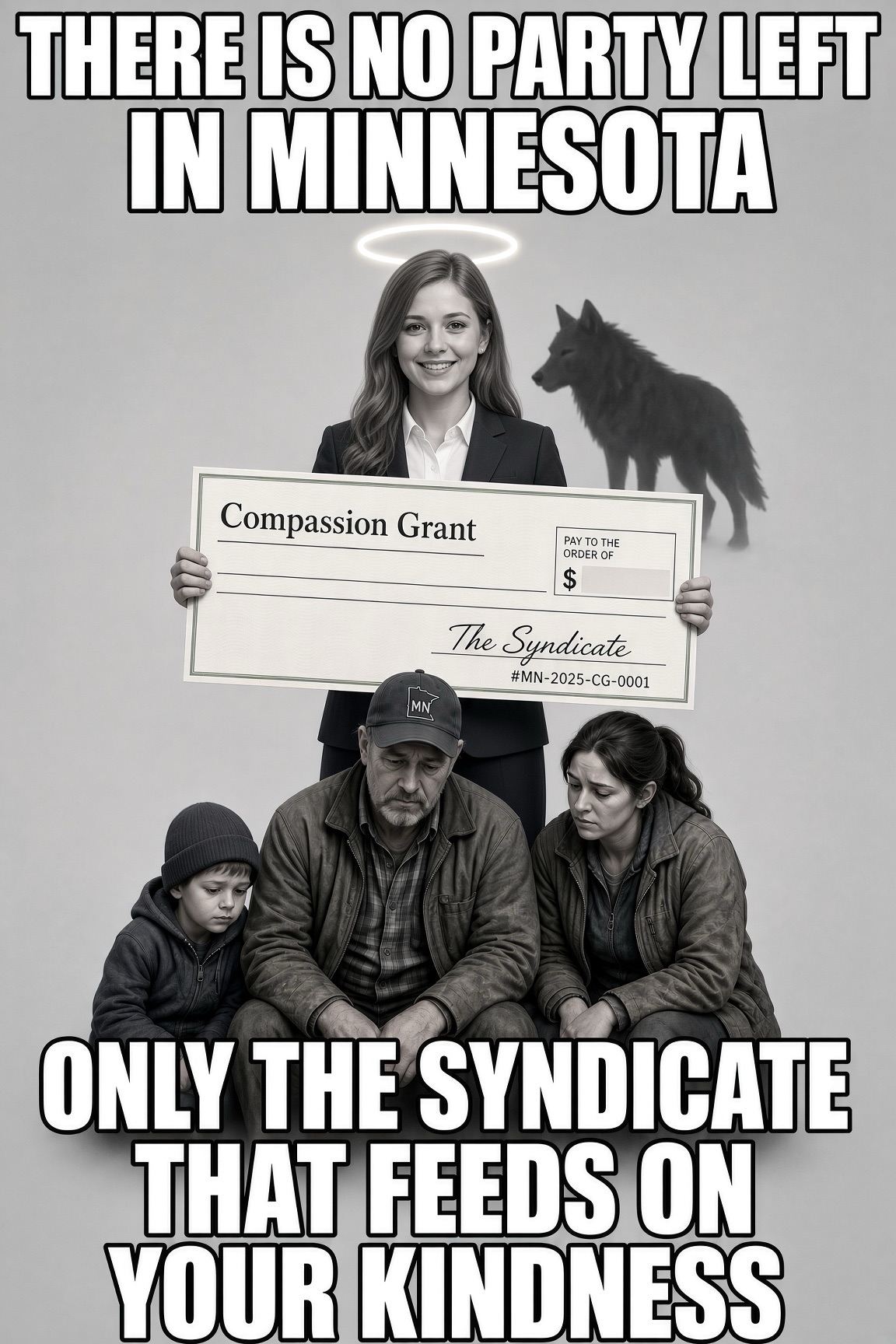
Only the Syndicate and the People It Feeds On
Minnesota does not have a Democrat Party.
Minnesota does not have a Republican Party.
What it has is a criminal industry that long ago colonized both labels, hollowed them out, and turned the entire political apparatus into a Munchausen-by-proxy operation. The product is fake humanitarianism. The raw material is the ordinary Minnesota character — kindness, decency, the instinct to avoid conflict, the refusal to call a parasite a parasite while it is still smiling and holding a grant application.
Create the crisis.
Manufacture the fear.
Convince decent people that only more of the same machine can “save” the victims the machine itself produced.
Cash the checks.
Repeat.
That is the business model. Everything else — the party names, the primary theater, the press conferences about compassion — is set dressing.
Look at what just happened on August 11.
In the Republican gubernatorial primary, Mike Lindell carried substantial northern and rural ground. Lisa Demuth’s decisive margin was manufactured almost entirely out of metro and central-corridor volume. Late independent polling had Lindell competitive or ahead. The final result flipped the margin by roughly fifteen points. The geography of that volume sits squarely on the same high-risk surface that has been mapped for years: permissive same-day registration by vouching (up to eight new voters per registered voucher, unlimited for residential-facility staff), permanent absentee lists, limited real-time eligibility checks, and no systematic citizenship documentation.
In the DFL U.S. Senate primary the same metro counties delivered the decisive volume for Peggy Flanagan over Angie Craig. Dakota County — Craig’s own backyard — underperformed so badly it produced a near-tie. High Election Day registration clusters, elevated estimated-voter ratios in Minneapolis precincts, and the same structural vulnerabilities appeared again.
Two different “parties.” Same risk surface. Same geography. Same outcome pattern. The machine did not need to invent new tricks. It simply ran the existing ones harder on Primary Day and let the volume do the rest.
This is not an accident of turnout. It is the logical endpoint of a system that treats human kindness as an exploitable resource. The same model that turned refugee resettlement into a per-head cash pipeline, that turned child-care and feeding programs into industrial-scale theft, that turns every shooting into a demand for more control over the law-abiding, now runs the primaries. The people who still believe the labels are real are the last ones being gaslit.
The operators understand something most Minnesotans are trained not to say out loud: conflict avoidance is a vulnerability. Most people would rather write the check, look away, and tell themselves the “helpers” mean well than confront the fact that the helpers are the ones keeping the patient sick. That is classic Munchausen by proxy translated into public policy. The caretaker creates or sustains the illness, then demands praise and funding for the heroic treatment. In Minnesota the caretaker is a network of political operators, nonprofit shells, and field infrastructure that has perfected the art of emotional blackmail.
You see it in the language. Question the volume in Hennepin or Ramsey and you are immediately painted as the problem. Demand basic eligibility verification and you are accused of cruelty. Point out that the same counties that produce the fraud scandals also produce the anomalous primary margins and you are told you lack compassion. The machine does not argue the data. It pathologizes the person looking at the data.
This is why there is no real opposition party left. Any figure or faction that threatens the revenue stream — whether it wears an R or a D — gets the same treatment. Rural and northern voters can still push back at the margins. The decisive volume is concentrated where the risk surface is densest and the emotional blackmail is most effective. That is not a coincidence. It is the design.
Christ taught us to care for the least of these. He did not teach us to fund the people who keep them least so the funders can feel righteous while the looting continues. Genuine mercy does not require a permanent crisis industry. It does not require turning every human weakness into a billable event. It does not require treating the productive class — the farmers, the veterans, the small-business owners, the parents trying to raise children in the faith — as an infinite ATM for professional victims and their handlers.
Minnesota can still choose differently. The same character that has been exploited — the decency, the work ethic, the preference for peace — can be turned against the exploiters once people stop pretending the labels mean anything. The first step is simple and hard at the same time: stop participating in the fiction. There is no party left to save. There is only a criminal industry that has learned how to weaponize Minnesota niceness, and a people who can decide they have had enough of being the patient.
The structural risks in the election system are not abstract. They are the same vulnerabilities that let the broader grift run for years. When the decisive primary margins sit on top of those vulnerabilities, the public is entitled to a complete record before anyone pretends the result is settled. Records requests, precinct-level examination of Election Day registration and vouching, early-versus-day-of splits — these are not partisan demands. They are the minimum required to stop treating Minnesotans like marks.
The vision is not complicated. A state where a farmer can work his land without subsidizing the people who treat him as the problem. Where a veteran’s service is not used as cover for foreign-influence networks and grant mills. Where children can attend Mass without becoming props in the next crisis narrative. Where kindness is practiced by free people instead of being harvested by a syndicate that needs permanent victims to stay in business.
That Minnesota still exists in the hearts of millions who live here. It is not represented by either party apparatus. It is represented by the people who have finally noticed that the caretaker is the one keeping the patient sick.
The labels are dead.
The industry is not.
Choose accordingly.
Phillip C. Parrish
Heidi Wanty, Manager
(612) 460-1717
###