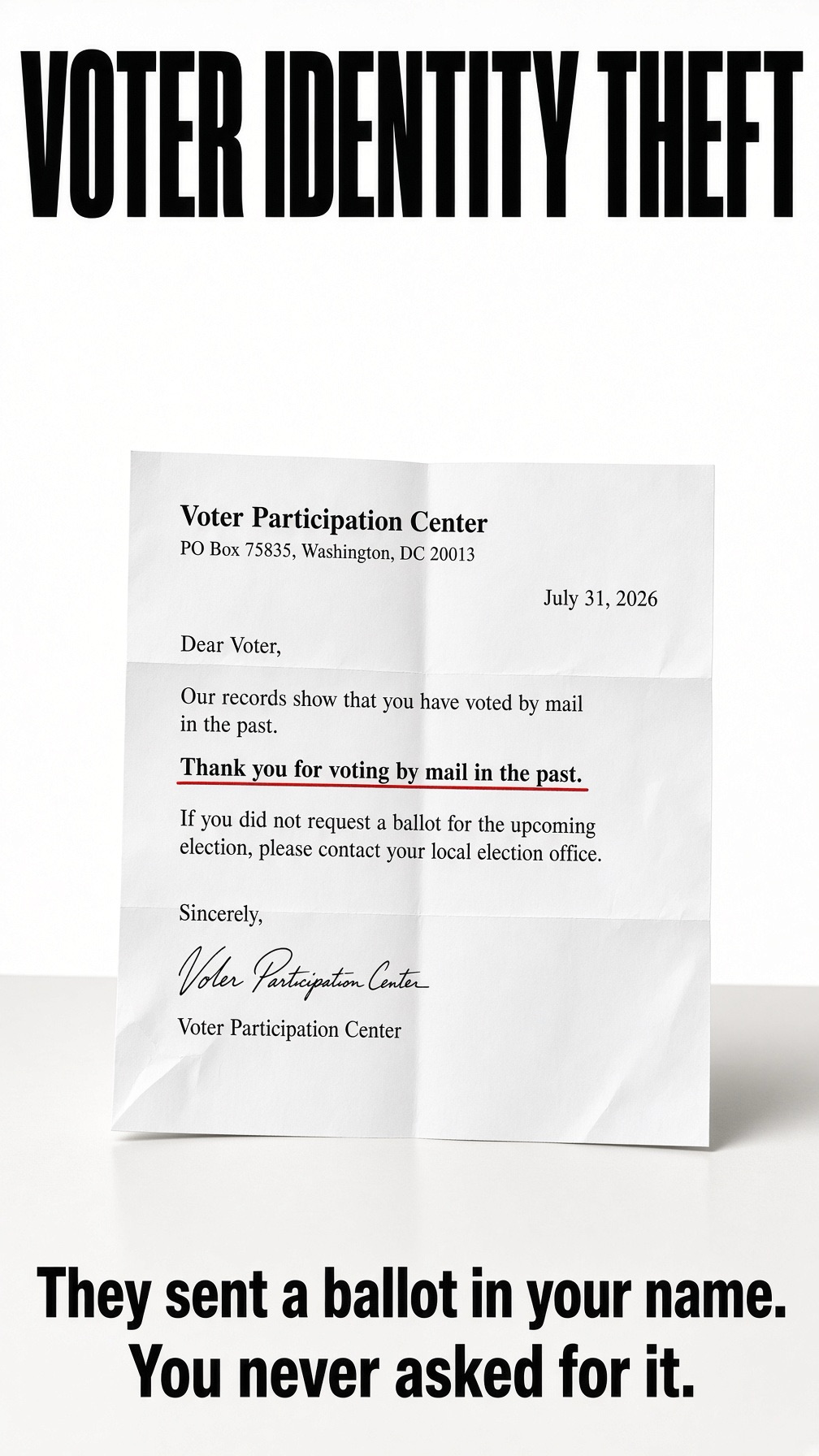
Jake Penn and his wife have never voted by mail in Minnesota. Yet in late July 2026, the Voter Participation Center mailed them a polished letter that opened with a lie: “Thank you for voting by mail in the past.”
Attached was a pre-filled absentee ballot application with their names and address already printed, plus a hard sell to join the permanent absentee list so ballots would keep arriving automatically.
They are not alone. The same letter is landing in mailboxes across Minnesota and other states. People who have only ever voted in person are being told the system already recorded them as mail voters. On Nextdoor, in replies, and in private messages, the reports keep coming: “I never voted by mail either.”
This is not a clerical error. This is voter identity theft.
What Voter Identity Theft Looks Like
Third-party groups such as the Voter Participation Center and Center for Voter Information buy or scrape voter files, layer on incomplete or outdated history data, and blast hundreds of thousands of pre-filled applications. In Minnesota alone this cycle they targeted more than 200,000 registered voters with vote-by-mail applications. Nationwide the numbers run into the millions.
The letter does three things at once:
1. It invents a voting history the recipient never created.
2. It normalizes automatic, no-request ballots.
3. It pushes people onto permanent absentee lists so future ballots arrive without any affirmative action by the voter.
Once a ballot is in the mail stream under your name, the chain of custody is broken. You did not request it. You may never see it. Someone else might. The system has already treated your identity as active for mail voting. That is identity theft at scale, performed with public voter data and private-group mailers.
Minnesota’s permanent absentee option and loose list-maintenance rules make the problem worse. Dirty data in, automatic ballots out. The same pattern shows up in reports of people discovering ballots already “returned” in their name when they arrive at the polls, or new voter cards arriving for people who are not registered.
Why Trump’s Executive Order on the USPS Matters
On March 31, 2026, President Trump signed Executive Order 14399 — “Ensuring Citizenship Verification and Integrity in Federal Elections.” It directed the Postal Service to stop acting as a passive conveyor belt for any envelope that claims to be a ballot.
Key pieces:
• States must submit lists of voters who are supposed to receive mail ballots.
• USPS would only process ballots that meet uniform envelope, barcode, and eligibility standards.
• Non-compliant states risk having their mail ballots refused.
• DHS is ordered to build citizenship-verification lists from federal databases.
The order is under heavy litigation. Lower courts blocked major parts; the Supreme Court on August 24, 2026, allowed certain provisions to move forward while others remain enjoined. USPS published a final rule on August 21 detailing tracking and data requirements, but full implementation for the November election still depends on further court action.
Even in its contested form, the order recognizes a basic truth: the Postal Service cannot remain the only major government agency that handles election materials with almost no front-end verification of who is supposed to receive them. Mass third-party mailings thrive in that vacuum. Closing it is not “voter suppression.” It is refusing to deliver stolen or unrequested ballots under someone else’s name.
Why the SAVE America Act Is Essential
The Safeguard American Voter Eligibility (SAVE America) Act, passed by the House in February 2026, attacks the problem at the source.
It requires:
• Documentary proof of U.S. citizenship — presented in person — to register to vote in federal elections (passport, qualifying REAL ID, military records tied to U.S. birthplace, etc.).
• Valid photo identification to cast a ballot, including a copy for mail ballots.
• Stronger, mandatory list maintenance so states purge non-citizens and outdated records using federal databases.
The bill is stalled in the Senate by filibuster rules. Trump has made its passage a top priority, correctly identifying that without citizenship verification and photo ID at the front end, the back-end mail system will keep getting fed dirty lists.
Mass mailings of the kind Jake Penn received are only possible because registration and list maintenance remain loose enough for private groups to treat voter files as marketing databases. Proof of citizenship and photo ID shrink that attack surface. They also make permanent absentee status and automatic ballot drops far harder to game.
The Real Choice
We can keep pretending that unsolicited, pre-filled, history-falsifying mailings are just “outreach.” Or we can treat them as the identity theft they are.
Ending mass third-party ballot applications and automatic no-request ballots is not extreme. It is the minimum required to restore the principle that a ballot belongs to a specific, verified citizen who actively asked for it. Trump’s USPS executive order and the SAVE America Act are the two tools currently on the table that force the system to confront that principle.
Minnesota voters who never asked for a mail ballot should not have to prove a negative every election cycle. The system should stop inventing their voting history for them. Clean the rolls. Require citizenship. Require ID. Stop the mass mailings. Anything less is an invitation to keep stealing identities one pre-filled envelope at a time.
###