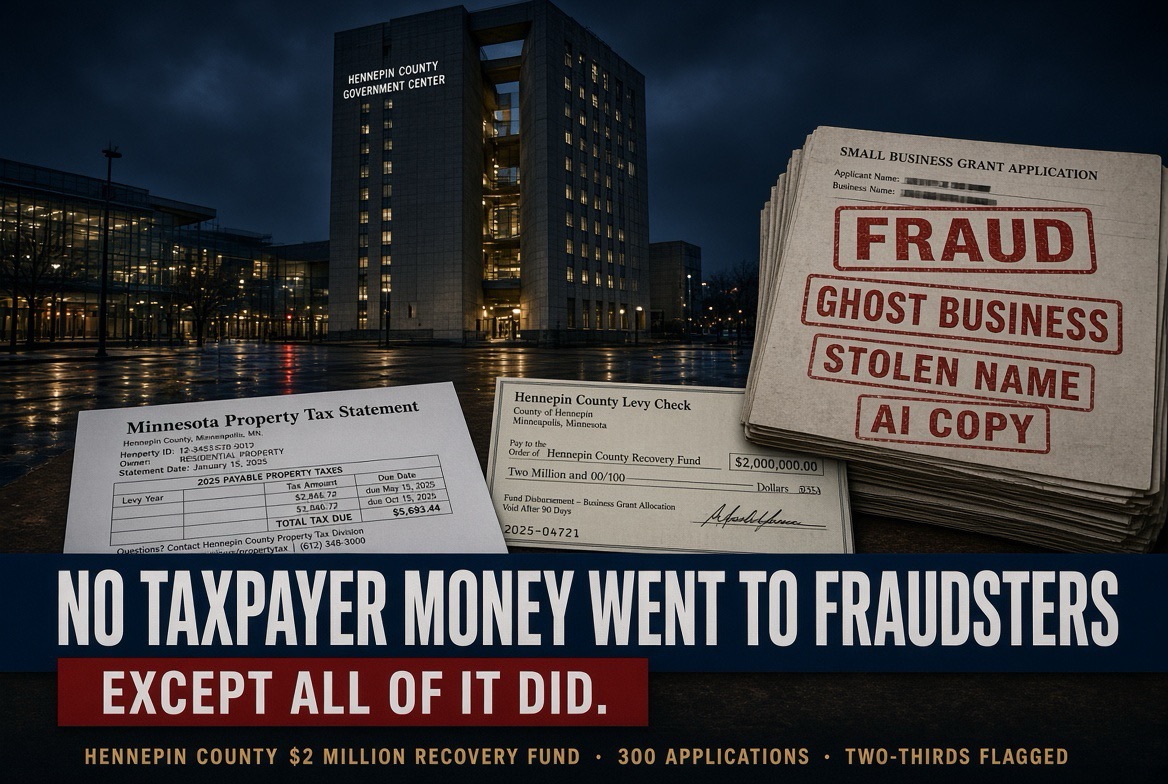
Hennepin County built a $2 million “recovery” pot after Operation Metro Surge. Two-thirds of the applications smelled like fraud. Then they called it a success.
By Phillip C. Parrish
Freedom Talk with Phil · September 18, 2026
KSTP ran a story this week that wants you to feel two things at once: relieved that the good guys caught the bad guys, and grateful that your money was “protected.” The line they keep circling is the one that should make every property-tax payer in Hennepin County sit up straight.

“No tax money actually went to fraudsters.”

That is not reporting. That is a magic trick. The entire $2 million was public money. The Housing and Redevelopment Authority that funded it lives on a property-tax levy — $21.8 million of it in the 2026 budget. Homeowners paid. Shopkeepers paid. Farmers on the edge of the metro paid. Calling the leftovers “safe” because the county stopped writing checks after the professionals showed up is like bragging the bank vault is fine because the robbers only made it to the lobby.
What they actually built
In March 2026, the Hennepin County Housing and Redevelopment Authority stood up the Small Business Recovery Fund. One-time grants of $3,000 to $10,000 to cover two months of commercial rent or mortgage. The pitch: businesses that claimed a 30 percent or greater revenue drop during Operation Metro Surge, the federal immigration enforcement action that began December 1, 2025.
They hired a nonprofit, NextStage, to administer it. Eligibility leaned on self-reported losses. In-person visits were not the standard at the start. They opened the window, advertised help for businesses — including immigrant-owned shops and “cultural corridors” — and waited.
Three hundred applications came in. Eighty-two got paid, about $500,000. The rest tripped red flags. Local outlets put the fraud share near two-thirds. The county would not give a clean number. Then they shut the program down and called the retreat “diminishing returns.”
Translation: the volume of liars beat the review staff.
The fraud was not subtle
Commissioner Jeffrey Lunde, who at least sounds like a man who has seen enough, described the pattern without perfume:
- Businesses that did not exist.
- Real businesses whose owners never applied — someone else used their name.
- Real businesses that inflated their losses.
- Applications that looked machine-made, copied and pasted across multiple names.
Lunde said the statewide fraud “makes me want to vomit.” He called the people doing it “the lowest scum on the earth.” He said this is not Mayberry anymore. On that last point he is right. Minnesota has spent years training a class of operators that treat every new grant announcement like a harvest. They do not fear God. They do not fear the county. They barely fear the U.S. Attorney. So they apply.
A massage therapist named Makayla Eckberg got $3,000 and said it kept her doors open. Good for her. One honest shop on camera does not wash two hundred applications that should never have been in the pile. Human-interest B-roll is how a syndicate story gets recast as a customer-service story.
The tax-dollar word salad
Watch the language. The tweet selling the segment called it a “taxpayer-funded program.” The body of the report then insists no tax money went to fraudsters. Both lines can sit in the same package only if “taxpayer money” means whatever is convenient that hour.
Federal slush is still tax money. County levy is still tax money. A nonprofit middleman spending county money is still tax money. Staff time spent chasing ghosts is still tax money. Site visits they added after the pattern was obvious are still tax money. The $1.5 million they did not hand to the first wave of fakes is still sitting in a public account, which means it is still yours.
And they already have a plan for that leftover pile. The county says the Housing and Redevelopment Authority approved “flexible, low-barrier financing” of up to $1 million, plus about $500,000 for consulting, legal help, and marketing. Low-barrier is a confession. After watching two-thirds of the last round try to steal the money, they answered by lowering the fence.
The file that has not arrived
In June the county asked the Hennepin County Sheriff’s Office to look at criminal activity. In July the Sheriff asked for the documents. By mid-September the Sheriff’s Office still had not received everything it requested. That is not “we caught it in time.” That is a file walking slowly across a parking lot.
If the applications were as rotten as Lunde says — ghost companies, stolen identities, inflated books, AI slop — then the interesting question is not whether the county “saved” $1.5 million. The interesting question is who built the pipeline, who gets charged, and whether anyone with a title ever pays a price for standing up another open tap in the fraud capital of the Upper Midwest.
Full circle, if you squint
KSTP framed it as a full-circle moment: fraud helped bring Operation Metro Surge here, and then the relief fund got hit by fraud. Cute. What the frame leaves out is the part every working Minnesotan already knows.
The same networks that looted Feeding Our Future, daycare, Medicaid, housing grants, and COVID pots are the reason federal enforcement showed up. Then local government created a new cash window for businesses that said ICE scared their customers away. The professionals treated it like another Tuesday. Nobody who has watched this state for the last eight years should be surprised. The only surprise is that anyone still writes “we didn’t lose any funds to fraud” with a straight face.
NextStage is not a random vendor. It already sits inside the county’s Elevate Hennepin advising and lending world — public money, nonprofit wrapper, “disadvantaged entrepreneur” language. That model is not evil because it is a nonprofit. It becomes a problem when the state and county keep stuffing cash into layers that cannot tell a real shop from a paper one until after the applications pile up.
This is how the machine eats
Stand up a fund. Point it at a sympathetic category. Hire a partner. Discover “red flags.” Halt the program. Announce that no dollars reached the thieves. Recycle the rest into a softer pot. Ask the legislature for a new penalty statute so it sounds like you learned something. Repeat.
That is not stewardship. That is inventory management. The grant-and-nonprofit complex in this state treats your levy like a warehouse. Fraud is not an accident that interrupts the work. Fraud is a cost of doing business they have learned to narrate as oversight.
Lunde wants attempting fraud to carry a real penalty and wants site visits to become standard. Fine. Put it in writing. Prosecute the ones who filed the fakes. Publish the names of the ghost shops. Hand the Sheriff the whole file this week, not after the next news cycle. And stop building “low-barrier” programs in a state that has already proved what happens when you lower the barrier.
A Minnesota worth keeping
The people I work with, farm with, and worship with do not want a lecture about compassion. They already practice it. They pay the levy. They keep a shop open without a county check. They sit in the pew and ask God to expose what is done in the dark. Scripture is not vague on this. “A false balance is an abomination to the Lord, but a just weight is His delight.” You do not get a just weight by calling public money something else when it is inconvenient.
Minnesota is a constitutional republic, not a grant factory. The vision is simple enough that a man on a tractor in Goodhue County and a woman running a storefront in Brooklyn Park can both recognize it: tell the truth about the money, punish the people who steal it, and stop feeding the networks that have turned “relief” into a trade. Protect the family that produces. Stop subsidizing the outfit that files.
Christ is King. The books still have to balance. And no amount of word salad changes the fact that $2 million of levy money was put on the table in a state famous for eating tables.
The county wants credit for pulling the plate away after most of the hands that reached for it were dirty. Minnesotans should give them a different kind of credit: they told us, again, exactly how the machine works. Now the question is whether anyone with a badge, a gavel, or a vote will treat it like the organized theft it is.
About the author
Phillip C. Parrish is a retired U.S. Navy Lieutenant Commander, fraud whistleblower, farmer, and host of Freedom Talk with Phil. He lives in Kenyon, Minnesota.
Press contact
Phillip C. Parrish — phillip@parrish4mn.com
Heidi Wanty, Manager — heidi@parrish4mn.com
Phone: (612) 460-1717
parrish4mn.com · X: @phillipcparrish