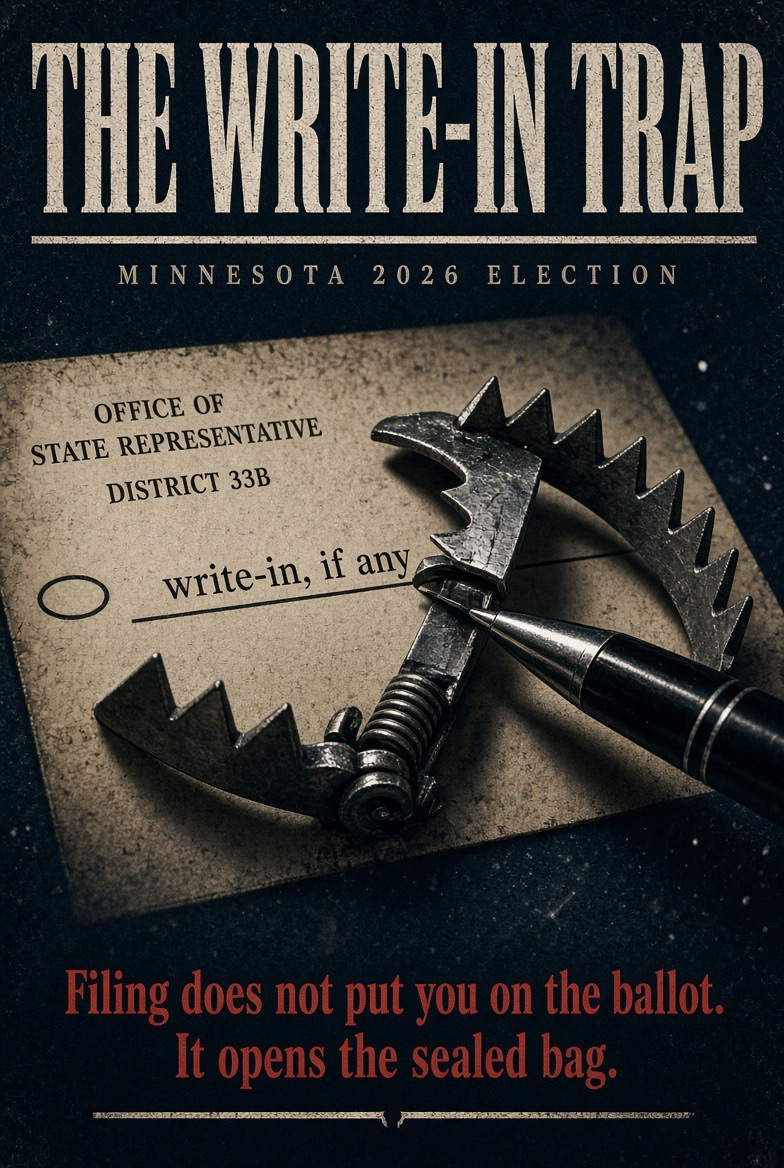
THE WRITE-IN TRAP
Why Lindell–Parrish Will Not File — and Why That Decision Protects the Movement
Mike Lindell and I have received a flood of calls, texts, and emails from people who supported this ticket in the primary and still want a way to write our names on November 3. That passion is real. It is not lost on us. You showed up when it cost you something. You did not wait for permission from the donor class or the party machinery. We are grateful for that, and we will not pretend otherwise.
Gratitude does not require us to walk into a trap.
A recognized write-in campaign in Minnesota is being sold as a second chance. It is not. It is a predictable set of mechanical and political consequences that weaken the effort to expose and dismantle the criminal syndicate running this state’s elections, nonprofits, and patronage networks. We will not file the write-in requests. That decision is final. Here is why.
What people think filing does
The pitch sounds simple:
• File the forms with the Secretary of State by 5:00 p.m. on October 15.
• Mike files for Governor. I file for Lieutenant Governor. Each names the other.
• Then write-in votes “count.”
That last sentence is the lie that does the damage. Filing does not put our names on the printed ballot. It does not make the machines treat those ballots like a normal candidate. It does not take the count out of the hands of the same officials and the same process we have already said we do not trust. It authorizes a second, messier count after election night.
What Minnesota law actually does
Voters can already write a name on every general-election ballot. The line is printed: “write-in, if any.” That line exists whether we file or not.
What filing changes is this: if we submit the joint request, county auditors must open sealed ballot containers after Election Day, pull write-in cards, read handwriting, decide “intent,” and produce a separate report for recognized write-in candidates. Minn. Stat. 204B.09, subd. 3 and 204C.33 require that extra handling only when the candidates ask for it.
If we do not file, those names are not individually credited to us in the official canvass. They fall into an undifferentiated write-in pile. That is ugly. It is also honest. Filing would not rescue those votes from the system. It would invite the system to touch the ballots again.
On optical-scan ballots — the equipment used across this state — a write-in is supposed to have the oval filled next to the written name. Voters will forget the oval. They will write only “Lindell.” They will write only “Parrish.” They will misspell. They will write on the wrong office line. They will mark a printed name and write ours.

That last mistake is an overvote. For that office, the ballot is defective. The governor race on that card is discarded. The rest of the ballot may still count. The race the voter cared about most does not. A write-in drive will manufacture exactly that pattern among people trying to “cover their bases.” They will not know they voided the contest.
Election judges then interpret. Intent rules exist. So do conflicting machine rules. Handwriting gets read. Defective ballots get duplicated. Sealed containers get opened. That is not transparency. That is more human discretion inside a process that has already failed audits, chain-of-custody fights, voter-roll challenges, and canvassing fights in this state.
The unintended consequences no one is advertising
It trains supporters to leave the printed contest.
Energy that should stay on paper ballots, poll books, configuration, absentee envelopes, and the names that actually tabulate on election night gets spent teaching people a handwriting exercise. The syndicate prefers that. Confused protest votes are easier to absorb than organized pressure on the official count.
It creates a talking point for the same officials we are fighting.
“They had a write-in option. The votes were counted.” Those votes will have been counted under the same roof, by the same structure, with extra interpretation layered on. That is not a check. That is a press release.
It splits the protest without building a governing ticket.
A write-in for Governor and Lieutenant Governor is not a campaign. It is not ballot access. It is not a recount posture with printed names. It is a side ledger produced after the machines are done. Movements that want to dismantle a syndicate do not hand the syndicate a second ledger.
It increases spoiled governor races among our own people.
Overvotes, missing ovals, one name instead of two, wrong line — those errors concentrate among first-time write-in voters who think they are being clever. The printed candidates do not pay that tax. We would.
It legitimizes a process we have already said is compromised.
We have spent this year documenting roll problems, certification fights, suppressed reports, and the networks that live off this state’s ballots and budgets. Filing a write-in request is a formal invitation for those same offices to adjudicate our names by hand. That is not resistance. That is participation in the weak point.
What we will not do
We will not file.
We will not tell people that October 15 is a path back onto the official board.
We will not spend October coaching handwriting so counties can open sealed containers in November.
If someone still writes the names, the blank line is already there. That is their choice. We will not convert that private act into an official request that triggers extra handling.
What actually helps
Keep the pressure where it can still bite: paper, lists, configuration, absentee envelopes, canvassing, and the printed races that determine who holds the offices that protect or bury evidence. Tell the truth about how this system works instead of selling a workaround that the system already designed.
Mike and I did not come this far to soothe people with a procedure that looks like hope and functions like a strainer. The gratitude is real. The write-in request is a bad instrument. We will not pick it up.
— Phillip Parrish
Lindell–Parrish
Minnesota