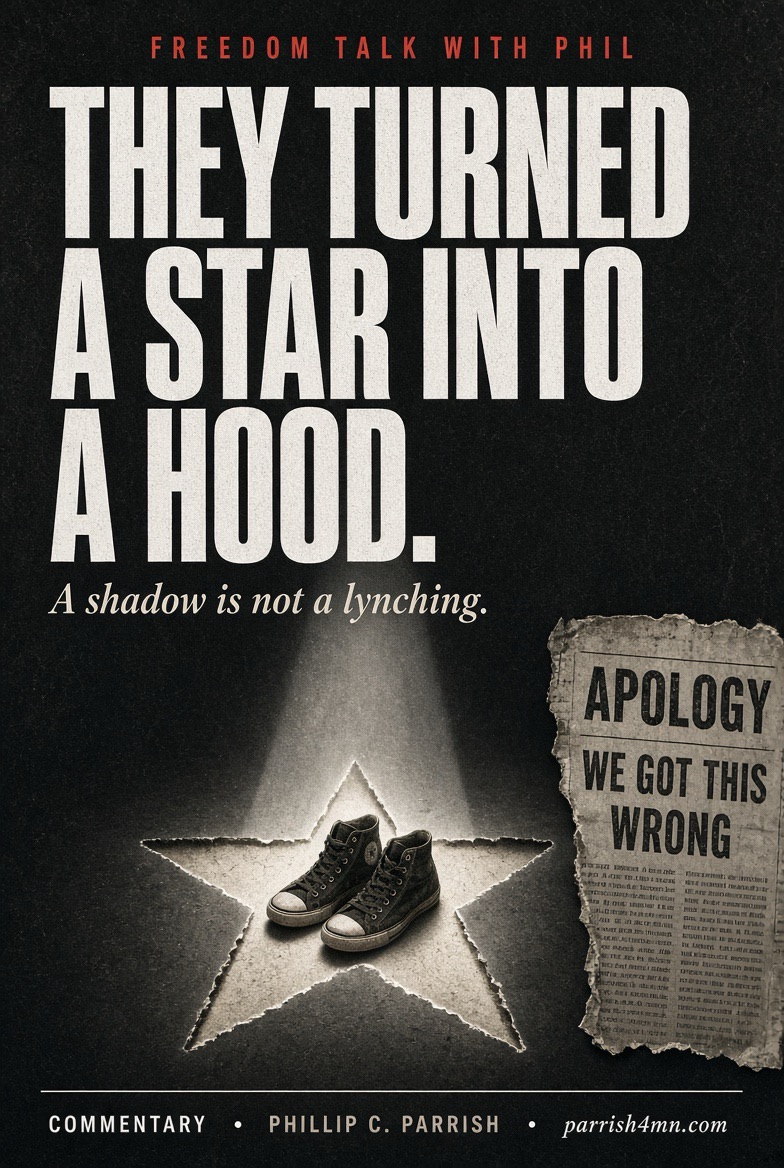
FREEDOM TALK WITH PHIL | Commentary | September 22, 2026
They Turned a Star Into a Hood
How a sneaker photo became a “lynching ad” — and why American companies keep kneeling to a method that manufactures hate out of shadows.
Here is what actually happened.
Converse hired Karina of aespa — a South Korean singer, not a prop from somebody’s American nightmare — as a global face. The campaign was built around the company’s five-pointed star. One still from a multi-look shoot shows her in a white skirt, standing in a star-shaped spotlight, holding a pair of black Chuck 70s. The light hits the fabric and throws a bright triangle. The shoes hang from her hand because that is how a model holds shoes.
For roughly two weeks the picture sat online as what it was: a sneaker ad. Then a slice of American social media decided the triangle was a Ku Klux Klan hood and the sneakers were the dangling feet of a lynching victim. Within days a congressman called it “racist, reckless and deeply offensive.” Converse pulled the frame and issued the ritual confession: “We got this wrong.”

That confession is the tell. The company did not admit to making a Klan poster. It admitted that the loudest interpretation now owns the photograph. That is not repentance. That is surrender to a method.
Minnesotans know this method. We have watched it run on ballots, on “feeding our future” nonprofits, on church basements turned into cash windows, on headlines that arrive before the facts. Isolate one image. Invent the crime. Force the apology. Cash the apology as proof. Then loot the next target.
The method
Five steps. It runs on demand.
Isolate. Take one still out of a campaign that also shows the same woman sitting, holding the shoes to her face, wearing jeans, wearing a jacket. Kill the context.
Project. Treat pareidolia — seeing a hood in a cone of light — as if it were intent. Announce that anyone who sees a fashion still is “insulting our intelligence.”
Anoint. Get a celebrity to declare the verdict in eight words. Get a member of Congress to put it on letterhead. Now it is not a take. It is “the controversy.”
Amplify. Headline the accusation as fact. “Ad evokes a lynching.” “Ad depicting a lynching.” The hedge words die in the headline. The apology is reported as confirmation.
Extract. Demand firings, boycotts, “who approved this,” “were the right people in the room,” an independent review. The brand, already shrinking and allergic to a two-day pile-on, pays in groveling.
Once the company says “we got this wrong,” the interpretation becomes official history. That is how you manufacture a moral crime out of a shadow.
Name the operators
No secret lodge is required. They did this in public.
Yvette Nicole Brown posted the frame on Threads and wrote: “That’s a lynching, yes?” Then: “AND a Klan robe. Damn, Converse.” That is the ignition sentence. She did not have to prove intent. She only had to name the picture. Every subsequent story quoted it.
Alyssa Milano piled on: “A lynching image. Getting rid of all my converse today.” The boycott is the sacrament. The woman in the photograph — Korean, not a Klansman — is collateral.
Stephanie Schwartz, a Chicago photographer, wrote that “every photographer can tell you, whoever did this ad knew EXACTLY what they were doing.” That converts an optical reading into a conspiracy of craft. No brief, no mood board, no art-direction note has been produced. The charge of deliberate Klan imagery is asserted as professional certainty.
Lee Merritt, a Texas civil-rights attorney, treated the apology as insufficient: it “doesn’t undo what got past legal, marketing and leadership at every step.” First declare the image a crime. Then demand process blood. The standard is not “did anyone intend this.” The standard is “someone should have seen what I see.”
Rep. Troy A. Carter, Sr. (D-LA) put the federal stamp on it. Official release, September 18, 2026, titled as if the ad depicted a lynching:
“Nike and Converse, what the hell were you thinking?”
“Your campaign shows what looks like a hooded Klansman, framed by what appears to be the dangling feet of a lynching victim.”
“Do not insult our intelligence by dismissing this as an unfortunate misunderstanding.”
He demanded to know who approved it and whether Black staff were in the room. He later told reporters an apology was not enough — he wanted leadership changes and an independent review.
A member of Congress is entitled to be offended by a shadow. He is not entitled to launder an interpretation into an official finding that an American company “depicted a lynching” and then demand heads. That is the seal of the House used as a club on a private brand’s art department.
Aaron Cain, CEO of Converse, completed the circuit. Internal memo, reported by Bloomberg: the images “should not have been used.” He promised a hard look at “the critical lens we apply to our work.” Translation: hire more people whose job is to hallucinate the next scandal before it is invented. Nike already has a Converse division that has been shrinking for years. Risk officers do not need a gun to the head. They need a headline.
The press did the rest. Adweek: “Ads That Evoke a Lynching.” Carter’s House page: “Sneaker Ad Depicting a Lynching.” Newsweek, Los Angeles Times, CBC, CNN, People, ESPN — the copy treated the reading as the news and the apology as the close. Almost none of that copy spent comparable space on the rest of the campaign stills, which destroy the “hood and hanging body” story if you look at them for ten seconds.
The motive is not a mystery
You do not need a dungeon manifesto. The incentives are sitting on the table.
Moral monopoly. If a triangle of light can be ruled a Klan hood, the people who spotted it own the high ground for a news cycle. Everyone else is “dismissing pain.”
Political inventory. A congressman who converts a sneaker still into a lynching statement is stocking the same warehouse the syndicate uses in Minnesota: “who was in the room,” corporate supervision by press release, a ritual firing to prove loyalty. It costs him nothing. It costs the company a brand week and a CEO memo.
Media oxygen. “K-pop star in a cute Converse ad” does not travel. “American brand depicted a lynching” does. The headline writes itself. The correction never does.
Corporate cowardice. This is the motive that makes the method work. Converse did not lose a court case. It lost its nerve. The apology ratified a charge no prosecutor could charge. That is how you train the next mob. Next time they will not even need a celebrity. They will only need the last apology.
There is a secondary cruelty the American conversation barely noticed. Karina is not a Klansman. She is a Korean woman who booked a job about stars and sneakers. The campaign caption was “Under stage lights or streetlights, the star always finds the frame.” The outrage machine took an Asian artist, ran her through a uniquely American historical filter, and made her the face of a hate object she did not design.
That is not protecting anyone from terror. That is using real historical pain as a weapon against a photograph of a woman holding shoes. Scripture is not vague about this. “You shall not bear false witness.” You do not get a waiver because the lie feels righteous. You do not get to spend the dead like a prop closet.
What the full campaign shows

The official WWD gallery — courtesy of Converse, published at launch in August — shows the same wardrobe in other poses: seated in the white skirt with the shoes on her feet; holding the high-tops up to her face; blue low-tops and jeans; leather jacket and star tee. The “hood” is a point of the brand’s own star, projected as a motif across the set. The “hanging feet” are a pair of Chucks in a model’s hand.
If the standing frame were a coded lynching poster, the rest of the shoot would have to be a coded lynching poster that forgot to code. It is not. It is a fashion set. Adults can tell the difference. Companies used to be able to say so.
The signal to American companies — and to Minnesota
Stand up.
If a critic sees a hood in your lighting, you may pull a frame out of prudence. You may say you regret that a composition read that way to some viewers. That is manners. What you may not do — if you intend to remain a company and not a hostage — is confess to a lynching you did not stage.
Do not let a member of Congress title your product launch as a depiction of murder. Do not let an actress’s two-sentence Threads post become your official art-direction history. Do not let “were the right people in the room” become a racial loyalty test on a photograph of a Korean idol selling sneakers.
Show the full set. Say the sentence Converse would not say: this is a star-shaped spotlight on a white skirt. Some people saw something else. We did not put a hood on her and we did not hang a body. We will not fire our photographers because a politician needed a press release.
Every apology of this type is a teaching document. It teaches activists that the charge does not have to be true. It only has to be expensive. It teaches editors that the accusation is the story. It teaches the next creative team that the safest picture is a blank wall.
Lynching was a real American crime. The Klan was a real American terror. That is precisely why you do not spend those words on a triangle of light. Cheapening the language does not honor the dead. It uses them.
Minnesota does not have to live like this. Farmers, veterans, parish families, shop owners who still make a thing and stand behind it — they already know the difference between a shadow and a crime. They want a state where a man can tell the truth without a comms shop rewriting it into a confession. A constitutional republic still has room for that. A syndicate does not.
Push back hard. Publish the contact sheet. Name the method. Refuse the frame. If a company cannot defend a woman holding shoes, it will not defend a county canvas, a church ledger, or a farmer’s land title either.
Christ is King. Truth does not require a mob.
Phillip C. Parrish is a retired U.S. Navy Lieutenant Commander (Intelligence), farmer, fraud whistleblower, and host of Freedom Talk with Phil. He lives in Goodhue County, Minnesota.
Press / bookings
Phillip C. Parrish — phillip@parrish4mn.com
Heidi Wanty, Manager — heidi@parrish4mn.com
Phone: 1 (612) 460-1717
Web: parrish4mn.com
X: @phillipcparrish | @parrish4mn
On the record: Rep. Troy A. Carter, Sr., official press release, Sept. 18, 2026, troycarter.house.gov; follow-up to USA Today Network / Shreveport Times, Sept. 20, 2026. Converse statement first reported by Footwear News / WWD, Sept. 18, 2026. Aaron Cain employee memo as reported by Bloomberg News, Sept. 20, 2026. Yvette Nicole Brown and Stephanie Schwartz as quoted in Adweek, The Independent, and WWD. Alyssa Milano as reported by PrimeTimer. Lee Merritt as quoted by Newsweek, CNN/AP, and FashionUnited. Official campaign stills: WWD gallery, Aug. 6, 2026. The people named spoke in public. This article holds them to those words. It does not allege a criminal conspiracy. It describes a method that is now standard, and a corporate collapse that made it profitable.