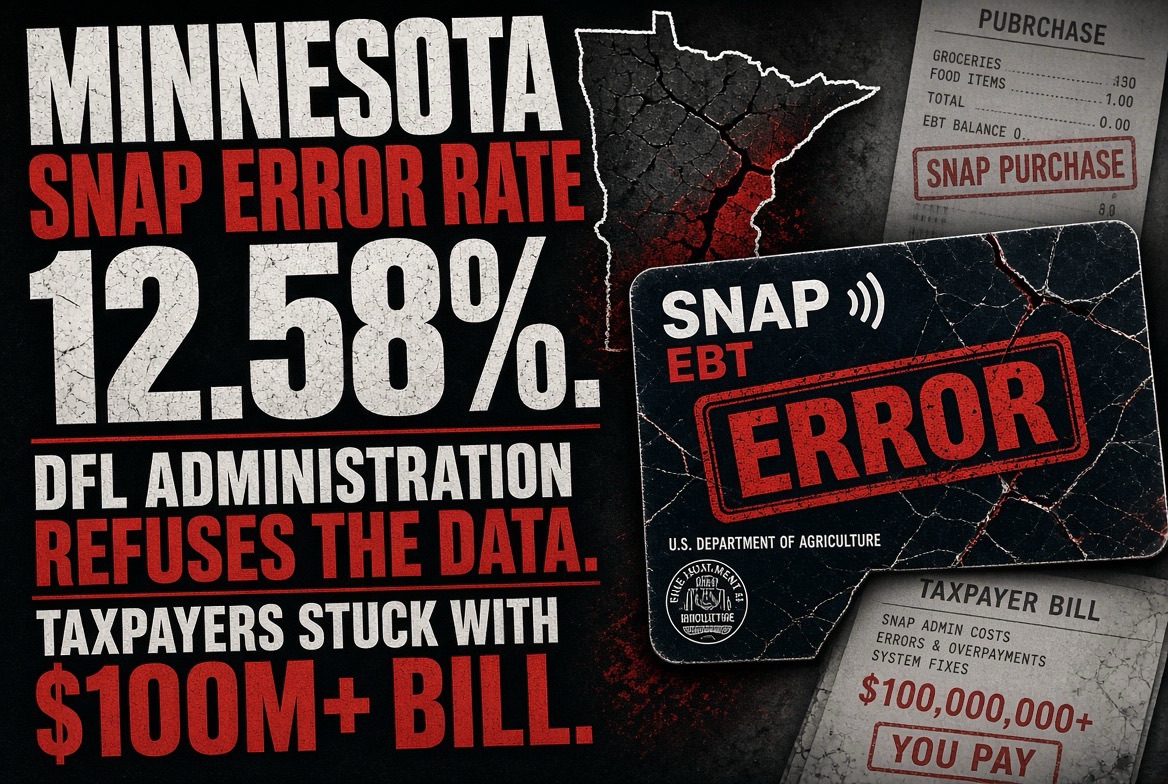
While KSTP soft-pedals the latest numbers as “mistakes” in the food assistance program, the facts are uglier. Minnesota’s SNAP payment error rate hit 12.58 percent in federal fiscal year 2025—up sharply from 8.98 percent the year before—with a 9.86 percent overpayment rate. The national average sat near 10.6 percent. Under the federal law that forces high-error states to cover a share of benefit costs, that rate triggers a 15 percent state obligation. Projections put the hit at roughly $105 million in state fiscal year 2028 and $145 million the following year, half of it landing on counties. Without a rapid drop, Minnesotans are on the hook for well over $100 million.
The USDA offered a practical path: share five years of applicant data so federal analysts can help identify ineligible claims, duplicates, and waste. Twenty-nine other jurisdictions complied. That data pointed to billions annually in overpayments and fraud nationwide—dead people certified, Social Security numbers used multiple times, and the usual patterns of leakage. Minnesota, along with a handful of other holdouts, refused. The Department of Justice sued in June 2026 to force compliance. USDA officials were blunt: the state administers the program and holds the records; without them, real cleanup is limited. Minnesota’s Department of Children, Youth, and Families calls the request unprecedented and a privacy threat while insisting the errors are mostly innocent paperwork glitches, not intentional abuse.
This is the same apparatus that previously sent the USDA inaccurate SNAP issuance totals and fraud figures—numbers the state later admitted were wrong. It is the same oversight culture that allowed Feeding Our Future and related child-nutrition schemes to siphon hundreds of millions before the scale became impossible to ignore, with legislative auditors documenting inadequate controls that created opportunities for fraud. Neighboring states run cleaner numbers. South Dakota’s error rate was a fraction of Minnesota’s. The pattern is not mysterious: weak verification, resistance to outside scrutiny, and a political class that treats transparency as optional when the money is flowing to preferred networks.
The human cost is straightforward. Every dollar diverted or overpaid is a dollar not available for legitimate needs, for roads, for schools that actually teach, for the farmers and producers who still keep this state running, or for the veterans and working families who pay the taxes. When the state finally gets the bill for its own error rate, that cost lands on counties and, ultimately, on property taxes and budgets already strained by years of the same practices. Communities do not get safer or more prosperous when public assistance systems become open-ended extraction schemes. They get poorer, more dependent, and less trusting.
The DFL-dominated administration’s response has been consistent: declare the problems mostly unintentional, resist the data that could quantify the damage, and point to internal training and technology upgrades as the solution. That is not stewardship. It is the continuation of a model that has already produced massive documented losses in related nutrition programs and left Minnesota with a reputation for high-profile fraud cases. Treating the refusal as a pure privacy stand ignores the track record and the fact that other states handed over the same categories of records without collapsing.
Minnesotans who still believe in a constitutional republic—not a managed extraction machine—deserve better. A state that prioritizes accurate eligibility, real audits, and consequences for those who game the system can protect the genuinely vulnerable without bankrupting the producers. It can restore the expectation that public funds go to actual households in need, not to layered nonprofits and facilitators who treat federal and state dollars as private revenue. Farmers, veterans, small-business owners, and families who keep the lights on should not be the residual payers for a system that has repeatedly failed basic controls.
The numbers are public. The lawsuit is public. The prior inaccurate reporting is public. What is missing is the political will inside the current administration to stop protecting the status quo and start cleaning the books. Until that changes, the cost of the failure will keep shifting to the people who live and work here. That is not a mystery. It is the predictable result of years of the same approach.