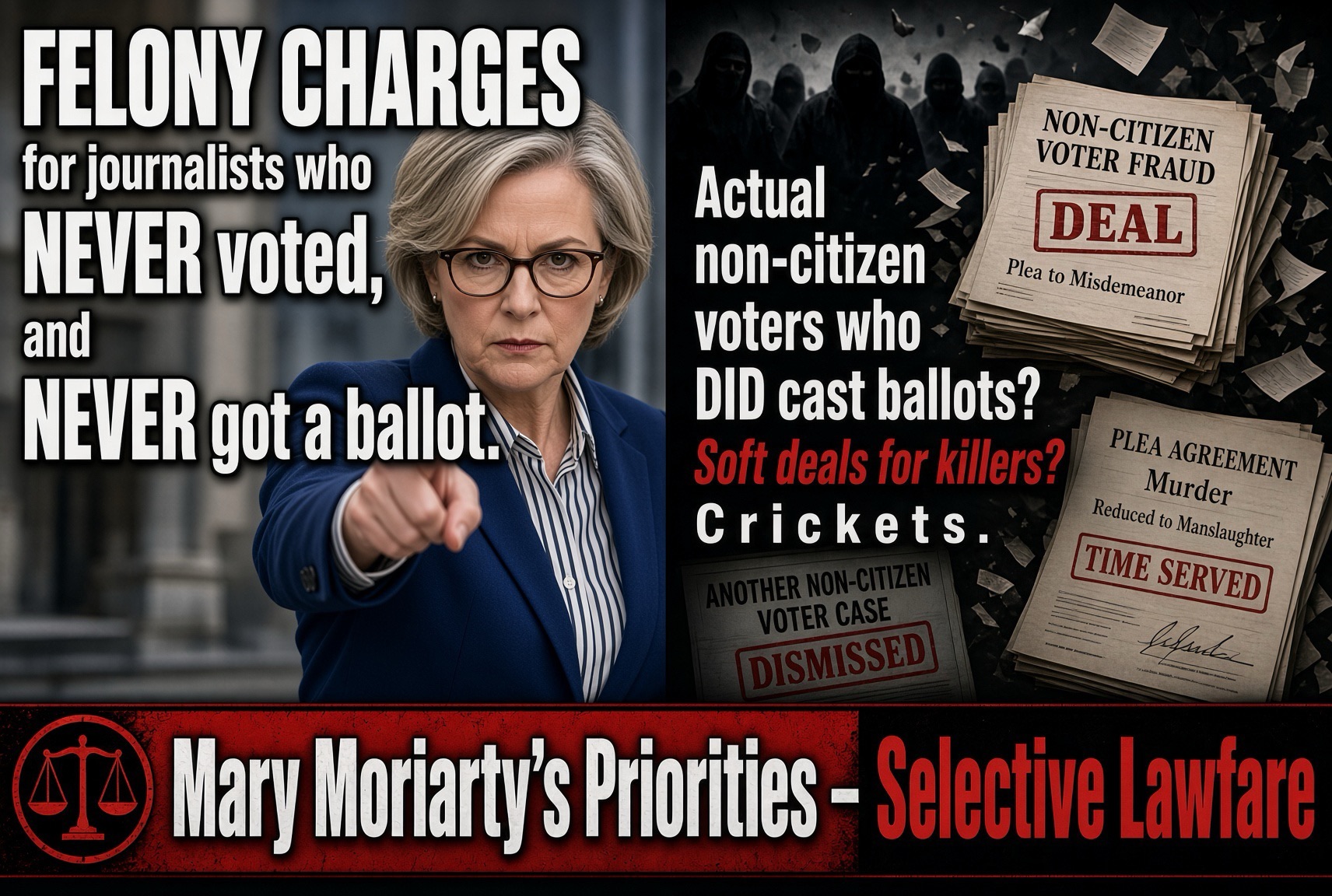
Hennepin County Attorney Mary Moriarty just charged James O’Keefe and Cam Higby with felonies for unlawful voting and identity theft. They walked into Minneapolis polling places during the August primary, dressed in Muslim attire, used accents, and gave election judges the names of real registered voters while asking about Minnesota’s vouching rules. They never signed the oath. They never received ballots. They never cast a single vote. They left after filming how far the process would go without proper identification.
Moriarty’s response is that intent doesn’t matter. Stating a false name while inquiring is enough to “begin to apply” for a ballot. She called the videos an attempt to disrupt and deceive election workers. Secretary of State Steve Simon piled on with the same script. This is selective prosecution dressed up as protection of the system.
The same August primary produced something far more concrete. Federal prosecutors indicted ten foreign nationals—green-card holders from Liberia, Ghana, Lithuania, Germany, Bosnia, Brazil, and elsewhere—for illegally registering or voting in Minnesota elections. One of them voted in that same August primary. These individuals actually cast ballots after falsely claiming citizenship. Moriarty’s office has shown no comparable urgency toward them. Simon’s office has repeatedly described non-citizen voting as vanishingly rare. The Department of Justice keeps finding it.
Minnesota’s vouching statute lets one registered voter in a precinct swear an oath that they personally know up to eight other people live there. That oath substitutes for traditional proof of residence. Poll workers in the O’Keefe and Higby videos treated the voucher as the identification. The investigation demonstrated the friction that does not exist. Charging the people who recorded it, while actual non-citizen ballots were cast in the same election, reveals the priorities.
Moriarty’s record on violent crime makes the contrast sharper. Her office declined to charge a Loring Park man after months of documented threats and gun-brandishing against neighbors. He later murdered two of them and wounded responding officers. She pushed soft outcomes in murder cases involving juveniles, including the Zaria McKeever killing, to the point that Governor Walz and Attorney General Keith Ellison stepped in to take control. Early in her tenure her office dropped charges against a man accused of raping a 14-year-old over a technicality. Families of victims have publicly described her approach as treating them as secondary to the offender’s rehabilitation narrative.
The pattern is consistent. Progressive charging policies, diversion, and probation for serious violent offenders. Full felony charges for two men who tested the election rules on camera and walked out without voting. The DFL apparatus—county attorney, secretary of state, and attorney general—treats election-integrity investigators as the threat while the loose rules they defend continue to produce non-citizen ballots and the soft-on-crime results that leave victims and neighborhoods paying the price.
Minnesota is a constitutional republic. Free and fair elections under the rule of law are not optional. They require verifiable identity, accurate rolls, and prosecutors who apply the same standard to actual illegal voting as they do to undercover tests that never produced a ballot. Families, farmers, and veterans who keep the state running should not watch their county attorney prioritize political theater over both election integrity and the prosecution of killers.
The charges against O’Keefe and Higby are set for court in November. The federal cases against the non-citizens who actually voted are already moving. The public record on Moriarty’s handling of violent offenders is available. None of this requires new legislation to state plainly. It requires prosecutors who treat real fraud and real violence as the priority instead of the people who document the gaps.
For a Minnesota where election integrity is enforced, violent criminals face consequences, and the people who produce rather than extract are protected, the current approach must be replaced. The court of public opinion can start with the facts already on the record.
Contact:
Phillip C. Parrish
Heidi Wanty
(612) 460-1717