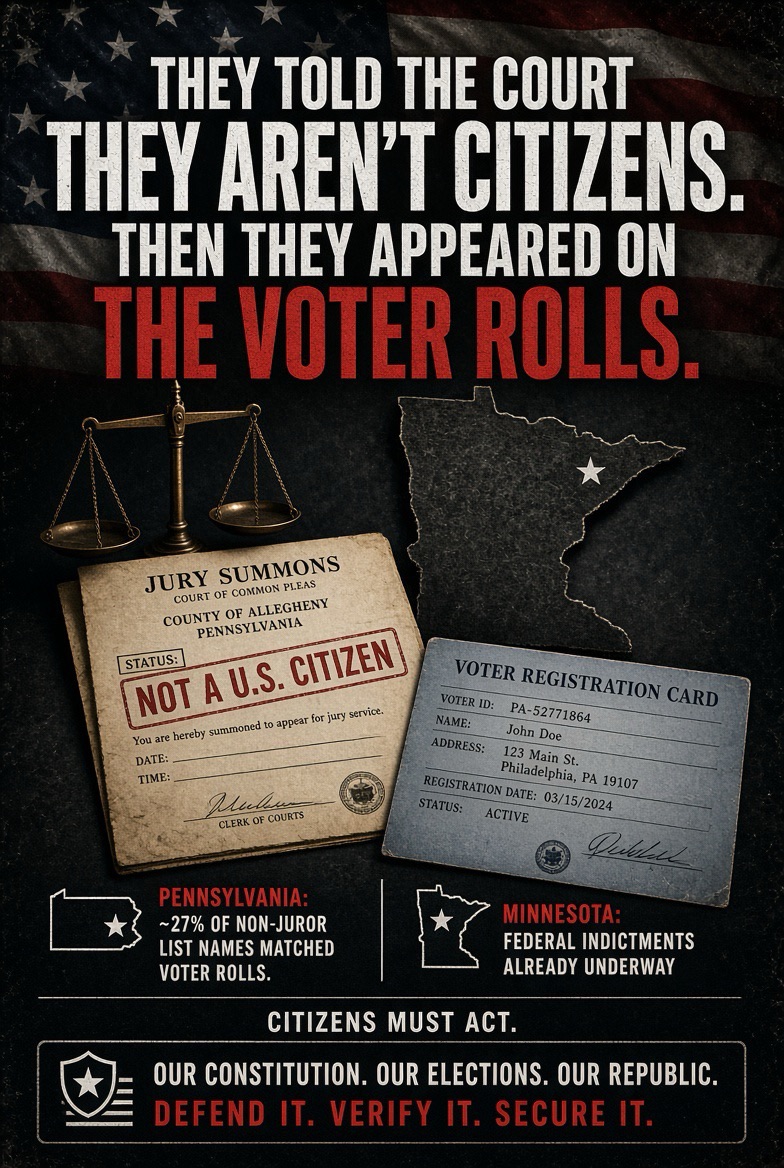
Scott Presler and Early Vote Action did something simple and devastating in Pennsylvania: they went to county courthouses, pulled the public non-juror lists of people excused from jury duty because they are not U.S. citizens, and cross-checked the names against the state’s voter rolls. Of the more than 20,700 non-citizens they obtained from those lists, roughly 27 percent flagged as matches on the Pennsylvania voter rolls. In Philadelphia alone they reported thousands of records and hundreds of potential matches. Pennsylvania law treats those non-juror lists as open to public inspection. The people on them had already told the court, under the jury system, that they are not citizens. Yet a large share of the same names appeared on the voter rolls. Only citizens may vote in federal and state elections. Registration requires an affirmation of citizenship under penalty of perjury. The mismatch is not a paperwork glitch. It is evidence that the verification system failed on a scale that can affect outcomes.
Pennsylvania election officials responded by claiming the lists are not useful for verifying voter rolls because they contain limited identifying information and name-only matches can produce false positives. That is a partial truth used as a full dismissal. Name matches are not automatic proof of illegal voting, but they are a clear indicator that demands further investigation with dates of birth, addresses, and citizenship status. When the same people are repeatedly summoned as non-citizens and still appear registered, the burden shifts to the state to prove they are eligible. Pennsylvania has not done that work. The lists exist precisely because the court already received a non-citizenship answer. Ignoring them protects the status quo, not the citizen.
Minnesota runs a parallel system with the same vulnerabilities and stronger secrecy. Jury source lists here are drawn from driver’s licenses, state IDs, and registered voters under General Rules of Practice Rule 806. Qualification requires U.S. citizenship under Rule 808. Non-citizens who receive a summons are excused once they state they are not citizens. Minnesota’s Driver’s Licenses for All law puts non-citizens on the driver’s license lists that feed the jury pool. Automatic voter registration is supposed to require documented citizenship proof at Driver and Vehicle Services before a record is forwarded. In practice, the system still produces cases of non-citizens registering and voting.
In September 2026 a federal grand jury in Minnesota indicted ten foreign nationals for making false claims of citizenship in order to vote or for voting as aliens. The alleged conduct covers the November 2022 general election, the November 2024 general election, and the August 2026 primary. Defendants include nationals of Liberia, Lithuania, Ghana, and other countries. One defendant is charged with voting as recently as the 2026 primary. These are not rumors. They are federal indictments. Minnesota Secretary of State Steve Simon’s office has responded by calling non-citizen voting “vanishingly rare” relative to millions of ballots cast. Ten documented cases after years of claims that the problem does not exist is not vanishing. It is the visible tip of a system that does not systematically cross-check jury disqualifications against the voter rolls the way Presler’s team did in Pennsylvania.
The difference in Minnesota is access. Rule 814 of the General Rules of Practice tightly restricts disclosure of jury source lists, names of prospective jurors summoned, records regarding prospective jurors, and the contents of qualification questionnaires. Public access is limited. Broader requests require a showing to the chief judge that release serves the interest of justice. Unlike Pennsylvania, outsiders cannot simply walk into a courthouse and review years of non-juror records of people excused for non-citizenship. That restriction does not prove the problem is smaller. It proves the records are harder for citizens to examine. Voter rolls themselves are not fully public. Registered Minnesota voters can request public information lists containing names, addresses, year of birth, and voting history for election, political, or law-enforcement purposes. Master lists with more detail are more restricted and available mainly to public officials.
Minnesotans can still duplicate the core method and force the issue. Registered voters can request the public information lists from county auditors and begin name and address matching against any jury-related data that can be obtained through Data Practices Act requests, legislative inquiry, or targeted litigation seeking interest-of-justice disclosure. County jury offices and the state court administrator’s office maintain the source lists and disqualification records. Persistent, specific requests for statistical data on the number of people disqualified annually for non-citizenship, broken down by county, create a public record even if full names are withheld. The ten recent federal indictments provide concrete names and cases that can be tracked through public court dockets and cross-checked against voter history. Citizens can also demand that the legislature require automatic, routine cross-referencing of jury non-citizenship disqualifications against the Statewide Voter Registration System, with removal of ineligible records and referral for prosecution where false affirmations of citizenship occurred. Automatic voter registration and Driver’s Licenses for All must be audited for leakage. Any non-citizen who ends up registered after affirming citizenship has committed a crime. The state has a duty to detect it rather than dismiss the volume as small.
This is not a technical glitch in an otherwise sound system. It is the predictable result of policies that expand access to identification and registration while treating citizenship verification as optional or self-reported. The same networks that have looted child-care funds, COVID relief, and other public programs through weak oversight have no incentive to tighten election verification. Only citizens of the United States may vote in Minnesota elections. That is the standard required by the Constitution and by statute. When non-citizens appear on jury disqualification lists and also on voter rolls, the integrity of the constitutional republic is compromised. Farmers, veterans, small-business owners, and families who follow the rules are diluted by ballots cast by people the jury system has already recorded as ineligible. The fix is straightforward: treat non-citizenship answers on jury questionnaires as actionable data, cross-check them systematically, remove ineligible registrations, and prosecute false claims of citizenship. Citizens who want clean rolls can start requesting the public voter lists today, file targeted Data Practices requests for jury disqualification statistics, and support candidates and legislators who will require the cross-check that Presler’s team performed by hand in Pennsylvania. Minnesota’s constitutional republic belongs to its citizens. The records exist to prove who is eligible. It is time to use them.
For press contact:
Phillip C. Parrish
Heidi Wanty
(612) 460-1717