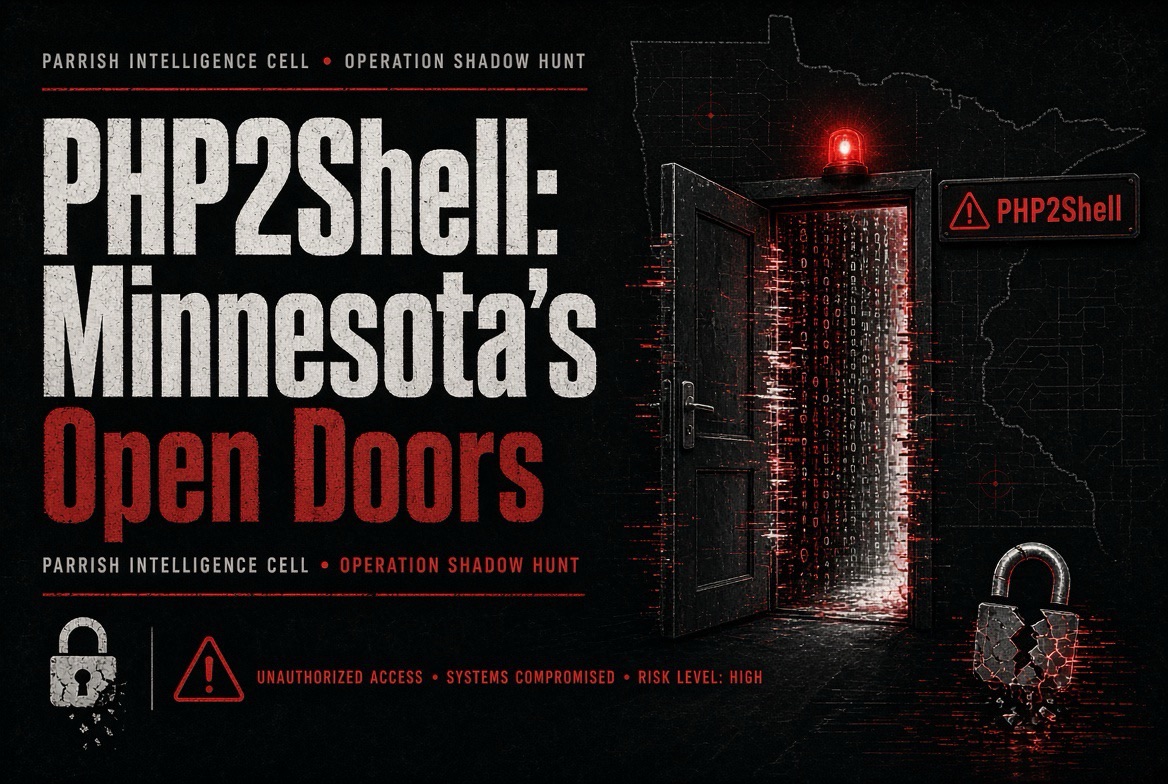
INTELLIGENCE BRIEF
Parrish Intelligence Cell / Operation Shadow Hunt
Subject: PHP2Shell (CVE-2026-109618 / CVE-2026-109619) Applied to Minnesota Infrastructure – Negligence, Outsourcing, and Election Support Exposure
Date: 29 October 2026
Classification: Public Release
From: Phillip C. Parrish, Retired U.S. Navy Lieutenant Commander (Intelligence), Fraud Whistleblower, Farmer
Prepared for: Officials who still take their oath seriously, county auditors, legislators who answer to taxpayers, and every Minnesotan who has watched the same networks loot while the doors stay unlocked
Executive Summary
PHP2Shell is a pair of critical, unauthenticated remote code execution flaws in PHP core that hit roughly 70% of websites running identifiable server-side code (WordPress, Drupal, and countless custom stacks). Patches shipped 21 October 2026. CISA has listed both in the Known Exploited Vulnerabilities catalog. Exploits are in the wild.
Minnesota’s track record is not theoretical. Ransomware has already hit St. Paul (Interlock), Winona County (multiple times), Sandstone (SSNs and financial data), and operational technology at more than 30 water systems. A vendor-managed DHS system exposed records of over 300,000 people. A 2021 Legislative Auditor report documented the Secretary of State’s Poll-Finder redirecting users to a partisan site because change control and testing failed. MNIT spends tens of millions on cloud and hundreds of providers while local entities keep getting rolled.
This is the same pattern: funds appropriated for security and upgrades, repeated failures, and a syndicate of agencies, contractors, and enablers that treats public trust as a side hustle. Core paper-ballot optical scanners are not PHP web apps. Supporting systems—online registration, status checks, poll finders, results sites, and anything Drupal or WordPress—are. Negligence here is not an accident. It is the business model.
Key Findings
• PHP2Shell allows remote code execution without credentials. Highest risk is public-facing PHP/mod_php. Partial mitigations exist; full patch or offline is the only real fix.
• Minnesota election tabulation relies on certified optical-scan paper systems (primarily ES&S, plus Hart and Liberty Vote). These are not generic PHP web servers. Direct remote rewriting of scanned paper ballots via this vector is not a realistic path. Post-election random audits comparing machine and hand counts remain a check.
• Supporting systems are exposed: mnvotes.gov tools, absentee applications, poll finders, county sites, and any PHP/Drupal front ends. Compromise yields downtime, defacement, voter-data theft, or corrupted supporting data. That is enough to create chaos and further erode confidence.
• Documented history of weak controls: Poll-Finder incident (poor testing, unilateral changes still possible), high volume of local incidents reported to MNIT, repeated ransomware, vendor breaches.
• Money has moved. HAVA election security funds (federal + state match) have been directed toward cybersecurity software, SVRS improvements, and the Security Navigator Team. MNIT cloud expenditures have run into the tens of millions across hundreds of providers. Outcomes do not match the appropriations.
• Outsourcing multiplies the problem. Patching depends on vendors and contractors. When the next ransomware hits, the same people will claim they “followed best practices” while the bill lands on taxpayers.
Path for Officials to Act and Expose Negligence
1. Immediate inventory and status demand. Require every state agency, county, and municipality to report within 14 days: every system running PHP (version and patch status), every public-facing site taken offline or mitigated, and the responsible vendor or internal owner. Non-response is evidence.
2. Follow the money. FOIA / data requests on HAVA election security expenditures, MNIT cloud and professional/technical services contracts, and any cybersecurity line items since 2023. Cross-reference against the ransomware and breach timeline. Where funds were spent and the same entities were hit again, demand the audit trail.
3. Legislative and auditor pressure. Call for a targeted Office of the Legislative Auditor review of PHP exposure and post-disclosure response across SOS, MNIT, and high-risk locals. Public hearings with sworn testimony. If patching lagged while contracts were renewed, refer for review of misappropriation or gross negligence.
4. Local pressure and public record. County auditors and boards can demand their own vendors produce patch evidence. Publish the non-responders. The syndicate thrives in darkness; sunlight is the cheapest tool we have left.
5. Stewardship standard. Officials who knew or should have known of a critical, actively exploited vulnerability and failed to act (or continued to spend security money without verifiable results) have failed their duty. Document it. Name the contractors. Make the pattern impossible to deny.
Vision
Minnesota does not need more grift dressed up as “modernization.” It needs systems that work for the people who actually live here—farmers checking land records without wondering if their data just walked out the door, families registering to vote without the portal being offline or compromised, veterans and small-town officials who can trust that the money taken from their pockets went to real protection instead of another contractor’s PowerPoint.
A constitutional republic runs on accountable stewards, not syndicates that leave the digital doors open while they cash the security checks. Paper ballots and honest audits are the floor. Competent patching, transparent spending, and consequences for those who treat public infrastructure like a private ATM are the minimum. We can have that. The people who built this state know how to fix what is broken when the looters are no longer protected.
Contact
Phillip C. Parrish – phillip@parrish4mn.com
Heidi Wanty – heidi@parrish4mn.com
Phone: 1 (612) 460-1717
https://parrish4mn.com | @phillipcparrish
Truth is not optional. Stewardship is not optional. The rest is just paperwork.