By Phillip C. Parrish
Retired U.S. Navy Lieutenant Commander | Fraud Whistleblower | Farmer | Lifelong Minnesotan
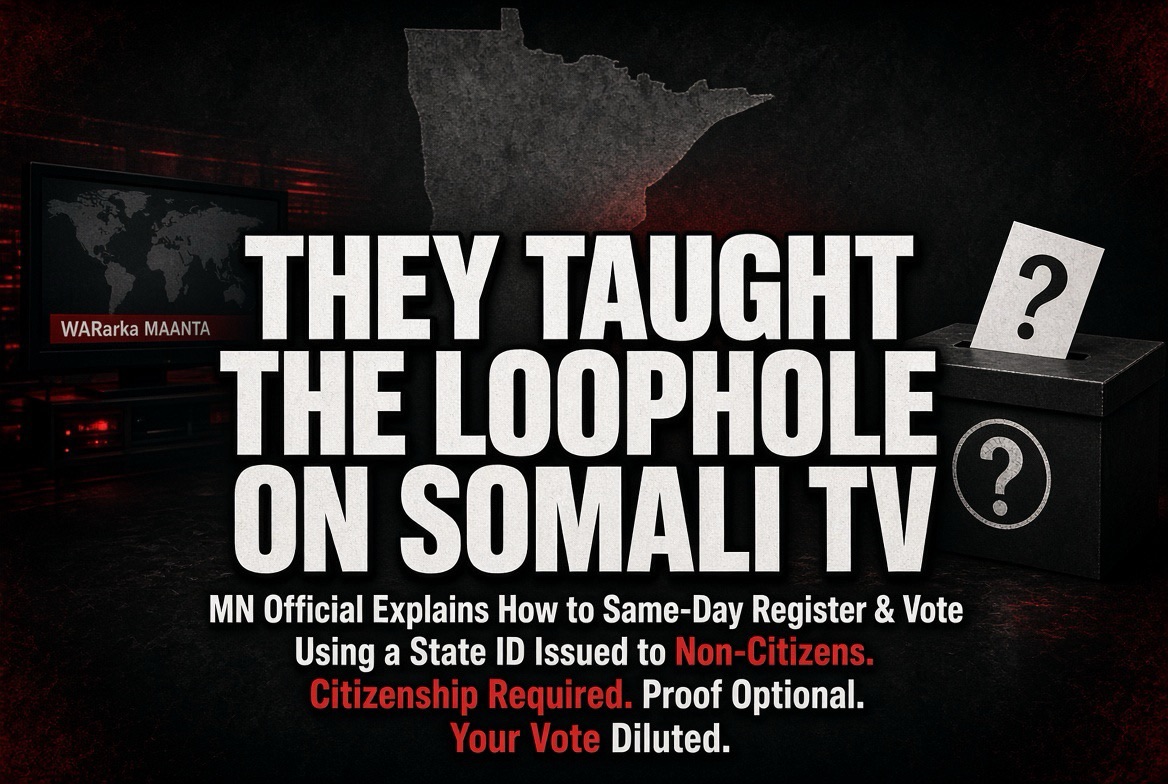
A Minnesota election official just went on Somali TV and walked viewers through how to same-day register and vote using a Minnesota state ID. That is not civic education. That is a public tutorial on the lowest-friction path through a system that already issues unmarked driver’s licenses and IDs to non-citizens, lets one registered voter vouch for up to eight others on an oath, and treats a self-attestation of citizenship as sufficient until after the ballot is counted—if anyone ever looks.
Citizenship is required by law in this constitutional republic. Non-citizen registration or voting is a felony under both Minnesota and federal statutes. It is also a deportable offense. The officials who designed, defended, and now promote this setup know that. They chose the architecture anyway.
How the system is built to minimize verification
Minnesota’s same-day registration rules accept a valid Minnesota driver’s license, learner’s permit, or state ID (or a receipt for one) as proof of residence and identity. Since the 2023 Driver’s License for All law, those credentials are issued to residents regardless of immigration status and carry no marking that distinguishes citizens from non-citizens. Automatic voter registration at the DMV is supposed to require citizenship documentation before a record is forwarded. Same-day registration at the polls does not. The person affirms U.S. citizenship under penalty of perjury. The ID itself proves nothing about citizenship. Verification, when it happens at all, is post-facto.
The vouching statute adds another layer. A registered voter in the same precinct can swear an oath confirming another person’s address for up to eight people. It covers residence, not citizenship. The person being vouched for still supplies a driver’s license number or the last four digits of a Social Security number. A non-citizen Minnesota ID satisfies that requirement. Residential facility staff face no eight-person cap. In 2024, thousands of new registrations and updates moved through this channel. My earlier intelligence briefings documented the absence of usable statewide records on who is vouching for whom, where the volume concentrates, or how many of those affidavits ever receive real scrutiny. Secretary of State Steve Simon’s office has treated demands for those records as something to resist rather than produce.
Simon, Ellison, and the DFL/DSA pattern
Steve Simon has repeatedly told Minnesotans that non-citizen voting is vanishingly rare and that the penalties deter it. He cites studies finding only a handful of prosecutions amid millions of ballots. That is not the same as real-time prevention. The same office has fought federal demands for voter registration data, including same-day and vouching records. When the Department of Justice recently indicted ten foreign nationals for illegal voting or false claims of citizenship in Minnesota elections—including the 2022 and 2024 generals and the August 2026 primary—Simon’s office responded by emphasizing how small the numbers are relative to total ballots cast. The architecture that made those ballots possible stayed in place.
Attorney General Keith Ellison’s public posture has been consistent with the same priorities. While the same networks have been linked to large-scale fraud in childcare assistance, nutrition programs, and Medicaid services, Ellison’s office has focused its election-related energy on reporting forms for “intimidation” and joining multi-state briefs opposing federal efforts to require documentary proof of citizenship. The pattern is familiar: maximize access, minimize friction at the point of registration, treat documentation of problems as an attack, and investigate later—or not at all.
This is the same approach that allowed documented fraud to scale in other taxpayer-funded programs before investigators finally moved. The officials who built and defend the election rules are not ignorant of that history. They operate under the same political umbrella.
What this does to Minnesota citizens
Every illegal ballot dilutes the vote of a citizen who followed the law. In a constitutional republic, the right to vote belongs to citizens. It is not a general benefit to be distributed on the basis of residence and an oath. When officials go on community television and explain the path that relies on an unmarked state ID and an affirmation, they are not neutrally informing the public. They are advertising the design features that make detection after the fact the primary control.
Minnesotans already live with the results of weak controls in other programs. The same networks that exploited childcare and nutrition funds operate in the same metro counties where same-day registration and vouching volume concentrate. The refusal to maintain transparent, auditable records on those processes is not an oversight. It is a choice.
The path forward
Minnesota does not need more outreach explaining how to use the loopholes. It needs the loopholes closed. That means proof of citizenship before a ballot is issued, an end to same-day registration without documentary verification, elimination of the vouching statute as currently written, and real-time matching against citizenship and immigration databases. It means county-level election integrity cells with the authority and the records to audit, not another round of centralized assurances that “the systems are certified” and “the numbers are rare.”
Citizens of this state—farmers, veterans, workers, families—have the right to elections in which every legal vote counts and none are canceled by people the law never authorized to cast one. The officials who designed the current system crossed the line from access to instruction on how to exploit its weaknesses. The public can see it. The records exist. The choice now is whether Minnesotans will demand the system be brought back into line with the law, or whether the tutorial continues.
For more information or media inquiries:
Phillip C. Parrish — phillip@parrish4mn.com
Heidi Wanty — heidi@parrish4mn.com
Phone: (612) 460-1717
Phillip C. Parrish is a retired U.S. Navy Lieutenant Commander with 21 years in intelligence, a longtime Minnesota fraud whistleblower, and host of Freedom Talk with Phil.