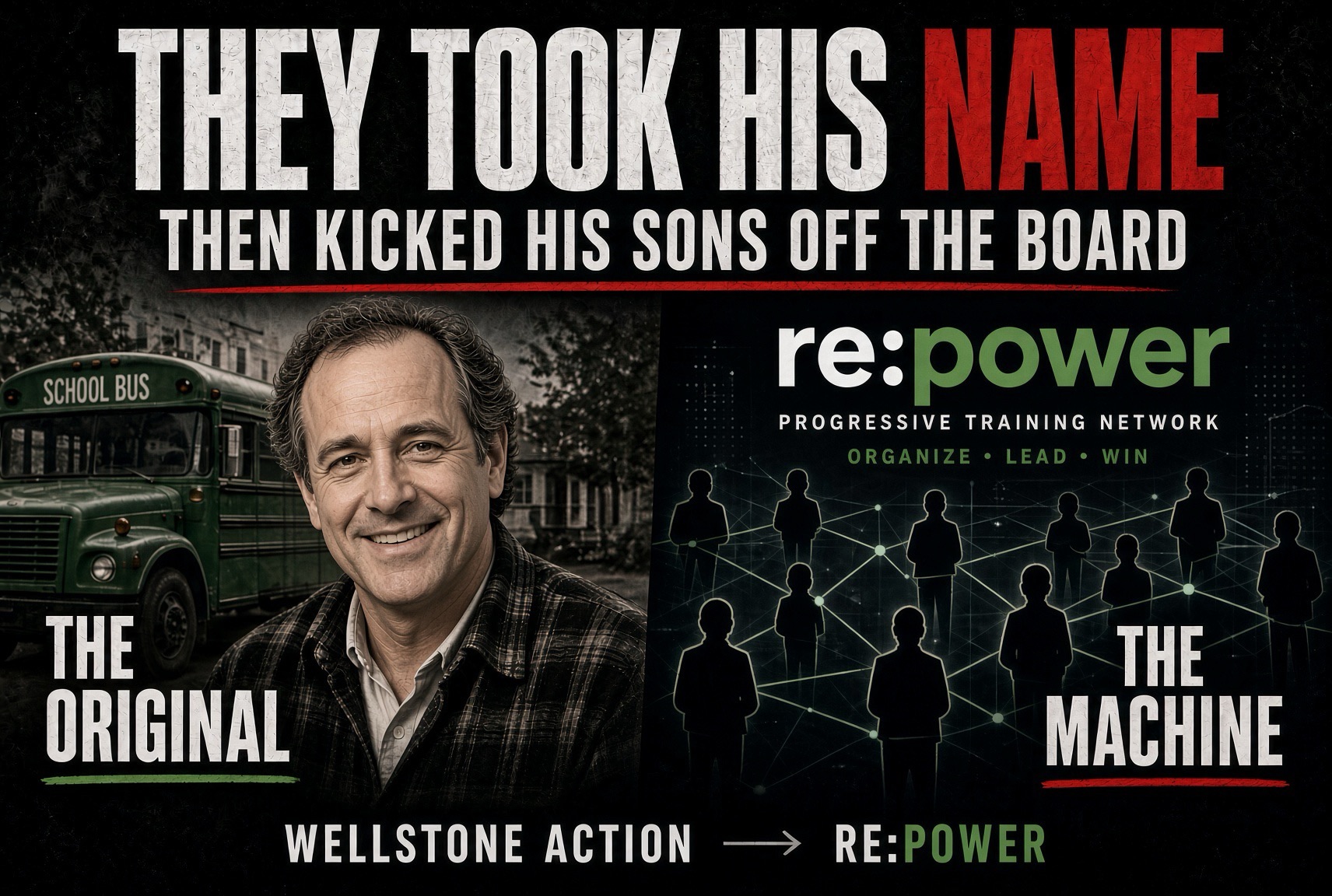
Paul Wellstone died in a plane crash on October 25, 2002, sixteen days before the election. He was the rare progressive who still talked like a populist: short, Jewish, liberal, professor, running around Minnesota on a beat-up green school bus telling people he didn’t represent the oil companies, the drug companies, or the insurance industry. “We all do better when we all do better” was his line. It was simple, and he meant it.
Within months, his former campaign manager Jeff Blodgett and Wellstone’s two surviving sons, David and Mark, created Wellstone Action (and the related Wellstone Action Fund). The stated purpose was to keep training people the Wellstone way—grassroots organizing, candidate training, the “Wellstone triangle” of electoral politics, community organizing, and public policy. Camp Wellstone became the flagship. It worked.
The Pipeline
In January 2005, a high school teacher and football coach from Mankato named Tim Walz showed up at a Camp Wellstone session at the Carpenters hall in St. Paul. He had almost no political experience. Peggy Flanagan was one of the trainers. Walz went on to win Minnesota’s 1st Congressional District in 2006—the first federal-level success for the program. Flanagan herself had worked on Wellstone’s final campaign as a University of Minnesota student, later spent years as a trainer at Wellstone Action, and became Walz’s lieutenant governor. Keith Ellison and Mark Ritchie were also products of the network. Multiple DFL legislative classes had heavy Wellstone Action alumni.

The organization was not a think tank. It was a practical training operation that fed people into campaigns, staff roles, and elected office. By the organization’s own later claims, it trained tens of thousands. In Minnesota it helped build a generation of progressive candidates and operatives who now occupy real power.
The 2018 Rupture
In February 2018 the board voted to remove David and Mark Wellstone. The official explanation was differences over organizational vision. The sons and several other board members, including longtime treasurer Rick Kahn, said the trouble started earlier when they raised questions about roughly $200,000 in overspending and a sharp drop in the cash balance. A forensic audit by Eide Bailly was commissioned; the board said it found no improper payments. The Wellstones and Kahn said they were never given the full report without a confidentiality agreement they disputed. Former board member Louis Frillman resigned citing unanswered financial questions.
The brothers asked that the organization stop using the family name. They wrote major funders, including the Ford Foundation and George Soros’s Open Society Foundations, asking them to pressure the group to drop it. The board refused to rebrand on the timeline the family wanted. After the sons were removed, the organization rebranded as re:power.
The sons described the outcome as a personal betrayal. David Wellstone said the board’s actions proved they would not honor his father’s legacy. The remaining leadership said the brothers’ actions created “untenable tension” over the group’s emphasis on inclusivity and equity and that the brothers wanted more aggressive issue advocacy after 2016 rather than continued candidate training.
What Replaced the Name
re:power’s current mission language is explicit. It exists to build social justice movements and leaders who practice “liberatory organizing,” defined as an organizing practice that is pro-Black and grounded in community, collective action, and abundance. Its stated vision is a liberated multiracial democracy free from the oppressive systems of white supremacy and patriarchy. Programs emphasize women of color and trans and gender-expansive people of color as the priority pipeline. Camp re:power is framed as a space for BIPOC leaders.
This is a clear evolution from the original Wellstone Action pitch of teaching ordinary people how to run campaigns and organize in the style of a prairie populist who built broad coalitions across rural and urban Minnesota. The organization still trains people, but the framing, target participants, and north star have shifted.
What Actually Happened
Wellstone Action did what it was designed to do: it professionalized progressive training and produced a pipeline that fed the modern Minnesota DFL. Walz, Flanagan, and others are direct products. That is not conspiracy; it is the public record of the organization’s own successes and the biographies of the people who went through it.
The 2018 split showed the limits of that claim. When the sons of the man whose name was on the door raised financial questions and disagreed about direction, they were removed. The name was eventually dropped and the organization continued under new branding with an updated ideological vocabulary. The family that founded it wanted no further association.
Paul Wellstone was not a foundation professional or a movement staffer. He was an underdog who beat an incumbent Republican while being massively outspent, talked about farmers and workers, and voted against both the first Gulf War and the Iraq War authorization. The institution that carried his name for fifteen years became a standard progressive training apparatus, then distanced itself from the family when that arrangement became inconvenient. The current organization no longer pretends to be the same thing.
That is the record. The green bus and the bumper stickers that said “What Would Wellstone Do?” were a different project from the one that trained the people now running the state and then rebranded when the sons started asking questions.