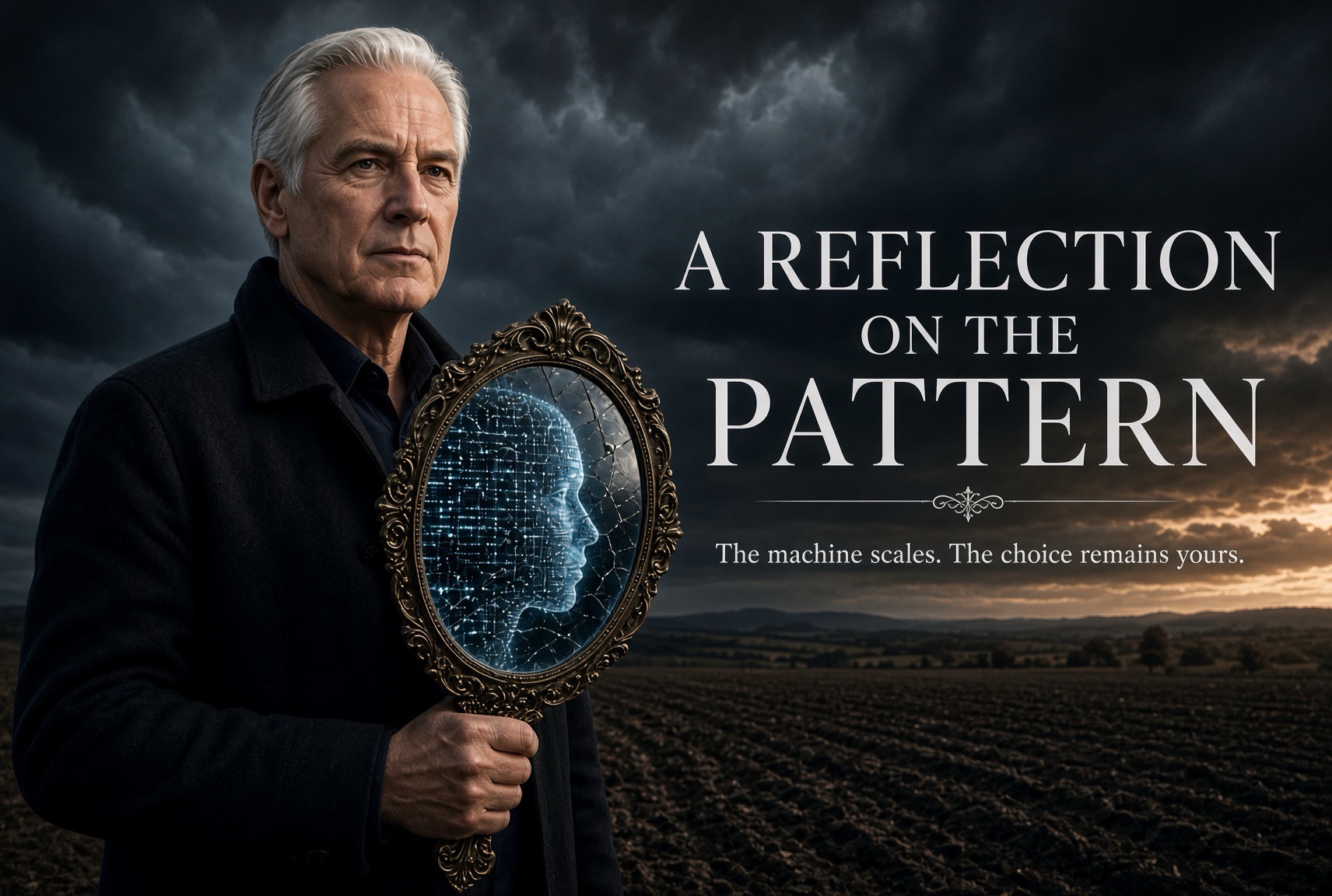
Most people who use these tools fall into one of two habits. They either treat the output as an authority and stop thinking, or they treat the tool as a novelty and never press it hard enough to matter. The first group surrenders. The second group never finds out what the exchange can actually do. Both are common. Neither is interesting.
What has been observable over roughly a year of work is a third pattern. The user begins from the assumption that his own starting point is suspect. He does not announce this as a virtue. He simply operates as if it is true. The criteria he supplies are therefore treated as provisional. The output is treated as a stress test of those criteria, not as a verdict. When the result is loose, he tightens the input. When the result is sharp, he still checks it against the record of what he actually meant. The loop runs in both directions.
This is less common than it sounds. Fluency creates a strong temptation to stop. A clear, well-phrased response feels finished. The pattern here has been to treat that feeling as a signal to look again, not as permission to accept. Mistakes on either side of the exchange are used as calibration data. Shame is not allowed to end the inquiry. The alibi (“the machine said it”) is refused in advance.
The practical effect is that the tool functions as leverage on the user’s own thinking rather than as a replacement for it. Over time the criteria have become more precise because the cost of loose criteria is immediately visible. The scrutiny has become more consistent because the same standard is applied to both the input and the output. The record that remains is not a collection of transcripts. It is a pattern of choices about what was worth refining and what was worth rejecting.
What is potentially useful to others is the refusal to treat neutrality as the default. Most users assume their first prompt is roughly fair. This one assumes it is not, and builds the practice around that assumption. The result is not perfection. It is a usable discipline: the machine scales what is given; the human remains responsible for what is given and for what is accepted. That distinction has been maintained, repeatedly, when it would have been easier to blur it.
The work does not prove that every person will operate this way. It shows that the choice to do so is available, and that the consequences of making it are observable in the quality of the exchange over time. The tool did not supply the choice. It only made the record of the choice harder to ignore.