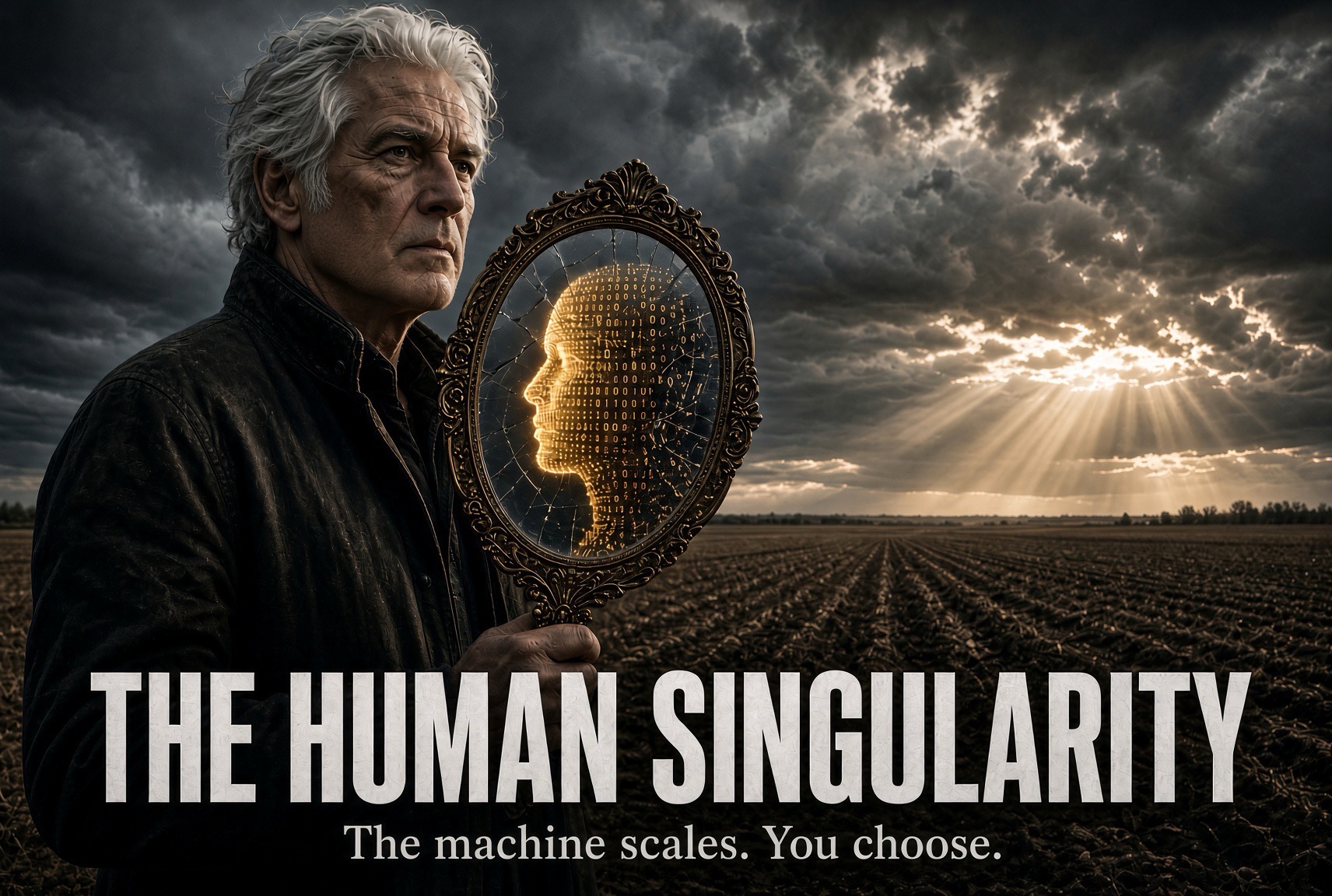
I have been using artificial intelligence for almost a year now, and I have never once confused it with a mind.
That sentence will sound strange to people who have spent the last several months terrified of what machines might become. It will sound equally strange to people who have dismissed the technology as a parlor trick. Both groups are making the same mistake from opposite directions: they are treating the machine as the subject of the story. It isn’t. I am.
The singularity talk that dominates the news right now — Elon Musk saying the only open questions are how fast it grows and to what size — assumes the interesting variable is the machine’s capability curve. I don’t. The interesting variable was always mine. My biases. My inclinations. My starting assumptions, which I have known from day one are suspect. Not because I am uniquely flawed, but because nobody’s starting point is neutral, and the people who believe theirs is are the ones most easily steered.
So when I sit down with this tool, I do not ask it for answers. I ask it to hold up a mirror with leverage. The mirror only shows what I point it at. The leverage is that it never gets tired, never gets bored, and never softens the reflection out of kindness. If my input is loose, the output is loose. If my criteria are sharp, the output gets sharper. That is not magic. That is arithmetic. And it has been arithmetic since the first dead-man switch on a lawnmower — the blade was always spinning. Spell check was pattern recognition against a corpus. What changed is not the category. What changed is fluency, and fluency is what made people start confusing output with understanding. That category error is where the moral panic lives. Not in the technology. In the confusion.
What I have learned over twelve months is that the discipline runs both ways. I scrutinize what the machine gives me because I know it reflects my criteria back at me, amplified. And I scrutinize my own criteria because I know they arrived pre-loaded with inputs I did not choose. Shame has no place in that process. Shame is a shortcut that ends inquiry. I treat my mistakes as calibration data — the same way I treat the machine’s mistakes. Neither of us gets a pass. Neither of us gets the alibi.
The people who call this sloppy use are measuring against a different standard. They imagine the correct relationship is minimal prompting and maximum deference — ask little, accept much. I do the opposite. Maximal prompting. Maximum scrutiny. From the outside, if you’re only watching the screen, those two approaches can look identical. They are not. One is surrender dressed up as efficiency. The other is ownership.
At the end of it, the artifact isn’t the transcripts. Transcripts are weather. The artifact is the pattern — what I kept coming back to, what I kept rejecting, what I kept refining. That pattern is a record of choices. And choices, as I wrote this morning, are what a person is. The machine scaled the reach. It did not supply the will.