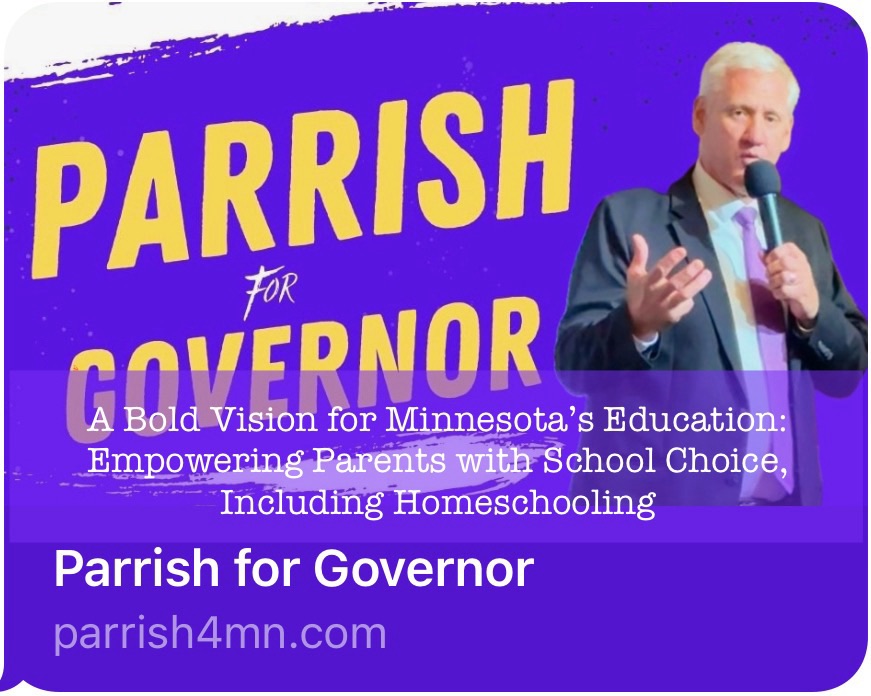
By Phillip C. Parrish, Republican Candidate for Governor of Minnesota 2026
October 27, 2025
Dear Fellow Minnesotans,
As your candidate for Governor in 2026, I’m committed to restoring prosperity, fairness, and opportunity for every family in our state. Our public education system is failing our children, and the Walz administration’s misleading narrative about a budget shortfall has sown fear about bold solutions like school choice. Today, I’m sharing my plan to empower parents with the freedom to choose the best education for their children—whether in public schools, private schools, or homeschooling—while protecting rural communities, supporting special education, and using our state’s stable finances responsibly. My 100-day plan, starting in January 2027, puts trust in parents, not centralized government, to make the best decisions for their kids, with simple accountability to ensure success.
The Crisis in Minnesota’s Public Education
Minnesota’s public education system is in crisis. Despite Governor Tim Walz’s claims of progress, with an 84.2% graduation rate in 2024 (59,720 seniors), only about half of our students meet grade-level standards in math and reading, according to 2024 Minnesota Comprehensive Assessment (MCA) data. Our national education ranking has fallen from #6 to #16 during his tenure. The Walz administration’s $2.2 billion education investment in 2023 has prioritized ideological agendas—like mandatory menstrual products in school restrooms and equity-focused curricula—over core skills like math, reading, and critical thinking, leaving students unprepared for independent living.
This failure is already hurting our communities. Rural schools are losing students as families seek better options. Special education programs are strained by bureaucratic inefficiencies, failing students with disabilities. Taxpayers are funding a system that doesn’t deliver, proving that centralized government authority is incapable of managing education funds effectively. My school choice plan puts trust in parents, using existing mechanisms to support public, private, and homeschooling options without adding red tape.
Debunking the Budget Shortfall Myth
The Walz administration’s narrative of a looming budget crisis is misleading. Minnesota’s fiscal situation is stable, with a projected $456 million surplus for the 2026-27 biennium, as reported by Minnesota Management and Budget, and no broad new tax increases in the 2025 bipartisan budget deal. My school choice plan uses this surplus—not existing public school budgets—to fund a pilot program that lets per-pupil funding ($7,281) follow the child to public, private, or homeschool settings. This ensures no new taxes or cuts to public schools, proving we can expand choice responsibly.
Strengthening Rural Public Schools Through Choice
Rural schools are the heart of our communities, and I know many of you worry that school choice could harm them or lead to consolidation. My plan strengthens rural schools by addressing enrollment declines and financial pressures while giving parents options:
• Protecting Funding: My pilot program uses the $456 million surplus to fund school choice, ensuring rural schools keep their full per-pupil funding for every student who stays. This prevents financial strain and protects rural districts from closure.
• Boosting Enrollment: Families are leaving public schools due to dissatisfaction with ideological curricula like Walz’s Due North Education Plan. My Day 20 executive order replaces it with a project-based learning framework focused on math, reading, science, and critical thinking—skills that prepare students for independent living. Developed with parents and educators, this will make rural schools more appealing, stabilizing enrollment.
• Cutting Bureaucracy: Consolidation often results from regulatory overreach and inefficient spending. My Day 15 executive order imposes a 90-day moratorium on new regulations and reviews burdensome rules, freeing rural schools to focus funds on classrooms, not administrative bloat.
• Investing in Rural Infrastructure: My Day 60 budget proposal boosts funding for rural broadband and roads, enabling schools to offer virtual learning and specialized courses like vocational training. This keeps small schools competitive without forcing mergers.
By trusting parents and strengthening rural schools, we ensure they thrive alongside choice options.
Supporting Special Education with Parental Choice
Every child deserves an education tailored to their needs, especially students with disabilities. The current system’s bureaucratic failures leave special needs students underserved. My plan prioritizes these students while empowering parents:
• Portable Funding: My Day 25 School Choice Task Force will design a framework using existing public school district mechanisms to let per-pupil funding, including IEP or 504 Plan allocations, follow the child to public, private, or homeschool settings. If a parent chooses a private school or homeschooling for a specialized program—like for autism or learning disabilities—their funding follows without added bureaucracy.
• Improving Public Schools: For students in public schools, my project-based learning framework will include flexible, individualized approaches to support special needs students, ensuring rural and urban schools meet diverse learning styles.
• Simple Accountability: We’ll verify student existence and ensure measurable educational outcomes (e.g., literacy, math proficiency, or vocational skills) to prepare students for independent living. Private schools and homeschooling families receiving funds will meet basic state standards, like those under the Individuals with Disabilities Education Act (IDEA), without complex bureaucratic hurdles.
This approach trusts parents to choose the best path for their child while ensuring support and accountability.
Empowering Parents, Including Homeschoolers, with Taxpayer Funds
You may wonder why taxpayer dollars should fund private schools or homeschooling. The current system proves centralized government can’t manage education effectively—proficiency rates are declining, and families are taxed for a system that fails too many. My plan puts trust in parents with simple, effective solutions:
• Trusting Parents: Parents know their children best. My pilot program lets per-pupil funding follow the child to public, private, or homeschool settings, using existing district mechanisms like those for charter schools. For example, a homeschooling family teaching a tailored curriculum or a parent choosing a private school for a child with unique needs can access funds they’re already taxed for, without navigating new bureaucratic systems.
• Fairness for Taxpayers: All Minnesotans pay education taxes, but only public and charter school families benefit. My plan ensures equity, especially for low-income families who can’t afford private or homeschooling costs, by letting their tax dollars follow their child.
• Simple Verification, No Bloat: We’ll use straightforward methods to verify a child exists (e.g., basic enrollment records) and ensure measurable outcomes, like proficiency in core skills or readiness for independent living. This avoids the administrative bloat plaguing the current system, trusting parents to make wise decisions.
• Cost Savings: Studies from the Friedman Foundation show choice programs often cost less per student than public schools due to competition and efficiency. By prioritizing low-income and underserved students, we maximize taxpayer value and reduce long-term costs in areas like welfare.
• Proven Inefficiency of Centralized Control: The Walz administration’s mismanagement—$2.2 billion spent with declining results—shows centralized authority fails. My plan shifts decision-making to parents, with minimal oversight to ensure funds are used for education, not ideology.
A Future Where Parents Lead
The Walz administration’s failing education policies and misleading budget narrative have eroded trust and left our children unprepared. My school choice plan uses Minnesota’s $456 million surplus to empower parents with public, private, and homeschooling options, without raising taxes or cutting public school budgets. By trusting parents, replacing ideological curricula with skills-focused learning, cutting red tape, and ensuring simple accountability, we’ll prepare students for successful, independent lives.
Join me in building a Minnesota where every child thrives. Visit parrish4mn.com to learn more, share your ideas, or get involved. Together, we’ll put parents and students first.
Sincerely,
Phillip C. Parrish
Republican Candidate for Governor of Minnesota 2026
Phillip C. Parrish is a retired Navy intelligence officer, father, farmer, teacher, administrator, and lifelong Minnesotan running for Governor in 2026 to restore integrity and prosperity.
###