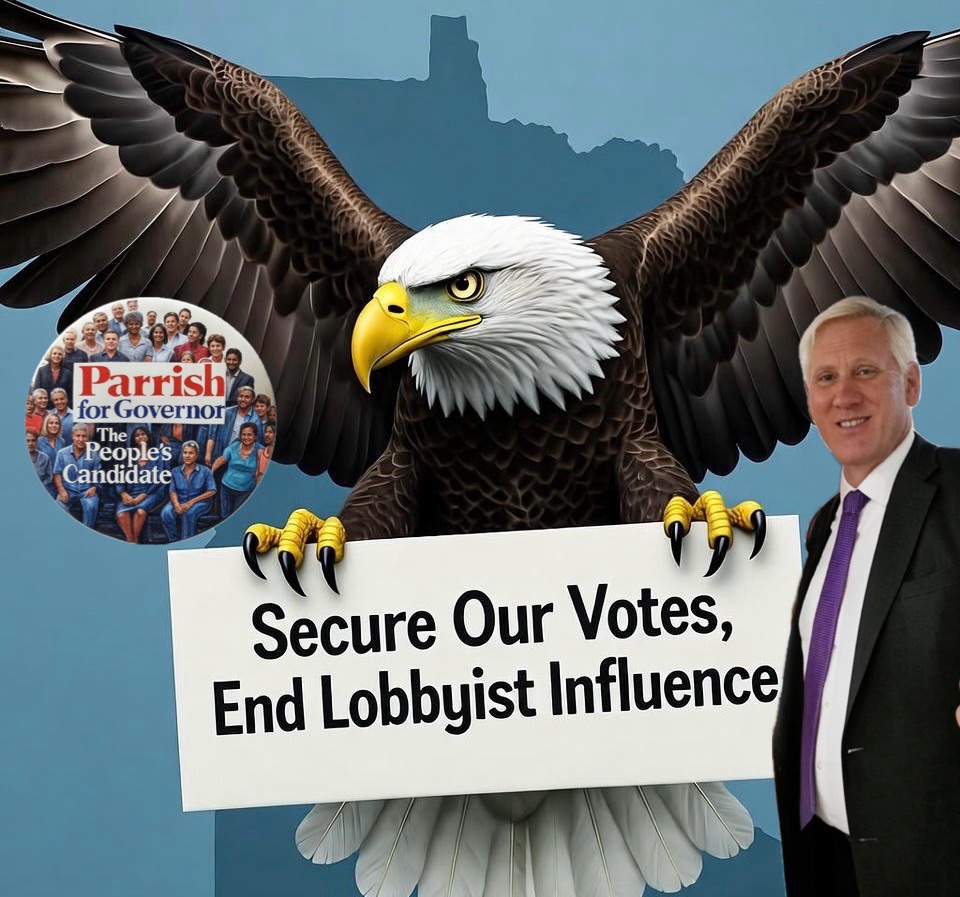
Dear Fellow Minnesotans,
As a retired U.S. Navy Lieutenant Commander with 21 years in counterterrorism and foreign policy, a farmer, educator, and Republican candidate for Governor, I have always fought for integrity and transparency in our institutions. Today, I write to you about a troubling example from the recent public hearing on the Secretary of State’s (SOS) proposed election rules amendments (OAH Docket No. 8-9019-39440; Revisor’s ID R-4824). This incident involving lobbyist Hana Abdelhamid’s testimony is not isolated—it’s a symptom of a deeper systemic issue in Minnesota: unchecked influence that prioritizes special interests over legal compliance, eroding the foundation of our Republic. We must bring this to an end before it further undermines public trust in our elections.
On October 10, 2025, during the Office of Administrative Hearings public hearing, Ms. Abdelhamid—a registered lobbyist and Legislative and Policy Associate at O’Connell Consulting LLC—testified in strong support of the SOS’s proposed changes to Minnesota Rules Chapters 8200-8250. She emphasized “keeping the progress” on voter access, advocating for expanded provisions in voter registration, absentee balloting, and ballot instructions. While access is important, her testimony ignored glaring compliance failures with state and federal law, such as the lack of mandatory voter roll maintenance (e.g., monthly purges for deceased or ineligible voters) and citizenship verification safeguards.
This selective advocacy exemplifies a systemic problem: lobbyists shaping public policy in ways that downplay legal obligations, often at the expense of election integrity. Ms. Abdelhamid’s remarks failed to address the U.S. Department of Justice’s September 25, 2025, lawsuit against SOS Steve Simon for violating the National Voter Registration Act (NVRA, 52 U.S.C. § 20507). Instead, they aligned with broader access goals while sidelining requirements under the Help America Vote Act (HAVA, 52 U.S.C. § 21083) and Minnesota Statutes §§ 201.071 and 201.061. By endorsing these rules as mere “technical clarifications,” she overlooked substantive deficiencies—like the absence of real-time audits or automated cross-checks against SSA death records and USCIS data—which violate NVRA’s mandate for “reasonable efforts” to maintain accurate voter lists. Courts have invalidated similar lax approaches (e.g., U.S. v. Virginia, 2020), yet her testimony risks perpetuating Minnesota’s inflated rolls (3.6 million registered voters vs. 4.2 million voting-age population), post-election “ghost” additions, and non-citizen vulnerabilities.
This bias is compounded by her professional ties. Representing clients focused on health care, human services, and legislative issues (e.g., through O’Connell Consulting’s work with nonprofits like TakeAction Minnesota), her statements appear to prioritize policy agendas over legal realities. She omitted critical discussions of HAVA’s audit requirements or Supreme Court precedents like Crawford v. Marion County Election Board (2008), which uphold strict verification to deter fraud. Such omissions create an unbalanced record, misrepresenting the rules’ alignment with law and undermining the rulemaking process’s purpose under § 14.131.
Worse, as a registered lobbyist under Minnesota’s Campaign Finance and Public Disclosure Board (CFB), her participation may violate key ethical and disclosure rules in Chapter 10A. Lobbying includes influencing administrative actions like this rulemaking (§ 10A.01, subd. 21). If she testified on behalf of a client (e.g., an entity spending over $3,000 annually on lobbying per § 10A.01, subd. 33), she must disclose it to the CFB within 14 days (§ 10A.08, subd. 1)—yet no such disclosure was evident in the hearing record, risking late fees and civil penalties. Advocating for rules known to conflict with NVRA/HAVA could also be seen as misleading (§ 10A.025, subd. 2), a gross misdemeanor punishable by up to $3,000. Chapter 10A prohibits practices that undermine public trust, including contingent fees (§ 10A.06) and inaccurate reporting (§ 10A.04, subd. 4). In the context of the DOJ lawsuit, this warrants CFB investigation (§ 10A.022) and penalties for non-cooperation (§ 10A.025, subd. 5).
Minnesotans, this is not just about one testimony—it’s emblematic of a systemic rot in our state’s election administration. For years, we’ve seen procedural lapses like dormant rulemaking dockets (violating § 14.366), technical failures silencing public input, and rules that favor access over accountability, all while federal lawsuits expose vulnerabilities. Lobbyists wielding undue influence without full transparency perpetuate this cycle, allowing non-compliant policies to persist and disenfranchise honest voters. We’ve witnessed it in padded voter rolls, unverified registrations, and insecure systems—issues that siphon public funds and invite exploitation. This must end. Our North Star State deserves elections that are secure, verifiable, and free from hidden agendas.
I urge the Administrative Law Judge to discount Ms. Abdelhamid’s testimony for bias (§ 14.15, subd. 2), require disclosure verification, and amend the rules to incorporate NVRA/HAVA fixes (e.g., monthly purges, citizenship proofs). But real change requires your voice: Contact your legislators, submit comments via the OAH eComments page by October 30, and demand hearings from the House Elections Committee. Together, we can dismantle this systemic influence and restore true integrity.
Sincerely,
Phillip C. Parrish
Republican Candidate for Governor of Minnesota
Retired LCDR, U.S. Navy
parrish4mn.com | @phillipcparrish on X
###