By Phillip C. Parrish, LCDR, USN (Ret.), Candidate for Governor of Minnesota 2026
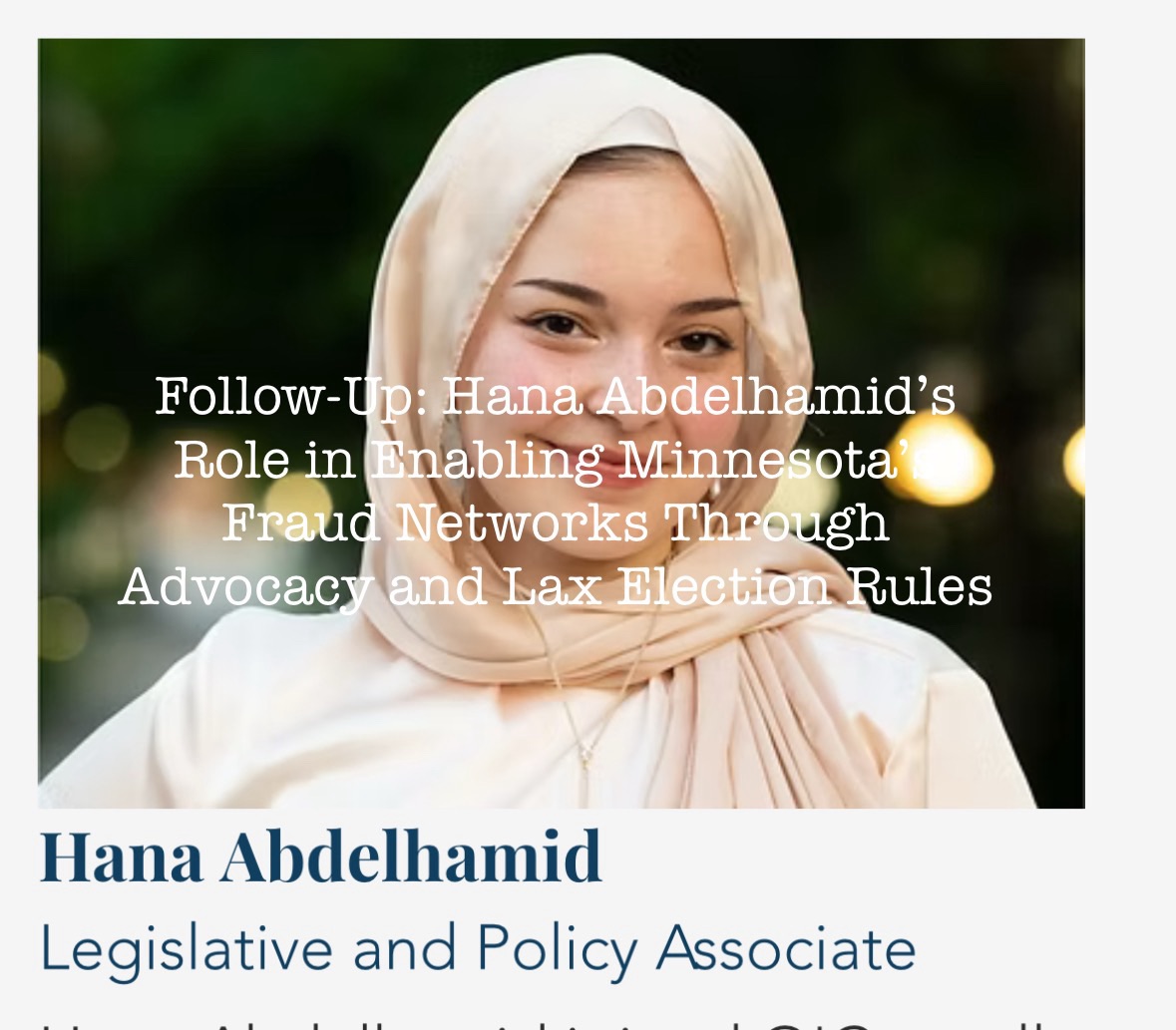
In my ongoing expose of the enablers behind Minnesota’s billion-dollar fraud epidemic, I turn the spotlight to Hana Abdelhamid, a Legislative and Policy Associate at O’Connell Consulting. Abdelhamid’s recent testimony at the October 10, 2025, election rules hearing (OAH Docket No. 8-9019-39440; Revisor ID R-4824) reveals her active role in advocating for maintaining and expanding Secretary of State rules that violate state and federal laws, potentially opening doors to voter fraud. By pushing for these lax regulations under the guise of “access and equity,” she exemplifies how activists use emotional extortion—appealing to benevolence for marginalized communities—to bury suspicions of systemic abuse. Well-meaning Minnesotans, swayed by narratives of inclusion, have long ignored red flags, allowing enablers like Abdelhamid and her network to perpetuate exploitation in welfare, housing, and now potentially elections.
Hana Abdelhamid: Background and Advocacy Ties
Abdelhamid, a Minneapolis resident originally from Cairo, Egypt, holds dual bachelor’s degrees in Economics and Political Science from the University of Minnesota. She joined O’Connell Consulting in January 2023, where she assists organizations in advancing policy goals through lobbying. Previously, as a Government Relations Associate at O’Rourke Strategic Consulting, she lobbied for nonprofits including the Minnesota Association of Small Cities, Better Futures MN, and SciMathMN, focusing on transportation, healthcare, workforce development, education, and environmental justice. Her work was part of the Capitol Pathways program, aimed at centering BIPOC students in government and policy.
As a registered lobbyist, Abdelhamid represents clients tied to broader activist networks. O’Connell Consulting’s client list includes ISAIAH, a faith-based organization previously highlighted for coordinating with groups like Indivisible Twin Cities and the Muslim Coalition to push for expanded grants in education, immigration, and housing—programs rife with fraud vulnerabilities. ISAIAH’s advocacy mirrors tactics used in the Feeding Our Future scandal, where community recruitment from mosques led to fake participants and over $250 million in stolen funds.
Abdelhamid’s associates at O’Connell further embed her in enabling networks. Principal Maureen O’Connell, Senior Consultants Kenza Hadj-Moussa and Sarah Greenfield, and others have deep ties to TakeAction Minnesota, a progressive group advocating for expanded welfare, labor, and voting rights policies. TakeAction Minnesota intersects with Faith in Minnesota, another enabler using “faith community pressure” to promote unchecked programs in childcare and housing—echoing the overbilling and fake claims in Minnesota’s $6 billion deficit-contributing scandals. These groups blend activism with political influence, hiding risks behind benevolent rhetoric.
Better Futures MN, one of Abdelhamid’s former clients, operates in workforce development for vulnerable populations, areas plagued by fraud in related programs like Medicaid and housing stabilization. While no direct charges link Better Futures, its involvement in state-funded initiatives places it within the ecosystem of exploitable systems Abdelhamid helps advance.
Advocacy in the Election Rules Hearing: Enabling Potential Voter Fraud
On October 10, 2025, Abdelhamid testified at the virtual hearing on proposed amendments to Minnesota Rules Chapters 8200-8250, advocating for rules that critics argue undermine election integrity by allowing lax voter registration, absentee balloting, and verification processes. These changes, described as “technical” by the Secretary of State, include handling registrations in the wrong county and ballot safeguards—provisions that could facilitate fraud by reducing oversight, much like COVID-era waivers enabled the Feeding Our Future theft. Abdelhamid’s push to maintain and expand these rules, framed as promoting access for minorities, uses emotional appeals to deflect scrutiny, burying long-held suspicions that such leniency invites abuse.
This advocacy aligns with her network’s pattern: TakeAction Minnesota and Faith in Minnesota have championed voting rights expansions, dismissing fraud concerns as unfounded while ignoring evidence of systemic exploitation elsewhere. By enabling rules that violate laws on secure elections, Abdelhamid contributes to a broader environment where fraud thrives under the cover of “equity.”
The Broader Network: Hiding Complicity Through Benevolence
Abdelhamid’s work with ISAIAH and ties to TakeAction/Faith in Minnesota place her in a web of activists who promote policies without demanding accountability, enabling the jury bribery, shell companies, and kickbacks seen in ongoing scandals. These groups exploit goodwill, guilting Minnesotans into supporting unchecked expansions while burying evidence of wrongdoing. As a BIPOC advocate passionate about “dismantling systems of oppression,” Abdelhamid’s efforts ironically sustain systems that harm the vulnerable through fraud.
Demand Accountability: No More Cover-Ups
Hana Abdelhamid’s testimony and associations reveal how enablers like her, through O’Connell Consulting, ISAIAH, TakeAction Minnesota, and Faith in Minnesota, perpetuate exploitation. Minnesotans must reject this false benevolence and demand rigorous oversight. As governor, I’ll prosecute these networks and restore trust. Join the fight—visit parrish4mn.com for more.