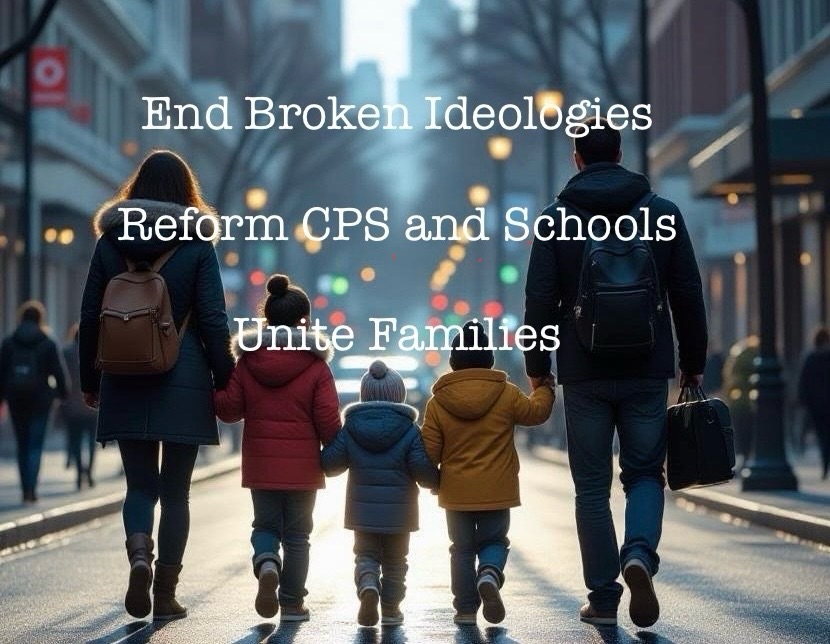
By Phillip C. Parrish, Candidate for Governor of Minnesota 2026
As a lifelong Minnesotan and father who has traveled our great state listening to the voices of everyday families, I am running for governor in 2026 to restore sanity, accountability, and family-first priorities to our government. From the Iron Range to the Twin Cities, I’ve heard heartbreaking stories of systemic failures in our child protective services (CPS), family courts, and public schools. These institutions, meant to protect our children, have instead become battlegrounds for biased ideologies, perverse financial incentives, and unchecked cultural experiments that tear families apart.
The evidence is clear and substantiated: Minnesota’s systems are plagued by institutional biases that disproportionately target minority and working-class families, financial structures that reward family separation over reunification, and the imposition of radical gender ideologies that confuse and harm our youth. Worse, these issues are compounded by the willful ignorance of grooming risks through social media and public schools—threats that erode parental authority and expose children to predators. It’s time to end these intellectually and morally broken practices and rebuild a system rooted in merit, family integrity, and common sense.
The Substantiated Concerns Plaguing Minnesota Families
Our child welfare system, overseen by the Department of Children, Youth, and Families (DCYF) and county agencies, suffers from deep-rooted biases that view certain cultures as “less capable” of raising children. Racial and ethnic disparities are stark: Black children face CPS investigations at rates 2-3 times higher than white peers, with overrepresentation in foster care persisting despite reform efforts. Native American children are 16.8 times more likely to enter out-of-home care, often for poverty-related “neglect” misinterpreted through ethnocentric lenses. A 2024 civil rights complaint by the NAACP and Children’s Rights against Minnesota DHS highlights systemic discrimination, with Black families twice as likely to face removals and lower reunification rates. These biases are exacerbated by Diversity, Equity, and Inclusion (DEI) policies and quota-based hiring practices that prioritize ideological alignment over merit, leading to a workforce disconnected from the human condition and real family needs.
Financial incentives are a core driver of family division. Under federal Title IV-E funding, Minnesota receives reimbursements for foster care and adoptions—up to $33,091 per child annually in some cases—far outpacing support for prevention or reunification services. Adoption bonuses, including extra payments for special-needs children, create a perverse structure where agencies benefit more from permanent separations than keeping families intact. A 2024 NBER study on Minnesota’s foster system shows how equalizing post-exit payments for adoption and kin guardianship improved outcomes, but it also underscores how incentives can prioritize placement over family preservation. This “hidden foster care” system, as noted in advocacy reports, allows informal placements to retain funding while bypassing due process, fueling fraud and unnecessary removals. Public discourse on platforms like X echoes this, with Minnesotans decrying CPS biases and financial incentives that ignore family unity.
Compounding these is the push of gender ideologies in schools and child welfare, which I view as intellectually and morally broken experiments on our children. Minnesota’s 2023 trans sanctuary law (HF 1465) grants courts jurisdiction over out-of-state custody disputes involving gender-affirming care, potentially overriding parental rights and enabling “forum shopping” that divides families. Federal scrutiny in 2025, including HHS demands to remove “gender ideology” from sex education materials and threats to cut Title IX funding, highlights how these policies clash with biological realities and family values. In schools, proposed 2025-26 standards require teaching gender identity to third-graders, prioritizing controversial concepts over science-based sex education. This ignores community backlash and risks confusing children, as seen in executive orders targeting “discriminatory equity ideology.”
Finally, grooming through social media and public schools is a glaring, ignored factor. Minnesota’s Attorney General released a 2025 report on AI and social media’s harms to youth, detailing addictive features that exacerbate mental health issues and exposure to predators. Online crimes against children spiked in 2025, with generative AI reports soaring from 6,835 to 440,419. A TikTok complaint filed by the Attorney General in August 2025 alleges the platform’s design leads to violent reactions when access is restricted, yet schools often incorporate social media without safeguards. NPR reports on “violent online networks” grooming minors, and Minnesota’s new law compensating child content creators addresses exploitation but overlooks broader school-based risks like unchecked LGBTQ+ curricula that bypass parents. Public concerns on X highlight how these are dismissed in favor of ideological agendas.
Proposed Changes: Effective and Efficient Reforms for Minnesota
As governor, I will prioritize reforms that dismantle these broken systems and restore family sovereignty. First, eliminate financial incentives that divide families. I propose auditing and reforming Title IV-E reimbursements to cap foster care funding and redirect resources toward prevention services, aiming for a 50% increase in family support budgets within the first year. End adoption bonuses that incentivize permanent separations, modeling after successful kin guardianship equalizations but with strict oversight to prevent fraud. This will reduce unnecessary removals and save taxpayer dollars, as evidenced by Minnesota’s SFY 2020 spending patterns.
Second, remove gender ideologies from schools and child welfare. Ban the teaching of gender identity concepts in K-12 curricula before high school, replacing them with biology-based sex education. Repeal aspects of the trans sanctuary law that undermine parental rights, ensuring custody decisions prioritize family unity over out-of-state ideological disputes. Enforce merit-based hiring in DHS by ending quota policies under federal scrutiny, focusing on qualified professionals who respect diverse family structures without bias.
Third, address ignored grooming threats head-on. Mandate age-appropriate social media literacy in schools, with parental opt-in for any digital platforms, and require annual reports on online exploitation incidents. Partner with federal agencies to regulate addictive apps like TikTok, building on the Attorney General’s 2025 complaint. In schools, prohibit secretive policies on gender or sexuality discussions without parental notification, ending the “wedge” between kids and families.
These changes are efficient: They leverage existing audits (e.g., Office of the Legislative Auditor) for quick implementation, cut wasteful spending, and refocus on evidence-based protection. By ending intellectually and morally broken ideologies, we’ll protect our children from confusion and harm.
A Call to Minnesota Families
Minnesotans deserve a government that unites families, not divides them for profit or politics. As your next governor, I’ll fight these pervasive issues with bold, substantiated reforms. Join me in 2026 to reclaim our state’s moral compass—because our children’s future depends on it. Visit my campaign site to learn more and get involved. Together, we can end this era of broken ideologies and build a stronger Minnesota.
###