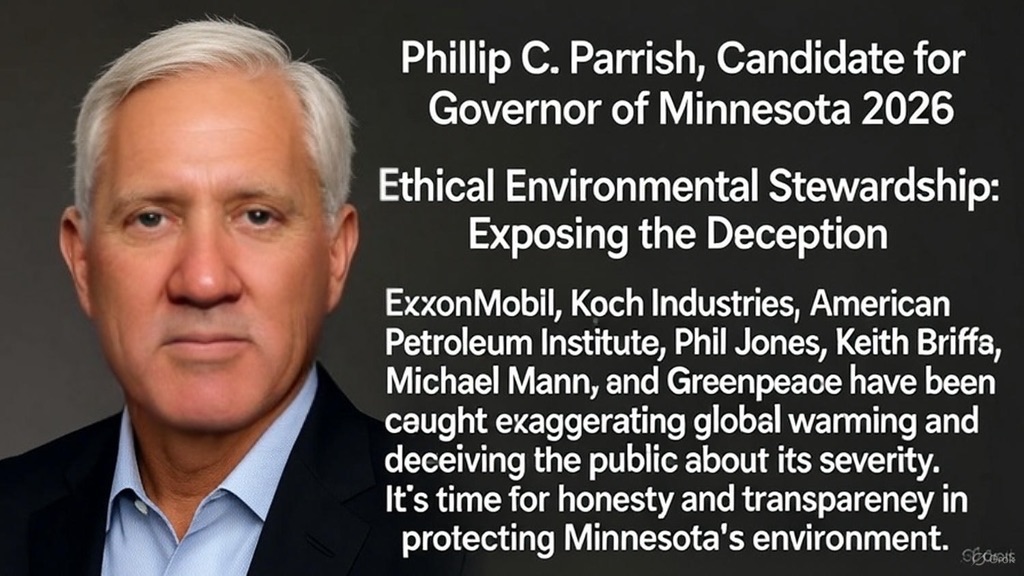
By Phillip C. Parrish, Candidate for Governor of Minnesota in 2026
Fellow Minnesotans, we live in a state blessed with unparalleled natural beauty—from the crystal-clear waters of our 10,000 lakes to the fertile soils of our farmlands and the vast forests that define our northern horizons. It’s no secret that the vast majority of us hold a deep commitment to strong and ethical stewardship of this environment. Recent polls underscore this shared value: a 2025 University of Minnesota survey revealed that 93% of Minnesotans are concerned about pollution in our waters, reflecting a broad consensus on protecting our resources for health, recreation, and future generations. Another survey from the Minnesota Pollution Control Agency shows over 80% prioritizing clean air, water, and soil, and voters overwhelmingly renewed lottery funding for environmental projects in 2024, extending it for another 25 years. This isn’t about politics; it’s about preserving the land we love for our families and children. No one disputes the need for clean air to breathe, safe water to drink, and healthy ecosystems to sustain our communities.
Yet, this unity is too often exploited by those on all sides who employ intellectually and morally broken tactics for personal or financial gain. As your candidate for governor, I stand for open dialogue and the courage to confront exploiters—whether they’re corporate giants, activist groups, or scientists with agendas. I believe in calling out deception fairly, naming names where evidence demands it, and encouraging every Minnesotan to discern the truth for themselves. Let’s examine the patterns, expose the fear-for-profit playbook, and chart a path forward with honesty and transparency.
The Industry Side: Deception for Corporate Gain
On one hand, powerful industries have a documented history of manipulating data and spreading misinformation to protect profits, often at the expense of real environmental progress. In Minnesota, we’ve seen this firsthand through legal actions against fossil fuel behemoths.
Take ExxonMobil, Koch Industries, and the American Petroleum Institute (API). In 2020, Minnesota Attorney General Keith Ellison filed a landmark lawsuit against them, alleging they violated state consumer protection laws by deceiving the public about climate science for decades. The complaint details how these entities funded misleading campaigns, cherry-picked data to downplay the role of fossil fuels in global warming, and withheld internal research showing the risks—all to safeguard their business models. ExxonMobil, for instance, has been accused of knowing about climate impacts since the 1970s but publicly denying them, leading to billions in profits while communities like ours face increased flooding and agricultural disruptions. Koch Industries, with its deep ties to oil refining, has similarly poured millions into disinformation efforts, influencing policy to delay transitions to cleaner energy. These tactics aren’t just unethical; they’re intellectually bankrupt, prioritizing short-term gains over the long-term health of Minnesota’s environment.
The Activist and Scientist Side: Exaggeration for Funding and Influence
To be fair and balanced, deception isn’t limited to industry. Some climate activists and scientists have faced credible accusations of exaggerating threats, cherry-picking data, or even manipulating evidence to heighten alarm, secure grants, or drive policy agendas. While many in this space act in good faith, the controversies highlight how fear can be weaponized for profit or power on this side too.
A notorious example is the 2009 “Climategate” scandal involving scientists at the University of East Anglia’s Climatic Research Unit, including Phil Jones and Keith Briffa. Hacked emails suggested efforts to “hide the decline” in certain temperature data that didn’t fit warming narratives, suppress dissenting research, and manipulate graphs. Although multiple investigations cleared them of outright fraud, critics argued the episode revealed a lack of transparency and selective data use that fueled propaganda and eroded trust. Similarly, climate scientist Michael Mann, creator of the famous “hockey stick” graph showing rapid recent warming, has been accused by skeptics like blogger Mark Steyn of data manipulation to exaggerate trends. While Mann won a 2024 defamation lawsuit against his critics and was cleared in earlier probes, the controversy underscores how selective methodologies can amplify fears.
More recently, NOAA whistleblower Dr. John Bates in 2017 accused colleagues of rushing a 2015 study that eliminated a perceived “pause” in global warming by adjusting data without proper protocols, potentially to influence the Paris Agreement. Activist groups aren’t immune either; organizations like Greenpeace have been criticized for campaigns that cherry-pick extreme weather events to claim imminent catastrophe, ignoring natural variability and longer-term data for fundraising purposes. These tactics, while often well-intentioned, can be morally flawed when they prioritize alarm over accuracy.
Exposing the Fear-for-Profit Playbook: Global Warming Exaggerated, Not Apocalyptic
At the heart of these deceptions is the fear-for-profit playbook: hype threats to extract money, whether through corporate subsidies, activist donations, or research grants. Global warming is a real challenge—we’re seeing shifts in weather patterns that affect Minnesota’s agriculture and winters—but it’s been exaggerated to the point of hysteria. The world is not ending today, nor anytime soon. As experts like Bjorn Lomborg argue, climate change is a problem to address rationally, not through panic-driven policies that enrich the few. Doomsday predictions, from vanishing ice caps by 2013 to mass famines, have repeatedly fallen apart; in fact, global calorie production is projected to rise even with warming. Studies show exaggeration often stems from desires for media attention or funding, turning solvable issues into “existential threats” that aren’t. Meanwhile, the richest 10% drive two-thirds of emissions, profiting while preaching doom.
This fear mongering diverts us from practical solutions, like innovative farming and community-led cleanups, and exploits the innocent—farmers facing regulations based on skewed data, families burdened by higher energy costs.
A Call for Courage, Dialogue, and Discernment
As a retired U.S. Navy Lieutenant Commander and counterterrorism expert, I’ve learned that true leadership means confronting threats head-on with facts, not fiction. My ethic is one of open dialogue: inviting industries like ExxonMobil and activists like those in Greenpeace to the table for honest reckoning. I have the courage to name exploiters on all sides and protect the vulnerable. But ultimately, Minnesotans, the power lies with you—start discerning the truth for yourselves. Question the data, follow the money, and demand transparency.
Together, with honesty as our guide, we can conquer these challenges. Let’s pivot to ethical stewardship: fund real protections, support regenerative practices, and build a resilient Minnesota without the chains of fear or profit-driven lies. Join me in this movement at parrish4mn.com. The choice is ours—truth over tactics, people over agendas.
Phillip C. Parrish is committed to servant leadership and ending fraud in all forms. Learn more at parrish4mn.com.
###