By Phillip C. Parrish, Candidate for Governor of Minnesota
Retired LCDR, USN – 21 Years in Navy Intelligence, Counterterrorism, and Foreign Policy Expert
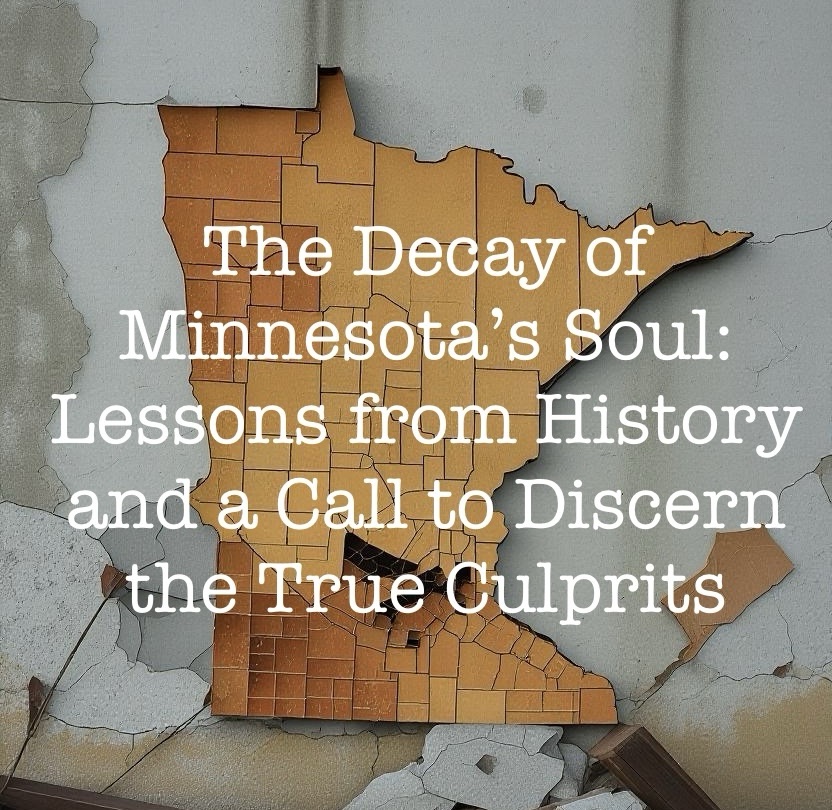
As a lifelong Minnesotan, a veteran who served our nation in the shadows of intelligence and counterterrorism, and now a candidate for governor, I’ve witnessed patterns of human behavior that repeat across centuries and continents. These aren’t abstract theories; they’re the hard truths I’ve seen in global hotspots and, increasingly, right here at home. Minnesota, once a beacon of Midwestern integrity, innovation, and community, is facing a profound decay in its intellectual and moral fabric. This isn’t about pointing fingers at any race, creed, or color—far from it. The real villains are the ill-intended opportunists: narcissists, pathological criminals, and white-collar exploiters who prey on the innocent and unaware, using crises to amass power and wealth while deflecting blame to maintain their grip. Drawing from historical parallels, I’ll outline this decay, expose the patterns, and urge Minnesotans to reclaim our state through discernment and action.
Historical Parallels: When Societies Decay and Opportunists Rise
History teaches us that societal decay often begins with economic strain and moral erosion, exploited by those who see opportunity in chaos. In Weimar Germany (1918-1933), hyperinflation wiped out savings, unemployment soared to 30%, and cultural shifts in urban centers like Berlin were labeled “decadence” akin to Sodom and Gomorrah. Opportunists in finance and politics profited from speculation and loans, while the intellectual elite fragmented amid rising extremism. When policies failed, leaders scapegoated minorities—Jews, immigrants, and dissidents—to distract from their own corruption, paving the way for authoritarianism. This pattern of exploitation and projection led to catastrophe, as the morally broken projected their misery onto the vulnerable.
Similarly, in the late Roman Republic (around 100 BCE), figures like Julius Caesar exploited civil unrest and provincial rebellions to seize wealth through war spoils and patronage. Economic inequality deepened, moral standards eroded with lavish excesses among the elite, and when decay set in—famines, corruption, and institutional collapse—scapegoats like foreign tribes or political rivals were blamed. The Black Death in medieval Europe (1347-1351) offers another stark example: Nobles and clergy used the plague’s chaos to seize lands and impose taxes, blaming “moral sins” or minorities while hoarding resources, sparking revolts and further division.
These aren’t distant tales; they’re blueprints for what happens when ill-intended individuals—regardless of background—exploit systems for personal gain. In Minnesota today, we see echoes: Economic uncertainty, fraud scandals, and social fractures being leveraged by opportunists who know no loyalty but to their own ambition.
Minnesota’s Current Decay: The Intellectual and Moral Erosion
Our state, once renowned for its strong economy, excellent education, and low crime, is slipping. Slow economic growth has threatened our prosperity, with businesses reporting rising costs, cooling demand, and uncertainty from new regulations. An aging population and rural depopulation exacerbate this, as young talent leaves for opportunities elsewhere, leaving behind stagnant communities. Persistently high health care costs burden families, while the job market weakens and businesses close.
Intellectually, our education system is in crisis: Most students are failing in math and reading, a decline that undermines our future workforce and critical thinking. Morally, the fabric frays through unchecked exploitation. Crime rates show mixed trends—violent crime has declined in some areas like Minneapolis in 2025, following national patterns—but perceptions of safety remain low amid high-profile incidents and ongoing youth involvement. Serious crimes may be up in broader metrics, fueling fear and division.
The most insidious decay comes from corruption: The Feeding Our Future fraud scheme, one of the largest in U.S. history, has seen 75 defendants charged, with potential losses exceeding $1 billion in taxpayer funds meant for child nutrition during the pandemic. This isn’t isolated—juror bribery attempts in related trials, political connections funneling money to insiders, and a “culture of corruption” in Minneapolis highlight systemic rot. Public discourse on platforms like X echoes this frustration, with Minnesotans decrying fraud, graft, and unaccountable leadership. These scandals divert resources from the needy, erode trust in institutions, and foster a moral vacuum where exploitation thrives.
The True Persons to Blame: Exploiters of the Innocent, Spotlight on Oversight Failures
The blame doesn’t lie with any ethnic group, political party in totality, or the average Minnesotan struggling to get by. It rests squarely on the ill-intended opportunists—narcissists and pathological criminals—who knowingly exploit vulnerabilities. A prime example is the Feeding Our Future scandal under Governor Tim Walz’s administration, where lax oversight by the Minnesota Department of Education (MDE) and Department of Human Services (DHS) allowed $250 million in federal funds—intended to feed hungry children during COVID—to be siphoned off in one of the nation’s largest fraud schemes. Despite warnings as early as 2018 about irregularities, and media reports in 2020 flagging suspicious claims, state agencies continued payments without halting the program or conducting thorough audits until after public exposure in 2022. Congressional investigations in 2025 have grilled Walz’s team on their responsibility, revealing a pattern of delayed action that enabled fraudsters—often with ties to political insiders—to thrive, while vulnerable communities meant to benefit were left underserved and stigmatized. This isn’t mere negligence; it’s a moral failing where leaders prioritized optics and connections over protecting the innocent, projecting blame onto “bad actors” or media while evading systemic reforms.
These exploiters know no race or creed; they’re simply predators who prioritize power and wealth over the public good. In Minnesota, they’ve turned programs meant to feed children into personal piggy banks, leaving taxpayers footing the bill and communities divided. Recent echoes, like the $14 million autism fraud scheme and housing stabilization services misuse, further illustrate this under Walz’s watch, with over $500 million in total fraud losses tied to state oversight gaps.
Encouraging Discernment: Recognizing Patterns to Expose the Ill-Intended
To break this cycle, Minnesotans must cultivate discernment—the ability to distinguish right from wrong through pattern recognition. Look for these red flags of narcissistic, pathological behavior:
• Exploitation of Crises: They position themselves as saviors during downturns, promising solutions that funnel resources to their networks. In history, Caesar did this with wars; today, it’s fraud amid pandemics, as seen in unchecked COVID aid under state leadership.
• Deflection and Scapegoating: When policies fail, they blame others—minorities, opponents, or abstract “enemies”—to avoid accountability. Weimar’s “stab-in-the-back” myth is a classic; modern equivalents include downplaying oversight lapses while attacking whistleblowers or investigators.
• Lack of Empathy and Transparency: Pathological opportunists show no remorse for harming the innocent, hiding behind bureaucracy or stonewalling probes. Recognize when leaders prioritize self-preservation over justice, as in delayed fraud responses despite clear red flags.
• Repetition of Lies and Manipulation: They weave narratives that exploit the unaware, repeating falsehoods until they seem true. Discern by demanding evidence and cross-checking facts.
By spotting these patterns, we expose the true criminals. Right is serving the public with integrity; wrong is exploiting it for gain. As your governor, I’ll prioritize audits, transparency, and cross-party reforms to root out these predators.
A Call to Action: Reclaim Minnesota’s Moral Compass
Minnesota’s decay isn’t inevitable—it’s the result of unchecked opportunism. Drawing from history’s warnings, let’s reject division and demand better. Vote for leaders who fight exploitation, not enable it. Together, with discernment, we can restore our state’s intellectual vigor and moral strength. The ill-intended thrive in shadows; let’s flood them with light.
For more on my vision, visit parrish4mn.com. Let’s build a Minnesota where the innocent are protected, not preyed upon.
###