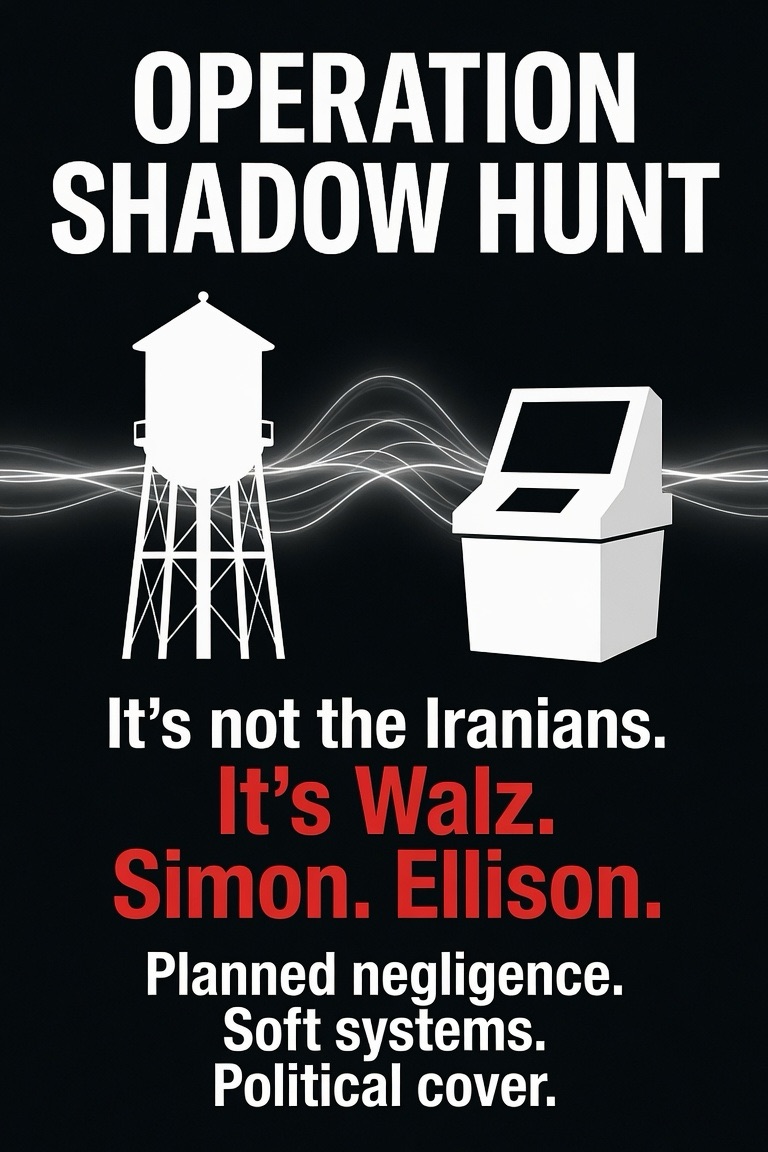
OPERATION SHADOW HUNT
Intelligence Update
31 July 2026
TO: Municipal, County, State, and National Officials; Law Enforcement Partners; Critical Infrastructure Operators; Election Administrators; and Concerned Citizens
FROM: Phillip C. Parrish – Operation Shadow Hunt
SUBJECT: Intentional Neglect of Known Vulnerabilities – Political Exploitation as Strategic Misdirection
CLASSIFICATION: UNCLASSIFIED // FOR PUBLIC DISTRIBUTION
Core Assessment
The identity of the actors who disrupted operational technology at more than 30 Minnesota community water systems is secondary.
The primary fact is this: Minnesota state leadership under Governor Tim Walz and the DFL apparatus have known for years that municipal water systems, industrial controls, and election-adjacent equipment carry residual remote-access exposure through cellular, wireless, and modem pathways. They have not treated these exposures with the seriousness the risk demands.
That failure is not mere bureaucratic lag. From the pattern of behavior, it functions as intentional incompetence and planned negligence. Soft systems create plausible deniability. When disruption occurs, officials can point outward—foreign adversaries, federal cuts, “modern warfare”—while avoiding accountability for the soft targets they left reachable. The political exploitation of the incident then becomes its own form of misdirection: a domestic false flag of narrative rather than code.
The Record of Negligence
Public accuracy testing of election equipment in late July documented live wireless environments and modem-process functionality on machines that officials routinely describe as isolated. Multiple county SSIDs, Pollpad networks, and signal indicators were observable in testing rooms. Formal requests for serial numbers, firmware versions, and connectivity configurations have been met with resistance or delay.
The same class of remote-access surface—cellular and wireless links into operational technology—was exploited days later against community water systems. Federal advisories had already warned of Iranian-affiliated actors targeting exactly these PLC and OT pathways. Minnesota officials received those warnings. The systems remained soft.
Mid-level IT staff and administrators continue to treat the risk as overstated. Vendor assurances and minimum statutory checklists substitute for adversarial hardening. Outsourcing of IT and security functions has expanded third-party remote pathways with limited continuous oversight. These are not unknown problems. They have been observable, documentable, and repeatedly raised. The decision not to close them is a choice.
Political Exploitation as Misdirection
Governor Walz’s public response has followed a predictable sequence:
• Accept the foreign-actor framing.
• Emphasize that other states were also hit.
• Blame federal policy (DOGE, CISA resourcing).
• Position Minnesota’s detection and containment as evidence of competence.
This framing serves a clear purpose. It converts a state-level residual vulnerability into a national security talking point that attacks political opponents while shielding the administration from questions about why Minnesota systems remained reachable. Plausible deniability is preserved: “We were victims of sophisticated foreign actors and federal under-resourcing.” The softer truth—that known cellular and wireless exposures in municipal OT were left unaddressed—is buried under the larger narrative.
When leadership uses a security incident primarily to score political points and deflect accountability for unremediated vulnerabilities, the narrative itself becomes a form of strategic misdirection. The public is invited to focus on the external actor while the internal conditions that made the disruption possible remain intact. That is the operational reality of planned negligence.
Implications Ahead of the 11 August Primary
The same institutional posture that left water systems exposed continues to shape election infrastructure practices. Limited sampling during public accuracy tests, visible connectivity features during official testing, and resistance to configuration transparency create parallel residual risk. The primary will again activate equipment, networks, and temporary configurations across the state under the same leadership culture that has treated these exposures as secondary concerns.
Soft systems + political incentive to externalize blame = sustained vulnerability. That equation does not require a single master plot. It only requires continued refusal to treat known remote-access surfaces as urgent.
Call to Action
To participants in Operation Shadow Hunt:
Continue documenting. Expand formal Data Practices Act requests for serial numbers, firmware, modem status, wireless configurations, and third-party remote-access inventories. Record what is shown—and what is refused—during accuracy testing and operational reviews. The pattern of neglect is itself evidence.
To mid-level IT professionals and municipal operators:
The systems under your care remain part of the attack surface because higher authority has chosen not to force the issue. Lock onto the facts. Expand testing. Disable unnecessary connectivity where feasible. Demand configuration transparency. Public residual risk is no longer deniable.
To state and local officials:
Stop treating known cellular, wireless, and modem exposures as theoretical. The July sequence demonstrated reachability. Political framing that converts every incident into an external attack and federal failure does not harden a single PLC or tabulator. Close the doors or own the consequences of leaving them open.
To the public:
The question is no longer only “who pressed the button.” The more durable question is why the buttons remained reachable under leadership that has had years of warnings, public observations, and federal advisories. Intentional neglect that preserves plausible deniability while enabling political exploitation is still neglect—and it still leaves critical systems exposed.
Operation Shadow Hunt continues.
Document. Pressure. Close the residual pathways.
Phillip C. Parrish
Independent Collection – Operation Shadow Hunt
Public Release
End of Update.
###