INTELLIGENCE BRIEFING
To: State and Federal Election Officials, County Auditors, Attorneys General, Congressional Oversight Committees, Department of Justice, Department of Homeland Security, and relevant Inspectors General
From: Independent Analysis – Minnesota Primary Absentee Monitoring
Date: August 8, 2026
Subject: Elevated Risk Indicators in Minnesota August 11, 2026 State Primary – Outstanding Absentee Applications, List Maintenance Gaps, Geographic Concentrations, and Selective Ballot Patterns
Classification: For Official Use – Time-Sensitive Oversight
1. Executive Summary
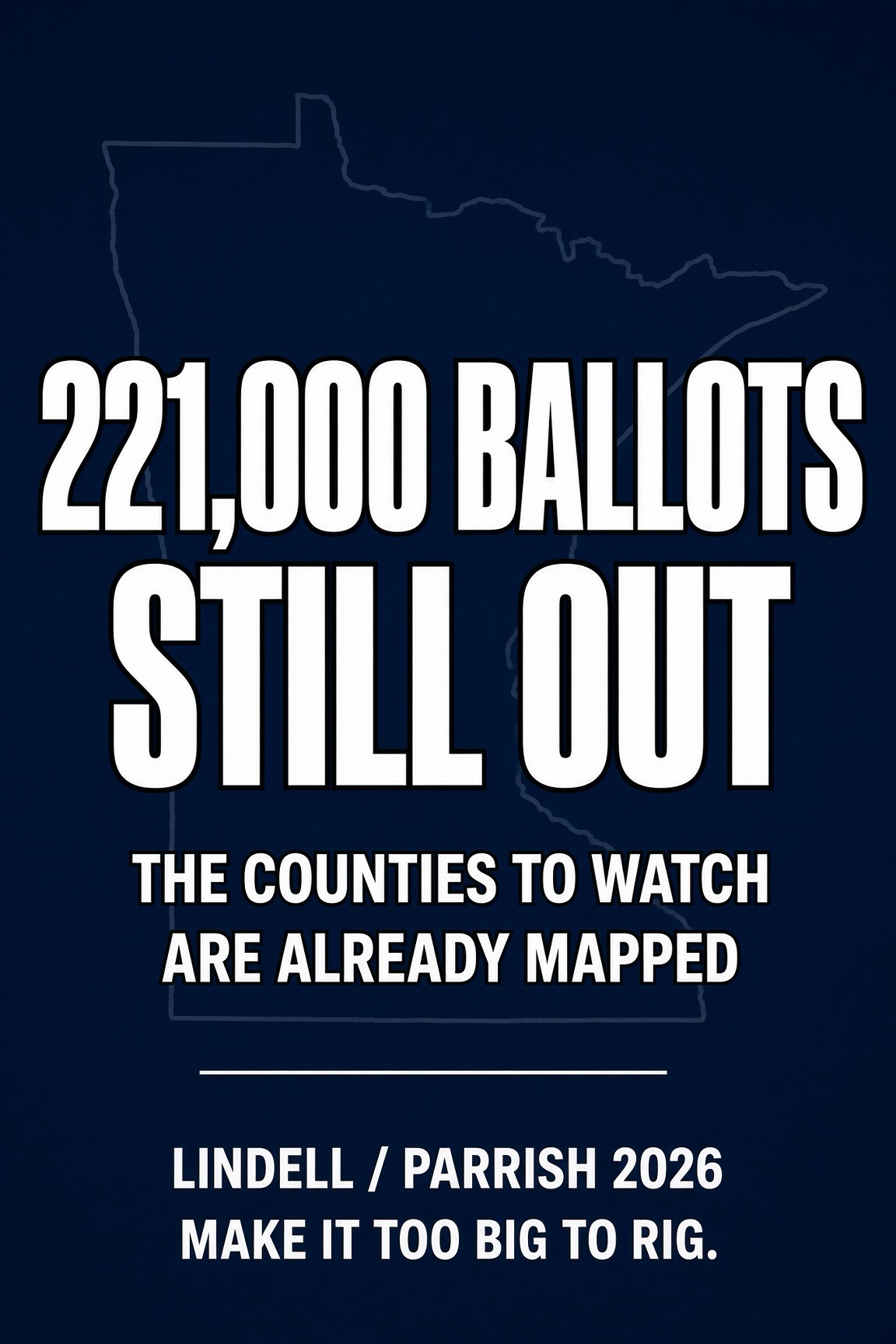
As of August 7, 2026, Minnesota has 394,958 absentee applications and 173,968 accepted ballots for the August 11 primary, leaving approximately 221,000 applications outstanding.
These outstanding applications are heavily concentrated in Hennepin, Ramsey, Dakota, Anoka, and Washington counties — the same jurisdictions that record the highest volumes of refugee resettlement, the largest estimated unauthorized immigrant populations, the most intensive recent ICE enforcement activity (Operation Metro Surge), and the strongest local policies limiting cooperation with federal immigration authorities.
Structural vulnerabilities already documented in prior voter-roll reviews, House oversight materials, and independent analyses create conditions under which late-cycle anomalies, if they occur, are most likely to appear in these counties. Real-time list maintenance remains limited. Automatic generation of ballots via the permanent absentee list continues for any active record. Citizenship is not systematically verified at most points of registration.
A further indicator requiring attention is the historical appearance of ballots that vote only (or primarily) in statewide contests while leaving federal races blank. This pattern interacts with the legal distinction between federal and state voting prohibitions.
This briefing identifies specific indicators to monitor, detection methods available under current law, and legal pathways for immediate corrective action. Failure to exercise existing authorities will leave the process exposed and will be a matter of public record.
2. Key Indicators Already Observed
• Outstanding applications exceed recent non-COVID primary totals at the same point in the calendar.
• Hennepin County alone accounts for ~14% of statewide outstanding volume (31,151). Ramsey, Dakota, and adjacent metro counties hold the next largest shares.
• Permanent absentee list ballots are included in the “applications” total and are mailed automatically.
• Vouching has been used for tens of thousands of Election Day registrations/updates in recent cycles (18,898 in 2024 alone), with no public county-level or method-level tracking maintained by the Secretary of State.
• Minnesota does not require documentary proof of citizenship for the majority of registration pathways.
• Local sanctuary-style ordinances in Minneapolis and St. Paul, combined with limited ICE detainer compliance in Hennepin and Ramsey, reduce the flow of immigration-status information into state systems.
• USPS handling of election mail remains a known variable; Executive Branch directives on postal accountability are directly relevant to chain-of-custody and late returns.
3. Federal vs. State Legal Distinction and Selective Ballot Patterns
• Federal elections (U.S. Senate, U.S. House, President): It is a federal crime for a non-citizen to vote (18 U.S.C. § 611).
• State and local elections: Federal law does not directly criminalize non-citizen voting in pure state races. Minnesota law, however, requires U.S. citizenship for any election (Minn. Stat. § 201.014). Voting while ineligible remains a state crime.
Practical consequence: A ballot that contains votes only for statewide offices and leaves federal races blank may reduce exposure to the clearer federal criminal statute while still violating Minnesota law.
Minnesota has previously recorded measurable numbers of ballots that vote in statewide contests yet contain undervotes or blanks in concurrent federal races. When such patterns cluster in the same high-outstanding, high-resettlement counties, they constitute a legitimate indicator for heightened eligibility review during the canvass.
4. What to Watch For (August 8–12 Window)
Monitor the following in real time, with particular scrutiny on Hennepin, Ramsey, Dakota, Anoka, Washington, Stearns, and Olmsted:
1. Late spikes in accepted ballots that deviate sharply from daily trends established through August 7.
2. Undeliverable / returned-as-undeliverable rates that rise disproportionately in the high-outstanding counties.
3. Rejection rates outside the historical 3–6% band, or sudden acceptance of previously challenged/rejected envelopes.
4. Same-day or near-Election-Day registrations followed by rapid absentee casting in the same precincts.
5. Ballot curing or witness-signature patterns that cluster abnormally.
6. Discrepancies between county-reported figures and the statewide Secretary of State dashboard.
7. USPS scanning / tracking anomalies — delayed scans, bulk drops, or unusual processing times for election mail originating from or destined to the listed counties.
8. Selective voting patterns: Concentrations of ballots that vote for statewide offices while systematically undervoting or leaving blank the U.S. Senate or other federal contests, especially in the high-outstanding counties.
Any of the above appearing after close of business on Monday, August 10, or on Election Day itself, warrants immediate escalation.
5. Detection Methods Available Now
• Daily download and comparison of the Secretary of State Absentee Data file against the August 7 baseline.
• County-level requests for permanent-absentee-list versus one-time-request breakdowns.
• Cross-check of accepted ballots against the Statewide Voter Registration System for challenged, inactive, or recently reactivated records.
• USPS Informed Visibility / election-mail tracking reports (where accessible to election officials).
• Post-election canvass comparison of provisional, cured, and late-arriving absentee envelopes by precinct.
• Analysis of undervote rates by contest and precinct, with specific attention to federal versus statewide races.
• Existing statutory authority for county auditors and the Secretary of State to challenge or investigate returned ballots that fail signature, witness, or eligibility checks.
6. Legal Pathways to Act
Current Minnesota and federal authorities already provide tools:
• Minnesota Statutes Chapters 201 and 203B: County auditors and the Secretary of State have ongoing duties to maintain accurate registration records, process challenges, and reject non-compliant absentee ballots.
• National Voter Registration Act (NVRA) § 8: Requires reasonable efforts to remove ineligible voters; failure to maintain accurate lists is enforceable.
• Help America Vote Act and related federal election provisions: Support oversight of absentee processes and chain of custody.
• 18 U.S.C. § 611: Federal prohibition on non-citizen voting in federal elections.
• Minnesota Stat. § 201.014: Citizenship requirement for all elections in the state.
• Federal immigration and citizenship statutes: Knowing registration or voting by non-citizens remains prosecutable.
• USPS accountability directives: Executive Branch authority over postal operations can be used to demand transparent tracking, prioritization, and audit of election mail.
• Congressional and state legislative oversight: Subpoena power, inspector-general referrals, and public hearings remain available.
• Civil and criminal referral: Documented irregularities can be referred to county attorneys, the Minnesota Attorney General, U.S. Attorney’s Offices, and the Department of Justice.
These pathways do not require new legislation. They require the will to use existing law.
7. Required Oversight Actions
1. Immediate public release of county-level permanent-list versus one-time application splits and daily acceptance/rejection tallies through August 12.
2. Independent verification of undeliverable ballot rates and list-maintenance actions in the top outstanding counties before certification.
3. Full chain-of-custody documentation for all late-arriving and cured absentee envelopes.
4. Canvass-level review of undervote patterns between federal and statewide contests in the high-volume counties.
5. Coordination between election officials and federal immigration authorities where records indicate potential non-citizen status (consistent with existing information-sharing authorities).
6. Preservation of all electronic and paper records for potential post-election audit or litigation.
8. Consequences of Inaction
If anomalies materialize in the identified counties at the latest possible hour and officials decline to exercise the authorities listed above, the resulting certification will rest on an incomplete public record. That record will be available for legislative, congressional, and judicial review.
Public confidence is maintained by visible, timely use of existing legal tools — not by assertions that no risk exists. The time-stamped baseline established on August 7 exists precisely so that deviations can be measured and acted upon.
Officials at every level now have notice of the geographic and structural concentrations, including the interaction between selective ballot patterns and the federal/state legal distinction. The choice is whether to monitor, detect, and correct using current law, or to allow the process to proceed without that scrutiny.
This briefing is provided for operational awareness and lawful oversight. All actions must remain within statutory bounds.
###