On behalf of the Phillip C. Parrish Intelligence Cell and Operation Shadow Hunt. Unclassified. For public dissemination.
UNCLASSIFIED — FOR PUBLIC DISSEMINATION
Phillip C. Parrish Intelligence Cell
Operation Shadow Hunt
August 20, 2026
The public was shown a dashboard. The audit is in the envelopes.
Minnesota’s Election Reporting System refreshed percentages until the race looked settled. Totals even went backwards when results files were replaced. That feed is not the record. The record is the accepted absentee envelopes, the rejected pile, the early-vote lists, the vouching forms, and the paper ballots.
Rick Weible put the sequence correctly: review the envelopes, make sure the names make sense, make sure the counts are correct, and get the accepted absentee and early-voting data now. Today is the last day for the data originally requested. If it is not produced, the Secretary of State is in violation. The envelopes cannot be destroyed until the contest clocks run — or until a contest is finished.
This briefing tells the team, the counties, and the public what the law requires and what must be done before anything is shredded.
The two clocks
Clock 1 — Data already requested.
Today is the last day for the Secretary of State and the counties to produce the accepted absentee and early-voting data originally requested. If they do not produce it, document the refusal in writing and treat it as a statutory and Data Practices failure.
Clock 2 — Envelope destruction.
Minnesota Statutes § 203B.121, subdivision 4(d), is explicit. Officials may not dispose of or destroy absentee ballot envelopes until 48 hours after the deadline to bring an election contest expires, or, if a contest is filed, until 48 hours after the contest and all related appeals are finished, whichever is later.
A statewide primary contest notice must be served and filed within five days after the canvass is completed. Minn. Stat. § 209.021. If the State Canvassing Board completed its canvass on August 18, that window runs through August 23. Envelope destruction cannot start until 48 hours after that window — and it cannot start at all if a contest is on file.
They do not get to skip the clocks.
The biggest legal fact most people will miss
A rejected absentee signature envelope may not be opened or reviewed except in an election contest filed under Chapter 209. Minn. Stat. § 203B.121, subd. 2(e).
You can compare accepted names and counts from the lists and the physical envelopes. You cannot finish the audit of the rejected pile without a contest. If no contest is filed, that evidence stays sealed.
What the law already gives a candidate
Guard the ballots now.
Minn. Stat. § 209.05: upon demand to the custodian, and notice to the opponent, a candidate may keep a continuous visual guard over the ballots until the time for instituting contests expires. After a contest is filed, the contestant or contestee may keep that guard. Up to two agents at a time. The custodian must appoint a third person so the ballots are not in one side’s sole custody.
This is not a courtesy. Demand it in writing.
Inspect precincts after a contest is filed.
Minn. Stat. § 209.06: either party may petition the district court for inspection of ballots in designated precincts. The court appoints three inspectors. They recanvass in the custodian’s office and report disputed ballots.
Statewide venue.
A contest of a statewide office is filed with the court administrator of District Court in Ramsey County. Minn. Stat. § 209.021, subd. 2. Service is made as in a civil summons.
A recount is not an audit.
A candidate-paid recount under § 204C.35 recounts ballots already accepted. It does not open rejected envelopes. It does not test vouching. It does not produce results-file logs. The § 204B.44 petition now pending as Case No. A26-1462 is not a substitute for a Chapter 209 contest. They do different jobs.
What must be preserved and produced
Do not ask only for “the data.” Lock and request:
• Accepted absentee lists by precinct
• Rejected absentee lists with reason codes
• Early-voting lists, separate from mail absentee
• Absentee applications, accepted and rejected (22-month retention, § 203B.06, subd. 5)
• Signature envelopes and secrecy envelopes (§ 203B.121, subd. 4(d))
• Precinct List of Persons Vouching (§ 201.061, subd. 3)
• Election Day registration applications and proof-of-residence method
• Precinct summary statements — ballots delivered versus returned (§ 204C.24; § 204C.28)
• County access logs to sealed ballot envelopes (§ 204C.28, subd. 1)
• Results files and ERS upload logs (Todd County already admitted a bad file)
• Polling-place rosters and signature certificates
• UOCAVA materials (six-year retention)
General lockbox: Minn. Stat. § 204B.40. All election materials retained at least 22 months, stored locked. If the election is contested, retain until the contest is finally determined, whichever is later. Federal elections also sit under 52 U.S.C. § 20701.
The Secretary of State already publishes request channels for accepted absentee, rejected absentee, early voting, and applicant lists. Voting history from the August 11 rosters is not even due to be posted until September 22, 2026. Do not wait for that dump. Get the source lists now.
What the team must do
1. Get the data today.
Final written demand to the Secretary of State and to Hennepin, Ramsey, Anoka, Dakota, Washington, St. Louis, Todd, and Blue Earth: accepted absentee counts, rejected counts and reasons, early-vote versus Election Day splits for the Republican gubernatorial race. If they miss today, send a written notice of noncompliance for Case No. A26-1462 and for any Chapter 209 file.
2. Review the envelopes, not the website.
Do the names make sense for that precinct? Do envelope counts match the reported accepted totals? Are there same-address clusters, similar handwriting, or residential-facility stacks that do not match a real roster? Do rejected envelopes exist in the numbers they claim?
3. Serve preservation notices today.
Cite § 203B.121, subd. 4(d), § 204B.40, and § 204C.28. Demand written confirmation that materials are locked and inventoried. Demand a § 209.05 guard.
4. File the contest if the records are incomplete.
Calendar the five-day deadline. Confirm the exact “canvass completed” timestamp. If the lists are withheld or the envelopes will not be produced for review, file in Ramsey County.
5. Do not let a recount replace the audit.
Hand-count paper after the envelope universe is captured. Not before.
Immediate assignments

Why this matters
The algorithm on election night told Minnesota the race was settled. Negative totals and replaced results files already showed that the public feed can publish a false picture until paper catches it.
The real pathway remains the one already documented: no-ID vouching, official training not to ask for identification, uncertified modem configurations, and metro volume that has flipped statewide results for a decade.
None of that is tested by a percentage on a website. It is tested by envelopes, lists, and paper.
Get the data today.
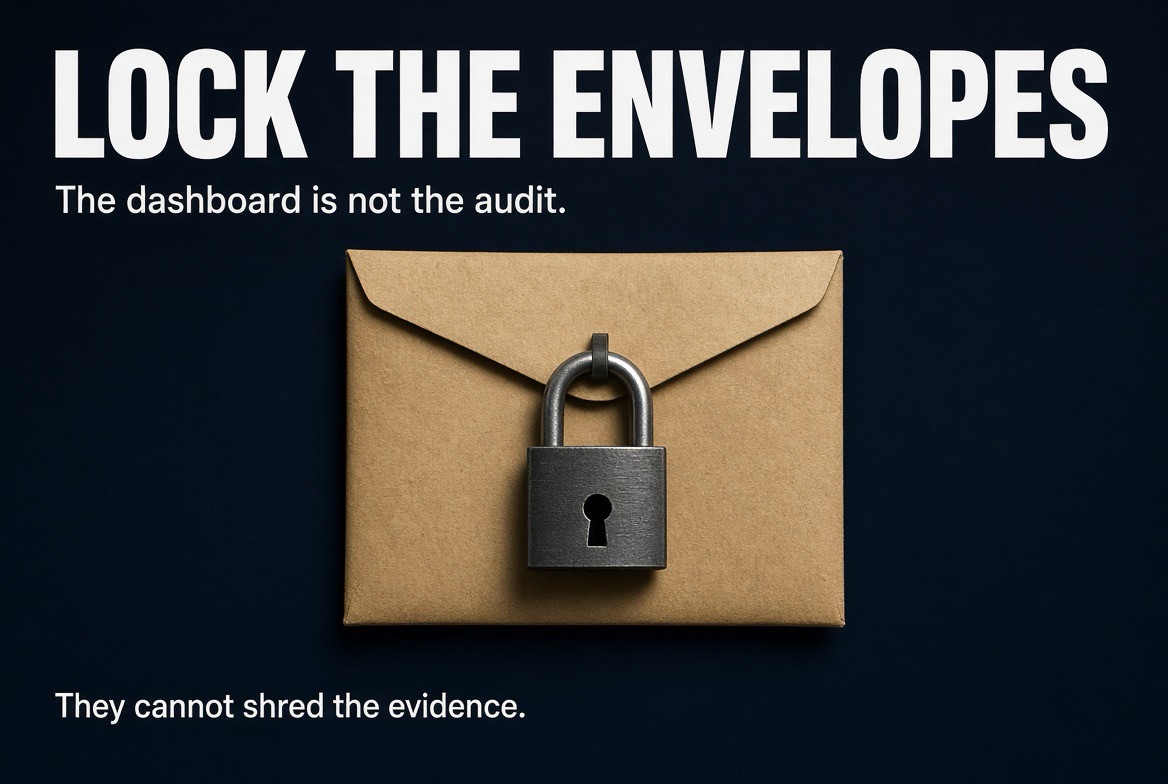
Lock the envelopes.
Review the names and the counts.
File the contest if they will not produce.
If the contest window closes and no notice is on file, they can start destroying envelopes 48 hours later. Rejected envelopes stay closed unless a contest is filed.
That is the last day that matters.
Christ is King.
Phillip C. Parrish
Candidate for Lieutenant Governor of Minnesota
Lindell–Parrish 2026
Phillip C. Parrish Intelligence Cell / Operation Shadow Hunt
###