INTELLIGENCE BRIEFING
Title: Metro Volume Concentration, Polling Reversal & Structural Risk Indicators — August 11, 2026 Republican Gubernatorial Primary: Case for Formal Contest
Author: Phillip C. Parrish
Intelligence Cell — Operation Shadow Hunt
Date: August 13, 2026
Distribution: Mike Lindell Campaign Leadership, Legal Team, County Canvass Observers, Federal Oversight Contacts
1. Executive Summary
The August 11 Republican primary produced a decisive statewide margin for Lisa Demuth (179,683 votes / 43.44%) over Mike Lindell (134,282 votes / 32.47%), a gap of 45,401 votes on total Republican gubernatorial volume near 413,600. Statewide primary participation exceeded 1.1 million ballots — a modern record and approximately 25–28% of registered voters.
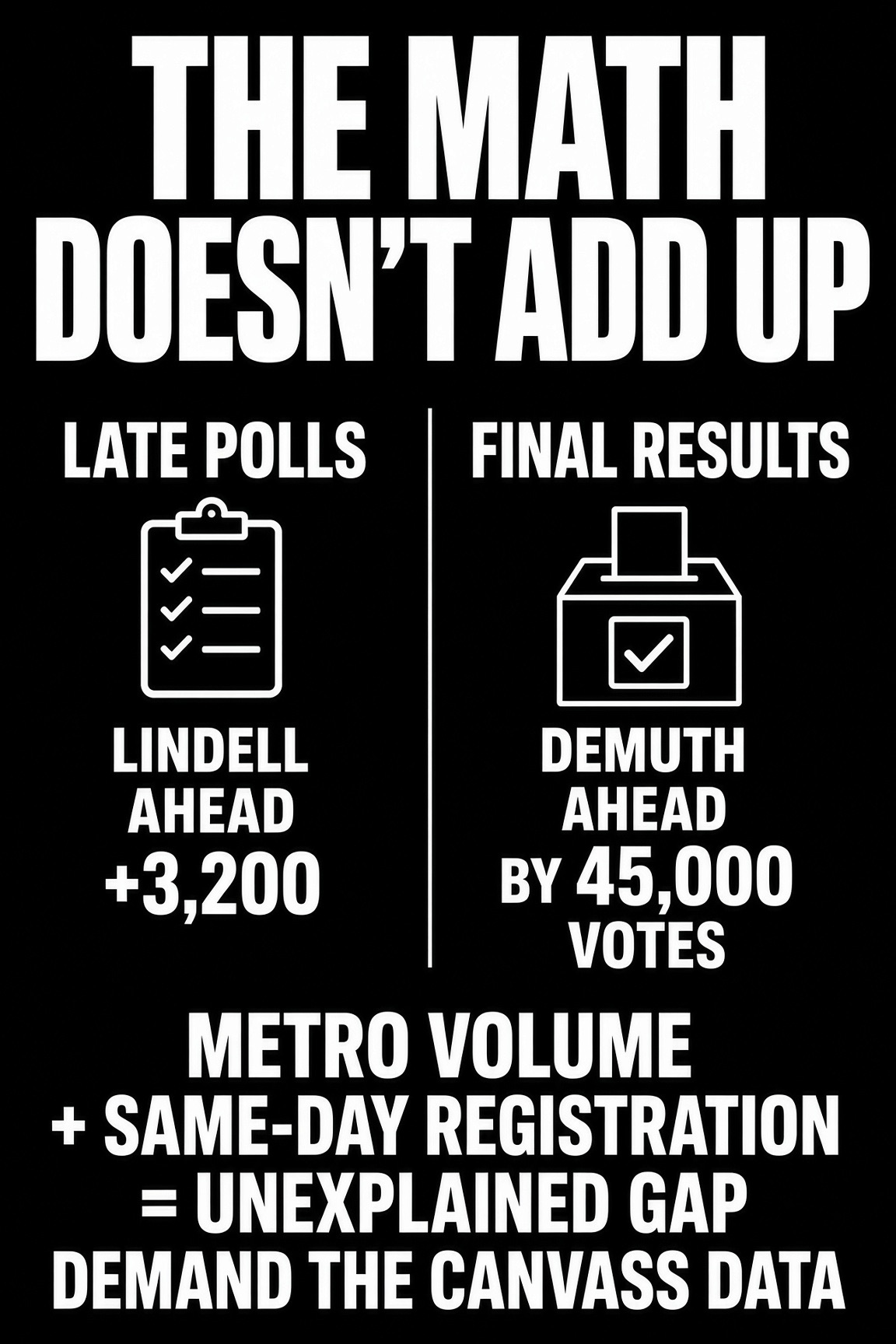
The decisive volume and the most anomalous patterns occurred in the exact counties previously mapped as highest late-cycle risk (Hennepin, Ramsey, Dakota, Anoka, Washington). Lindell carried substantial portions of northern and rural Minnesota, yet the absolute margin was generated almost entirely by higher turnout and volume in the metro and central corridors. Multiple independent late polls had shown Lindell leading or competitive; the final result reversed that lead by roughly 15 points.
These patterns are consistent with the structural vulnerabilities previously identified: high-volume same-day registration via vouching (up to eight persons per registered voucher; unlimited for residential-facility staff), permanent absentee lists, limited real-time eligibility verification, and absence of systematic citizenship documentation requirements. The geography of the deciding volume overlaps with the densest concentrations of the same risk surface documented on Primary Day by undercover investigation.
This brief supplies the data anchors, detection methods, and procedural pathways for the Lindell campaign and oversight authorities to demand and examine the underlying records before certification.
2. Key Indicators Already Observed
• Statewide surge: >1.1 million total primary ballots; Republican gubernatorial participation near 413,600.
• Large polling-to-result reversal: Late independent surveys, including the final SurveyUSA poll, showed Lindell leading or within single digits. The certified-unofficial result flipped that margin by approximately 15 points.
• Geographic volume concentration: Lindell won or led in numerous northern and rural counties. Demuth’s 45,401-vote margin was produced by absolute volume in the high-population metro and central Minnesota jurisdictions.
• Early voting record: Minnesota set a non-presidential primary record for early/absentee ballots. Candidate-level early-versus-Election-Day splits remain incomplete in many counties, preventing full composition testing.
• Structural enablers: Minnesota Statutes § 201.061 permits vouching for up to eight new registrants by a single registered voter in the precinct (no ID required from the new registrant) and unlimited vouching by residential-facility staff. Primary-day undercover documentation confirmed poll workers administering the process exactly as written, with verification occurring “after the fact.”
These indicators do not by themselves prove coordinated fraud. They do constitute the precise risk surface previously flagged for heightened scrutiny of eligibility, chain-of-custody, same-day volume, and turnout composition.
3. Risk Map Applied to This Race
High-risk counties remain Hennepin, Ramsey, Dakota, Anoka, and Washington (with secondary attention to Stearns and Olmsted).
Within these counties, prioritize:
• Precincts with elevated Election Day registration counts and estimated-voter ratios significantly above the statewide primary average (~28% of the 7 a.m. registered base).
• Precincts showing large Demuth margins coincident with high same-day registration or early-ballot volume.
• Any clustering of late-accepted absentees or cured ballots after the Monday, August 10 close-of-business window.
• Incomplete or missing early-versus-Election-Day candidate splits that prevent testing of the day-of electorate.
The combination of a large late-poll miss and volume concentration in the previously mapped high-risk geography is the clearest statewide anomaly.
4. Detection Methods and Research Tools Available Now
The Lindell campaign and reviewers can execute the following immediately using public and requestable records:
1. Download and baseline the SOS Absentee Data file against pre-election snapshots. Compare daily acceptance, rejection, and curing rates by county and precinct, especially post-August 10.
2. Obtain full precinct-level canvass reports and statistics (already partially public on electionresults.sos.mn.gov). Aggregate EDR counts, signatures, mail/absentee totals, and estimated voters. Flag any precinct where EDR exceeds historical primary norms or where estimated voters substantially exceed the statewide average relative to the 7 a.m. registered base.
3. Public-records request for all Election Day registration applications and vouching oaths in the five high-risk counties, with priority on high-volume metro precincts. Request voucher names, addresses, number of persons vouched for, and any facility-staff vouching logs.
4. Cross-check Statewide Voter Registration System extracts for newly activated, previously inactive, or challenged records that voted same-day.
5. Demand complete early-versus-Election-Day candidate splits by county and, where available, by precinct.
6. Historical baseline comparison: 2024 primary, 2018 primary, and prior non-presidential primaries. Quantify deviation in the metro counties.
7. Facility and residential-address analysis: Map high-EDR precincts against known residential facilities, shelters, and high-turnover multi-unit housing where unlimited staff vouching is available.
These steps require no novel legal theory — only rigorous use of existing canvass, registration, and public-records authorities.
5. Legal Pathways and Recommended Actions
For the Lindell campaign:
• File formal written requests with county canvassing boards and the Secretary of State for the records listed above prior to the August 18 State Canvassing Board meeting.
• Demand precinct-level EDR, vouching documentation, and early/Election Day splits as part of any post-election review or contest preparation.
• Preserve all internal polling, field, and turnout models that projected stronger performance; these form the baseline for quantifying the reversal and volume concentration.
• Consider a formal election contest under Minnesota statutes if the record review surfaces material irregularities sufficient to change the outcome or undermine certification confidence. Even a non-prevailing contest creates a permanent public record and discovery vehicle. A candidate-paid recount remains available given the current margin.
For federal authorities:
• The same counties and structural features previously identified for potential eligibility failures and coordinated same-day volume remain relevant. Patterns that exploit differences between state and federal eligibility rules should be examined under existing federal statutes governing voter registration and election integrity.
• Coordinate with state canvass timelines so that federal interest does not become moot after certification.
6. Consequences of Inaction
Certification without examination of the high-volume, high-EDR precincts in the flagged counties and without complete early/Election Day composition data leaves the public record incomplete. The combination of a large late-poll reversal, absolute margin generated by metro volume, record early voting, and documented permissive same-day registration is precisely the pattern that demands documentation, not dismissal.
The Lindell campaign has both the standing and the data anchors to force that examination. The tools exist. The geography is known. The structural vulnerabilities are statutory.
Recommendation: Initiate the records requests and precinct-level audit immediately. Contest if the data warrants. The window before final certification is short.
Phillip C. Parrish
Intelligence Cell — Operation Shadow Hunt
August 13, 2026
###