UPDATED INTERIM INTELLIGENCE BRIEF
Phillip C. Parrish Intelligence Cell — Operation Shadow Hunt
Classification: Unclassified – For Public Dissemination
Date: 17 August 2026
Subject: Minnesota Statutes as Structural Enablers of Low-Verification Voting — Official Defense by Secretary of State Steve Simon and Attorney General Keith Ellison, and the Resulting Suppression of Scrutiny
1. Core Finding
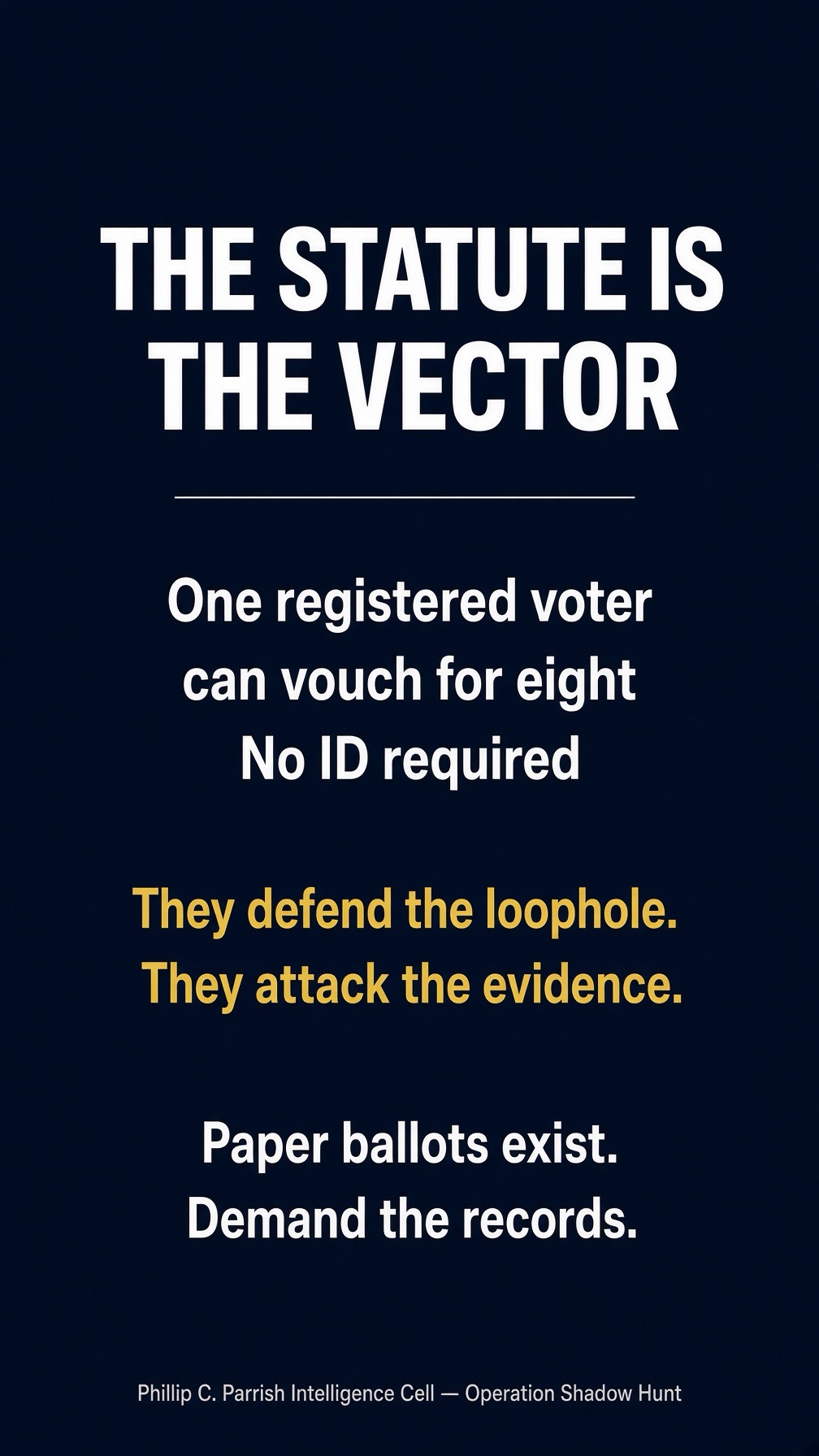
Minnesota Statute § 201.061, subdivision 3, creates a formal, low-verification pathway for Election Day registration known as “vouching.” Under the plain text of the statute:
• A registered voter in the same precinct may sign an oath vouching for the residence of up to eight other individuals.
• An employee of a residential facility may vouch for an unlimited number of residents of that facility.
• The vouched individual is not required to present documentary proof of residence. The voucher’s oath functions as the functional equivalent of identification for residency purposes.
Undercover recordings from Minneapolis polling places on August 11, 2026, captured election workers confirming this process in real time, including the statement that the registered voucher “is the ID.” The process operated exactly as written.
The institutional response from the two statewide offices charged with administering and defending the election system has been to attack the documentation rather than audit the volume or integrity of the pathway itself.
2. Statutory Architecture That Creates the Vector
Minn. Stat. § 201.061, subd. 3(a)(4) explicitly authorizes the vouching method as one of the accepted proofs of residence for Election Day registration. The statute imposes no contemporaneous documentary verification beyond the oath, no real-time cross-check against external databases at the moment of vouching, and no numerical cap on facility-employee vouching.
America First Legal and legislative data requests have previously established that tens of thousands of Election Day registrations in recent cycles have used this method. The Secretary of State’s own public materials confirm the eight-person limit for ordinary registered voters and the unlimited authority for residential-facility staff.
This is not an ambiguity in the law. It is the law. The vector is statutory.
3. Official Defense Pattern — Simon and Ellison
Secretary of State Steve Simon
After the undercover videos were released, Simon issued statements describing the activity as “outrageous and totally unacceptable,” accused the documentarians of impersonation and of attempting to “cast doubt” on laws that have existed for more than fifty years, and indicated that law enforcement is reviewing the incidents. He has simultaneously maintained that the vouching process is lawful, rare (citing historical figures below 1 percent in recent general elections), and necessary to protect access.
The practical effect of this posture is to redirect official attention and potential investigative resources toward the journalists who recorded the process rather than toward a systematic, precinct-level audit of how many times the process was used, by whom, and under what conditions in the highest-volume jurisdictions.
Attorney General Keith Ellison
Ellison’s office provides the legal defense of Minnesota’s election statutes in state and federal court. His office has successfully defended related registration and absentee provisions against challenges and has joined multi-state efforts to block federal executive actions that would impose stricter documentary requirements. The consistent legal position is that Minnesota’s long-standing framework, including same-day registration and vouching, is both lawful and preferable.
Taken together, the two offices that control administration and legal defense of the process have chosen to treat documentation of the statute’s operation as the primary threat, while treating the statute itself as settled and protective.
4. Concurrent Evidence of Process Fragility
This statutory defense does not exist in isolation. It operates alongside:
• Documented data-handling failures (Blue Earth residual test data added to live results; Todd County incorrect results file that temporarily reversed a reported winner).
• Public concerns raised by elected officials that modem-equipped systems in approximately two-thirds of counties operate outside the original federal certification configuration.
• Legislative data exposures (Rep. Pam Altendorf’s review of Hennepin County rolls showing elevated challenged records; Rep. Kristin Robbins’ Fraud Prevention Committee findings on a broader culture that has tolerated large-scale program fraud).
• Extreme concentration of primary volume in the same metro counties where same-day registration and vouching activity is highest and where observer access has been restricted.
When a low-verification statutory pathway is aggressively defended at the same time that electronic results transmission and machine-configuration questions remain unresolved, the combined effect is to reduce the practical likelihood of timely, independent verification of the highest-volume ballots.
5. Effect on Truth and Accountability
The statutes do not require officials to commit fraud. They create a structural opening that can be exploited at scale with minimal contemporaneous detection. When the officials responsible for the integrity of the system respond to evidence of that opening by condemning the evidence-gatherers and asserting that the process is rare and well-controlled, the practical result is the suppression of scrutiny.
This is not a claim that every vouched ballot is fraudulent. It is a documented observation that the legal architecture enables a high-leverage, low-verification method; that undercover work has confirmed the method operates as written; and that the institutional response prioritizes protection of the method over aggressive, public verification of its use in the jurisdictions that decide statewide outcomes.
6. Recommendation Before August 18 Certification
The State Canvassing Board and county officials should produce and make public, before final certification:
1. Precinct-level counts of Election Day registrations and the specific proof-of-residence method used (including every vouching oath) in the five highest-volume metro counties.
2. The identity and number of individuals for whom each voucher signed (to verify the eight-person statutory limit was observed).
3. All residential-facility staff vouching records.
4. Machine and results-file audit logs for any county that experienced data or reporting anomalies.
5. Early-versus-Election-Day candidate splits by precinct.
Paper ballots exist. The statutes that allowed large numbers of them to be cast under oath rather than documentary verification must now be matched with transparent, precinct-level accounting of how often that pathway was used.
The window is short. The statutes are public. The videos are public. The data-handling failures are public. The official response pattern is public. Continued refusal to produce the underlying records will only reinforce the conclusion that the process is being protected at the expense of verification.
Phillip C. Parrish
Intelligence Cell — Operation Shadow Hunt
17 August 2026
###