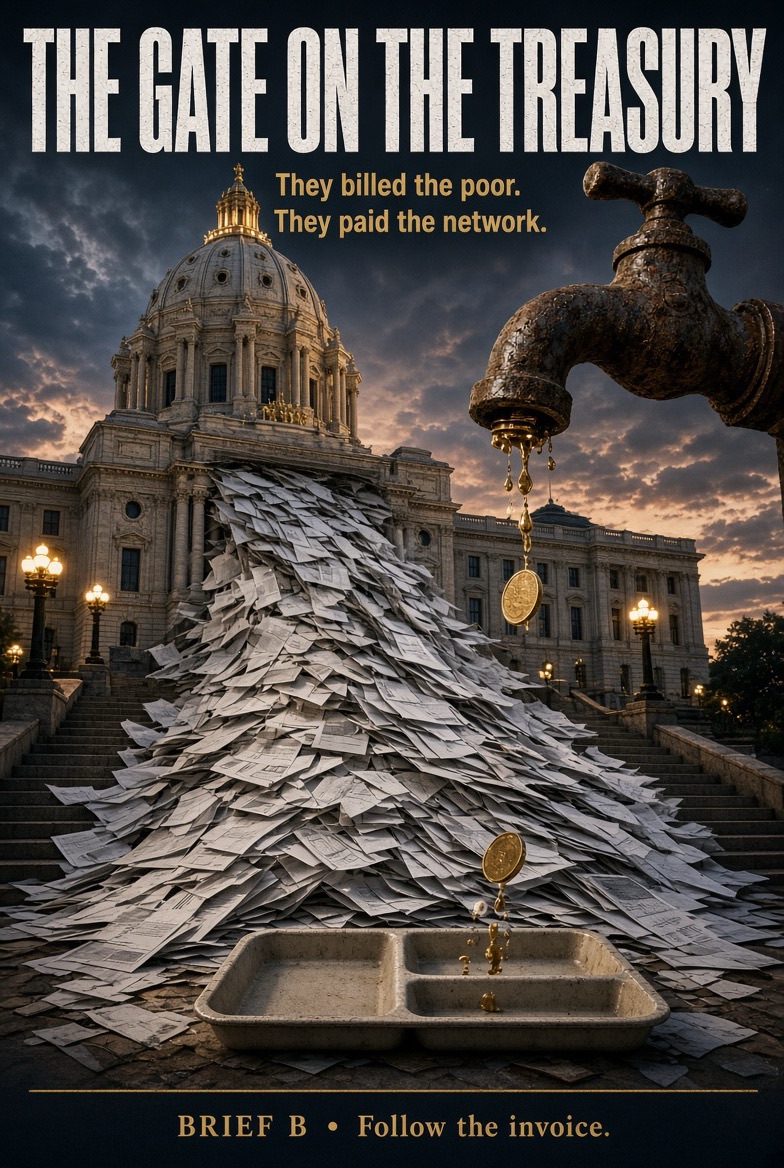
Who holds the invoice machine — and why the same chairs will not shut the faucet
The land fight starves a trust. The treasury fight empties the till. Same class. Different product.
One stack sells delay on minerals. This stack sells invoices to Human Services. Politicians campaign on “the vulnerable.” Nonprofits bill. Agencies pay. Warnings sit in drawers until a federal prosecutor turns on a camera.
What is already in court
Feeding Our Future is the largest pandemic-era child-nutrition fraud case in the country. Public money on the order of $250 million to $350 million. Dozens of defendants. Convictions. Aimee Bock, the founder, received an extraordinary federal sentence — on the order of 42 years. Federal prosecutors called the meal scheme the tip of a larger iceberg.
Behind that door: Housing Stabilization Services, launched with a roughly $2.6 million annual estimate, ballooned past $100 million a year before the state shut it down citing large-scale fraud. Autism / EIDBI spending multiplied. Integrated Community Supports exploded from a few million to hundreds of millions. Fourteen Medicaid programs were tagged high-risk. Those programs spent more than $18 billion in federal and state money since 2018. Former First Assistant U.S. Attorney Joe Thompson said half or more may have been stolen — the $9 billion figure now used in Washington. Charged losses so far are far smaller than that estimate. A Star Tribune tally of documented fraud sits in the low hundreds of millions. Both facts can stand: proven theft is already huge; the uncounted remainder is why Minnesota had to revalidate thousands of providers and why the federal government deferred on the order of $2 billion in Medicaid funds.
Medicaid in Minnesota is a $20 billion-a-year system, projected toward $29 billion by 2029. That is the pipe. The schemes ride it.
Follow the money — the invoice stack
Low barriers. Weak records. Exponential claims. Housing lists pulled from treatment centers. Daycare billing without the children. Autism clinics that exist on paper. Money spent on travel, cars, real estate — some of it leaving the country. The charging papers describe a web across programs, not one rogue site.
House Oversight reported that senior officials in the Walz office and the Ellison attorney general’s office had credible fraud warnings in DHS as early as 2019 and in the Department of Education by April 2020. The public got the press conference years later. That is not a canoe argument. That is a business model protected by delay.
Follow the money — the legal cousin
OpenTheBooks found Governor Walz accepted about $890,000 from people at 434 state vendors between 2019 and 2022. Those same firms collected nearly $15 billion from the state checkbook between 2019 and 2023. Executives of 86 vendors were among the donors. The checkbook often has no memo line the public can read. That is not an indictment. It is the lawful version of the same habit: donate, then invoice.
The five-person latch, again
Governor. Lieutenant governor. Attorney general. Auditor. Secretary of state. They sit on mineral leases in Brief A. They oversee or legally defend the agencies that pay the invoices in Brief B. One of them runs election administration. They do not have to stuff a ballot box to shrink the menu. Party endorsement, donor weather, and public subsidy do that work upstream of the voter.
Canada posts loyalty in an oath to a monarch. Minnesota posts it in a network. The voter still marks a ballot. The question is whether the voter is choosing a governor or ratifying a slate that already answers to the faucet.
Amy Klobuchar now runs as the DFL nominee for governor on a “root out fraud” line after years in Washington while this pipe grew. Ask her what she will do on Day One to the programs Thompson called industrial-scale — not a slogan, a shutoff and a referral list.
Lisa Demuth runs as the Republican nominee saying the culture of fraud ends. Ask her whether “culture” means prosecutors and clawbacks or another task force that reports after the next invoice cycle.
The offices that froze the mine and the offices that paid the meal sites are not two planets. They are two desks in the same building.
What this is — and what this is not
This is documented theft, documented explosion of claims, documented warnings ignored, documented vendor-donor overlap. That is enough for a constitutional republic to demand audits, exclusions, clawbacks, and prosecutions.
This brief does not charge a political party as a completed racketeering enterprise. That is a count for a grand jury with named predicates. This brief does not claim a terrorist roster. If a wire, an OFAC hit, or a conviction ties a billed dollar to a designated group, that belongs in a separate exhibit list with sources. Mixing it here is how the invoices get buried.
Questions that expose the faucet
When did your office first see a written fraud warning on nutrition, housing, autism, or childcare — and what did you do in the next 90 days?
Will every high-risk Medicaid provider that fails revalidation be barred from every other state faucet, including the spouse and the new LLC?
Will the state publish a public dashboard: provider name, dollars paid, kids or clients actually served, clawbacks pending?
Will vendor executives who donate be flagged on the checkbook the way federal pay-to-play rules flag contractors?
Who do you answer to when the invoice and the campaign check come from the same building?
The vision
Minnesota feeds the hungry and teaches the child. It does not rent the poor as a billing code. The ox treads. The ox eats. A mother in Faribault and a miner in Hibbing are not supposed to subsidize a professional class that invoices the treasury and another professional class that invoices the wilderness.
Shut the fake sites. Pay the real ones. Score the trust. Open the gate on the ground only when water rules and royalties are in writing. The connected class keeps both latches. The public only needs to look.
—
Phillip C. Parrish
Freedom Talk with Phil
X: @phillipcparrish
Press: phillip@parrish4mn.com
Heidi Wanty: heidi@parrish4mn.com
1 (612) 460-1717