By Phillip C. Parrish
September 6, 2026
After Friday, a lot of good people asked the same question.
If the problem is the process — the file Todd replaced, the test deck Blue Earth uploaded, the modem that takes a certified tabulator off the certified build, the rolls still being typed, the vouching statute, the mail channel the State just went to court to keep loose — why was the caption Parrish and Lindell v. Demuth and Wilson?
Why was it not the citizen versus the State?
Because Minnesota wrote it that way.
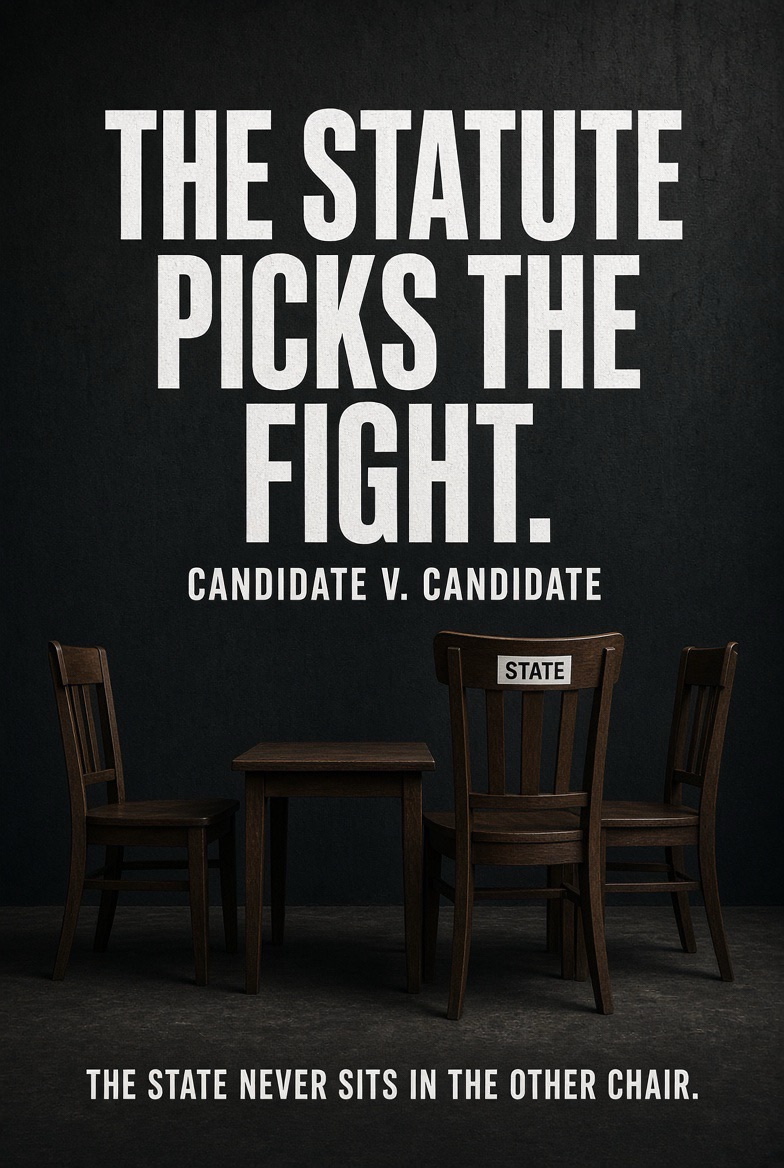
The statute picks the fight for you.
Chapter 209 is the election-contest chapter. Grounds can include an irregularity in the conduct of the election or the canvass. That sounds like a case against the people who run the canvass. Read the next section.
Minn. Stat. § 209.021, subd. 3: in a contest over the nomination or election of a candidate, the notice must be served on the candidate who is the contestee. A copy goes by certified mail to a last-known address. A copy is furnished to the official who issues the certificate. The Secretary of State is the contestee only if the contest is over a constitutional amendment. A local question makes the auditor or clerk the contestee. A statewide candidate race does not.
So the person who certified the equipment is not in the caption. The person who designed the “OTHER” pile is not in the caption. The person who is still taking voting history under § 201.121 is not in the caption. Lisa and Ryan are. They did not upload Todd’s file. They did not pour Blue Earth’s test deck into the state feed. They did not write Chapter 206. The statute still makes them the defendants, puts their lawyer in the room, and — if the contestee prevails — puts taxable costs on the contestants under § 209.07.
That is not an accident. That is architecture.
A process that wants to be questioned would put the custodian of the ballots and the author of the rules across the table. A process that wants to protect itself puts two campaigns in a knife fight on a five-day clock, then dismisses on the envelope.
The service trap is the first wall.
@Wikitube911 has been mapping this house of cards in public. Call it Card 12 if you want the label they use. The table talk is the same: one wrong envelope and no one reads page one. Franson (1965): no deviation, however slight. Pearson (1971): fourteen votes, sheriff late — dismissed. Stransky (1989): contestant served the papers himself — dismissed. Friday: email, certified mail, a party in the chain, no affidavit of inability to serve in person — dismissed, costs language attached.
Rule 4 does not let a party serve his own summons. Chapter 209 says serve the notice like a summons. Five days after the canvass on a primary. Statewide office, file in Ramsey. The official who actually holds the paper is a copy recipient, not the person whose lawyer has to answer why the configuration does not match the certificate.
You want to inspect envelopes that statute says may be opened only in a Chapter 209 contest. To get into Chapter 209 you have to survive a service rule designed for a lawsuit against a neighbor, not an audit of a statewide system. Then § 209.07 makes the loser of that knife fight pay. The State collects the benefit of the dismissal and never has to put a witness on the stand about the modem.
Two doors. One of them is a closet.
The other door is Minn. Stat. § 204B.44 — errors, omissions, and wrongful acts by officials. That is the petition that actually names the Secretary. We used it. The Minnesota Supreme Court said following the August 18 Contingent Plan is not, by itself, a wrongful act. Different question. Different relief. It did not put inspectors in Todd or Anoka. It told us the recount rule is the recount rule.
So here is the sorted design, in one paragraph.
If you want the paper opened, Chapter 209 says sue the other candidate, serve like a summons in five days, risk costs, and hope a panel will even reach the merits. If you want the official corrected, Chapter 204B.44 says petition the Supreme Court, and you will be told that following the official plan is not error. If you want the voter file, the United States has to sue Simon in federal court. If you want a unique barcode on a mail envelope, Ellison sues to freeze it. If you want to stand by the door where the ballots are stored, the Secretary’s counsel writes you a letter about what a “guard” is allowed to see.
That is not candidate versus candidate in nature. That is the State using the other candidate as a human shield.
Wikitube’s longer thread is the history of that shield: short windows, candidate-funded recounts outside thin margins, restricted data, a presumption that the official return is correct, and a case-law stack from the 1950s forward in which outsiders die on procedure while repeat players with counsel clear the same gates on narrow claims. You do not have to adopt every year they put on a card. You only have to read Friday’s order next to § 209.021. The pattern is the statute.
Intent is in the incentives.
A system that trusted itself would welcome a limited inspection in named precincts with nightly reports. A system that needs to stay closed makes the inspection a lawsuit against the nominee, then kills the lawsuit on the manner of delivery, then sends the cost bill. The public is trained to see two Republicans fighting. The cameras stay on the jersey. The configuration report stays in the closet.
Lisa and Ryan are not the authors of Chapter 209. They are the people the chapter put in the chair so Steve and Keith would not have to sit there. Their lawyer did what the design rewards: do not try the paper; try the envelope. The State did what the design rewards: file in other courts that the process is secure, celebrate injunctions against tighter mail custody, and tell the press the contest is over.
I did not file a contest because I wanted a personal war with a House speaker. I filed it because rejected envelopes and a statutory inspection live in Chapter 209, and Chapter 209 names the other candidate. That is the trap. Naming it is not bitterness. Naming it is how citizens stop mistaking a structural shield for a personality conflict.
The next reports from the precincts will not be about who liked whom. They will be about paper, lists, and configuration. Those are State facts. They always were.
The unknown caller said get on board with Republicans. The statute says get on board with the caption. I am still on board with the people who have to live under the count.
Phillip C. Parrish
With credit to @Wikitube911 for keeping the Minnesota case stack and the “service trap” map in public view.