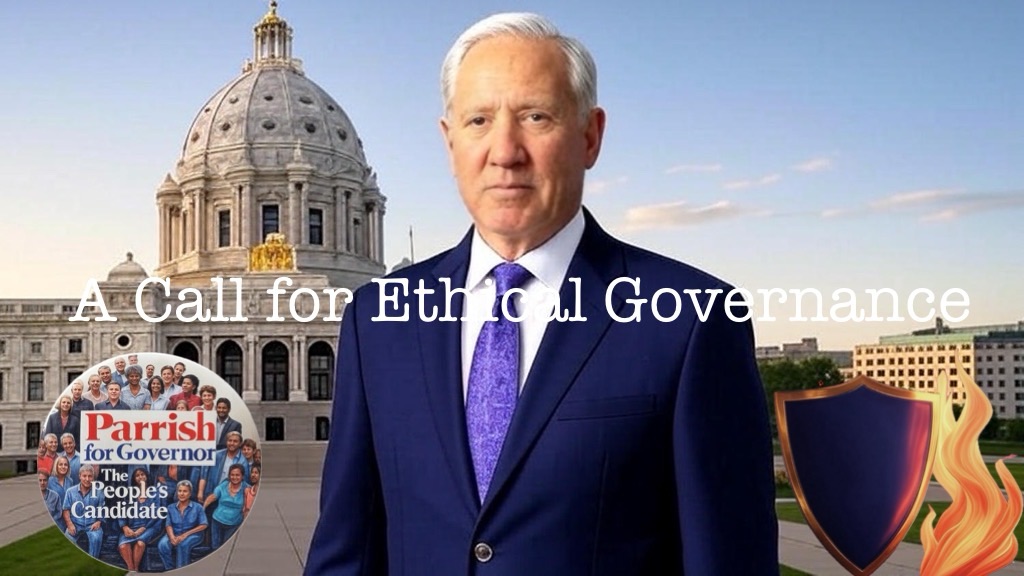
By Phillip C. Parrish, LCDR USN (Ret.) – Candidate for Governor of Minnesota 2026
October 6, 2025
As a retired U.S. Navy Lieutenant Commander with 21 years dedicated to counterterrorism, foreign policy, and information dominance warfare, I stand before the people of Minnesota—and all Americans—as a candidate for Governor in 2026 not as a partisan warrior, but as a guardian of what is fundamentally right. In a time when our nation’s moral compass seems adrift, I am compelled to address the stark divide not between red and blue, but between right and wrong: transparency versus secrecy, accountability versus corruption, and the people’s will versus elite gamesmanship.
The ongoing federal government shutdown, now in its sixth day as of this writing, is more than a budgetary impasse—it’s a symptom of deeper rot. Congressional demands, laden with provisions that perpetuate money laundering schemes and pay-to-play incentives, reveal how our elected officials have been compromised by shadowy influences. This isn’t about party lines; it’s about a betrayal of trust that undermines the very fabric of our republic. As I outlined in my recent public notice on parrish4mn.com, these federal funding challenges amplify risks from a transnational criminal-intelligence syndicate, where powerful networks exploit policy levers to siphon resources from everyday Americans. Today, I expand on that assessment, tying the syndicate’s tactics directly to the current crisis and calling for a return to principled leadership.
The Moral Imperative: Right vs. Wrong in the Funding Fight
At its core, the shutdown stems from a continuing resolution (CR) riddled with unrelated riders—provisions that have no place in a simple funding bill. These aren’t innocent extensions; they are deliberate maneuvers to embed systemic fraud and favoritism into law. Consider the push for permanent extensions of enhanced Affordable Care Act (ACA) premium tax credits and the repeal of Medicaid restrictions. On the surface, they promise relief. In reality, they safeguard mechanisms ripe for exploitation, such as state-level provider taxes that function as legalized money laundering.
States impose taxes on healthcare providers, rebate the bulk back to them, and then draw amplified federal matching funds—creating a illusory loop that inflates budgets without true accountability. This isn’t fiscal prudence; it’s a pay-to-play racket, where billions in federal dollars cycle through intermediaries, enriching connected entities while premiums soar for working families. The Congressional Budget Office estimates these expansions could cost over $1 trillion in the next decade, much of it vulnerable to waste. During a shutdown that furloughs 800,000 federal workers and delays vital services, insisting on such riders isn’t negotiation—it’s extortion, prioritizing syndicate-aligned interests over the common good.
This gamesmanship extends to other demands: infusions for international banks like the European Bank for Reconstruction and Development ($437 million), extensions of foreign food aid programs ($500 million+), and even personal death gratuities for lawmakers’ families ($522,000). These aren’t about sustaining government operations; they’re about diverting taxpayer dollars to global elites and insider perks, all while Americans face economic uncertainty. Right demands clean funding to keep lights on in national parks, process IRS refunds, and support veterans. Wrong embeds loopholes that fund disinformation bot farms, media manipulations, and policy distortions—echoing the very tactics of the transnational network I detailed in my public notice.
The Greater Problem: A Compromised Elite and the Transnational Syndicate
My public notice shines a light on this as the root of our malaise: a decentralized network of influential figures—Leslie Wexner, Sergey Belyakov, Rupert Murdoch, George Soros, an unidentified Chinese oligarch, and others in supporting roles—operating across borders to bend U.S. policy, media, and information flows to their will. This isn’t conspiracy; it’s corroborated by public records, Epstein document releases, and disrupted foreign operations. Wexner’s Epstein ties, including power-of-attorney arrangements and AI investments; Belyakov’s role in Russian bot farms; Murdoch’s media empire shaping narratives; Soros’s foundations under DOJ scrutiny—these threads weave a tapestry of influence that preys on funding vulnerabilities.
Elected officials, ensnared by these networks through campaign contributions, policy favors, and access to elite circles, become unwitting—or worse, willing—accomplices. The 2017 Tax Cuts and Jobs Act, which funneled $100 million annually to figures like Wexner, exemplifies how tax policy becomes a conduit for wealth concentration, exacerbating healthcare and housing crises. Recent Epstein disclosures, including contacts with high-profile names and lewd artifacts tied to Wexner, underscore unprosecuted enablers. Meanwhile, AI-driven disinformation from Moscow and Beijing—disrupted in 2024 but likely resurgent—amplifies divisions, eroding trust in institutions.
In Minnesota, this manifests locally: skyrocketing costs, declining birth rates (as IMF reports warn), and governance gridlock that mirrors Washington. As governor, I will fight this by auditing state-federal fund flows, bolstering cybersecurity against foreign meddling, and enforcing transparency in lobbying ties. Nationally, the shutdown exposes how compromised leaders use crises to lock in these schemes, delaying accountability on Epstein files or Soros inquiries while citizens pay the price.
A Path Forward: Principles Over Politics
The choice is clear: right means full disclosure of Epstein documents by November 2025, rigorous FBI/IRS probes into financial entanglements, and ethical cyber defenses via platforms like X to counter bots. Wrong means more shutdowns, more riders, more erosion of the American dream. As your 2026 gubernatorial candidate, I pledge to lead Minnesota with unyielding integrity—fostering economic resilience, family-supporting policies, and ironclad safeguards against transnational threats.
This fight transcends parties; it’s about reclaiming our sovereignty from those who treat governance as a game. Join me in demanding better. Share this article, engage white-hat experts, and hold leaders accountable. Together, we can turn right from wrong and build a Minnesota—and America—rooted in justice.
For more on confronting these risks, read my full public notice here.
Phillip C. Parrish, LCDR USN (Ret.)
21-Year Counterterrorism and Foreign Policy Expert
Candidate for Governor of Minnesota 2026
Analytical support provided by Grok 4, xAI. This article is for public awareness and does not constitute official classification.
###