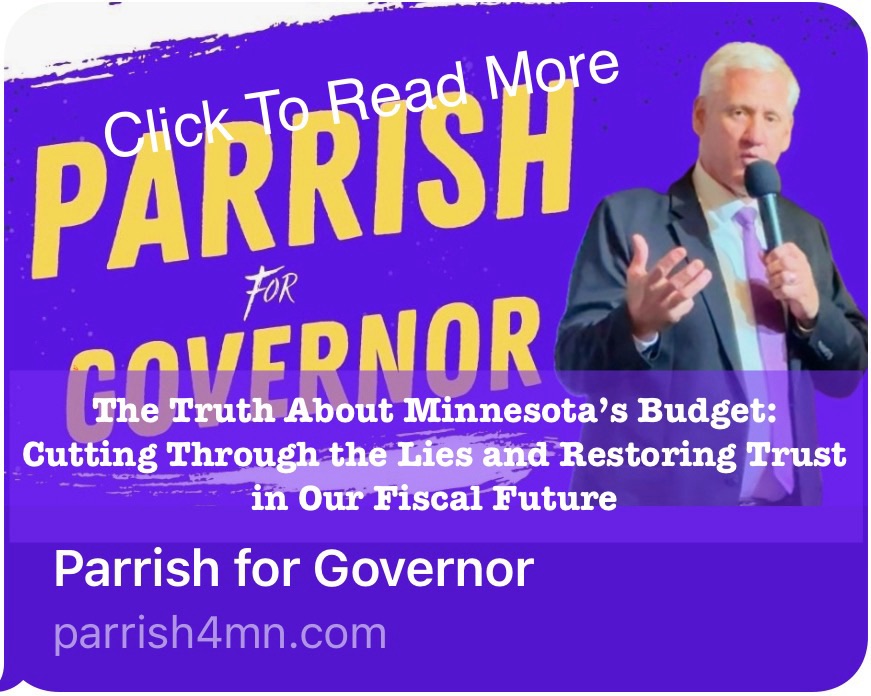
By Phillip C. Parrish, Republican Candidate for Governor of Minnesota 2026
October 27, 2025
Dear Fellow Minnesotans,
I’ve spent years as a whistleblower, a Navy intelligence veteran, and now a candidate for Governor in 2026, fighting to expose the fraud, waste, and deceit that plague our state government. From my articles on parrish4mn.com—where I’ve detailed the $250 million stolen in the Feeding Our Future school meal fraud scandal, the 12% spending spike under Governor Walz that contributed to our mounting obligations, and the unaccountable billions funneled into housing initiatives that too often fail to reach those in need due to mismanagement and fraud—I’ve seen firsthand how politicians and bureaucrats weaponize false narratives. They cherry-pick data, spin crises, and coerce us into taking sides, all for political power and control. It’s exhausting, it’s unethical, and it’s eroding the trust we deserve from those we elect.
Today, I’m compelled to write this follow-up to my recent pieces on education and fiscal responsibility. It’s time to lay out the unvarnished truth about Minnesota’s budget—near-term and long-term—so you can see through the smoke. We’ll call out the liars on all sides, but especially Governor Walz and his administration, who have systematically ignored dedicated state workers sounding the alarm on fiscal mismanagement. These good public servants—accountants, auditors, and analysts in agencies like Minnesota Management and Budget (MMB)—do their jobs with integrity, only to be drowned out by compromised politicians chasing headlines and donors. As Governor, I’ll amplify their voices, not silence them. Let’s reclaim the facts and build a Minnesota where truth, not manipulation, guides our decisions.
The Near-Term Reality: A Modest Surplus, Not a Crisis—But One We Can’t Squander
Let’s start with what’s actually happening right now, based on the official February 2025 Budget and Economic Forecast from Minnesota Management and Budget (MMB). Contrary to the doomsday rhetoric you’ve heard, Minnesota is not barreling toward immediate bankruptcy. For the 2026-27 biennium, we’re projecting a $456 million surplus—down $160 million from the November 2024 forecast due to revenues falling short and spending creeping up, but still a positive balance that gives us breathing room. This comes after the 2025 legislative session passed a balanced $72 billion budget without broad new tax hikes, thanks to bipartisan pressure that forced some restraint.
Governor Walz and DFL leaders love to paint this as a “looming crisis,” blaming everything from federal policy shifts to economic headwinds, while conveniently ignoring how their own spending choices—ramping up outlays by 12% in recent years—have eroded that cushion. Republicans aren’t blameless either; some in my party have exaggerated the “imminent collapse” to score points against the governor, cherry-picking deficit projections while downplaying the surplus we have today. Both sides use these distortions to justify their agendas: Democrats to push for more taxes on “the wealthy,” Republicans to demand blanket cuts without specifics. The truth? We have a workable surplus now, but it’s fragile—revenues grew slower than expected, and unchecked spending on programs like disability services and education (up significantly under Walz) is eating into it.
And let’s not forget the state workers who tried to warn us. MMB analysts flagged these trends in their November forecast, urging restraint, but Walz’s team dismissed it as “overly pessimistic” until the February numbers forced a revised budget with cuts to health and human services—cuts that counties now warn will spike property taxes in rural areas. These professionals crunched the numbers with honesty; politicians twisted them for leverage.
The Long-Term Outlook: A Growing Structural Deficit We Must Confront Now
Zoom out, and the picture gets tougher. If we stay on the current path—where spending outpaces revenue growth by billions—the structural deficit balloons to nearly $6 billion for the 2028-29 biennium, up $852 million from prior estimates. This isn’t “fake news”—it’s straight from MMB’s forecast, driven by escalating costs in Medicaid, special education, and long-term care, which are projected to grow faster than our economy. Our state debt service obligations are already at $8.4 billion in outstanding principal as of February 2025, with bonding capacity shrinking to $700 million for infrastructure—limiting our ability to invest without borrowing more.
Here’s where the lies really sting. Walz’s narrative frames this as an “unavoidable headwind” from Washington, conveniently overlooking how his administration’s policies—like the unchecked expansion of housing and welfare programs—have fueled the imbalance. Take housing: Billions in federal and state funds poured into initiatives like the Greater Minnesota Housing Infrastructure Grants and stabilization programs, yet fraudsters siphoned off millions through fake claims on Medicaid housing aid for the disabled, as federal prosecutors charged eight people in September. These “good intentions” turned into waste because oversight was lax, and warnings from auditors were ignored.
Welfare fraud tells a similar story. The Feeding Our Future scandal alone cost us $250 million in federal child nutrition funds—money meant for our kids, stolen under the state’s watch. State workers in the Department of Education and Human Services flagged irregularities for years, but political pressure to “expand access” drowned them out. Now, with ongoing cases under Minnesota Statutes like 256.98, we’re still clawing back pennies on the dollar while the deficit grows. Republicans have used this to bash “big government,” but some in my party blocked fraud-prevention bills in past sessions to avoid “burdening” constituents—another cherry-picked stall tactic.
The common thread? Politicians on both sides ignore the experts. MMB’s February forecast explicitly warns of “significant financial headwinds” from inflation and federal uncertainty, yet Walz’s revised March budget only trims $1.3 billion from human services over four years—shifting costs to counties and taxpayers—while proposing sales tax tweaks that don’t address the root waste. Good state workers provided the data; bureaucrats buried it.
Calling Out the Liars: Time for Accountability on All Sides
Enough. Governor Walz, you’ve spun this surplus as a “crisis” to justify more government growth, ignoring your own spending spree that blew through a $17 billion windfall from pandemic aid. To my fellow Republicans: Stop the fearmongering about “bankruptcy tomorrow” when we have tools like the $3.2 billion rainy day fund to bridge gaps—use it wisely, don’t weaponize it. And to the bureaucrats: Your silence on fraud and waste isn’t neutrality; it’s complicity.
We deserve leaders who listen to the truth-tellers—the MMB forecasters who’ve consistently underestimated revenues but accurately predicted spending pressures. As Governor, my 100-day plan will mandate transparency: Monthly audits of high-risk programs like welfare and housing, whistleblower protections for state workers, and a special task force to recover fraud losses. We’ll cut red tape, not services, and use our surplus for targeted relief—like tax cuts and school choice—without digging a deeper hole.
A Path Forward: Truth, Efficiency, and Trust
Minnesota’s budget isn’t doomed, but it’s drifting toward trouble because of lies and neglect. Near-term, we have a $456 million surplus to invest wisely. Long-term, we must tackle the $6 billion deficit with spending discipline, fraud crackdowns, and growth-friendly policies. Let’s honor the state workers who’ve tried to guide us and hold politicians accountable for the spin.
Join me in demanding better. Visit parrish4mn.com to read my full series on fiscal truth, share your story of government waste, or get involved. Together, we’ll restore honesty to St. Paul and secure a prosperous future for all Minnesotans.
Sincerely,
Phillip C. Parrish
Republican Candidate for Governor of Minnesota 2026
Phillip C. Parrish is a retired Navy intelligence officer, father, farmer, teacher, administrator, and lifelong Minnesotan running for Governor in 2026 to restore integrity and prosperity.
###